
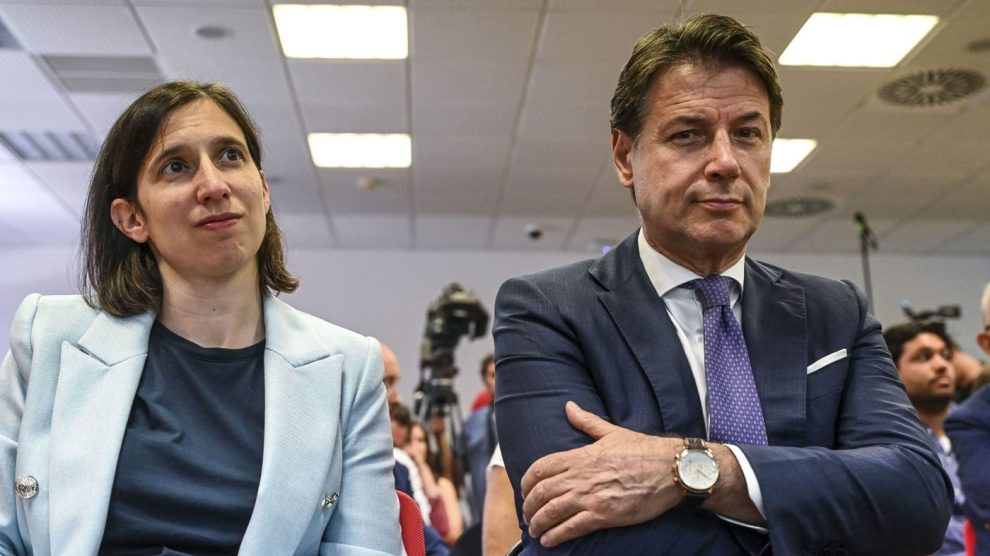
On Ukraine, “it is clear that we will first have to establish a few firm points, because we cannot have [Elly] Schlein or another candidate win tomorrow and then start sending weapons to Kyiv by the truckload, fueling a military escalation that is taking us closer to a third world war day after day,” Giuseppe Conte said yesterday at the festival of Il Fatto Quotidiano – an Italian newspaper whose editorial line is generally considered close to the Conte’s Five Star Movement (M5S).
“The Five Star Movement cannot sign up to a political platform that would simply continue what Meloni is doing in foreign policy,” the former prime minister and leader of the populist M5S warned. “In my view, sending weapons can only lead to a military escalation and drag us into war.”
- He has chosen a formula that is difficult to interpret as merely another difference of opinion within the parliamentary minority.
“No to rearmament”. M5S leader Giuseppe Conte wrote the words in chalk on a blackboard in a video posted today, after his remarks on Ukraine over the weekend had left little doubt about his position.
- Conte’s reference is to both direct increases in military spending — proposed within NATO in response to the deterioration of Europe’s security environment — and what he sees as indirect military spending through continued support for Ukraine.
Why it matters: The M5S leader reiterated that ending military support for Kyiv is a firm point of his political line. And he did so as the debate over future alliances inevitably begins to intersect with the prospect of a general election, due within less than a year.
- The message to the Democratic Party (PD), led by Elly Schlein, therefore goes well beyond Ukraine. Conte argues that the party winning the most votes should not necessarily have the right to nominate the candidate to lead a potential coalition, while insisting on the need for a shared political platform. But when the discussion turns to foreign policy, he draws a much clearer line: no more weapons to Kyiv.
For the M5S, this is not a new position. Opposition to continued military aid has over time become one of the most recognizable features of Conte’s foreign policy. What is new is the weight that this position assumes as the next election approaches: no longer merely a parliamentary disagreement, but an issue on which a future political convergence could be built — or broken.
The PD’s reformists push back. Conte’s remarks immediately drew a sharp response from the Democratic Party’s reformist wing, for which continued support for Ukraine remains a red line.
- Senator Filippo Sensi wrote on X that support for Ukraine and “the values of freedom and democracy that Kyiv defends every day” would continue, adding that “this is what the left does, this is what democrats do.”
- Lorenzo Guerini, a former defense minister who now chairs Italy’s parliamentary intelligence oversight committee (Copasir), went further, arguing that support should not only continue but increase after Italy slowed its assistance in recent months, until a ceasefire and a fair negotiating process can be reached.
- Lia Quartapelle, the PD vice president of the lower house Foreign Affairs Committee, was even more explicit: Conte’s repeated attacks on military assistance, she argued, raise doubts about whether he genuinely wants a united coalition. “He is not an ally, but a saboteur,” she wrote. Conte may have drawn his red line, but the PD’s reformists are making clear that they have one too: continuing to support Ukraine.
Schlein does not follow Conte. The response from the PD leader shows how difficult that gap will be to bridge. Schlein confirmed that the party has always supported and will continue to support “the people unjustly invaded in Ukraine by [Vladimir] Putin’s military offensive” — an equally clear position, accompanied by a call to create the conditions for a “just peace.”
- It is a balance that reflects the different sensitivities among the Democrats. Part of the party is closer to pacifist positions, critical of higher military spending and increasingly skeptical about continuing armed support. But there is also a substantial reformist wing that considers support for Ukraine an integral part of the party’s international positioning and strongly opposes both a retreat on Kyiv and an alliance with the M5S built on Conte’s terms.
- For Schlein, there is also a question of political continuity. Since the beginning of the full-scale invasion, the PD has supported Ukraine and maintained its position within the Euro-Atlantic framework. Abandoning that trajectory would open a rift not only over defense policy, but also over the party’s international identity.
This is why the confrontation of the past few days belongs to a much longer story. Russia and the war in Ukraine have divided Italian politics for years. As the election approaches, however, that division is becoming less theoretical: sooner or later, the different positions will have to be translated into governing platforms and possible alliances.
Meloni holds the line. A similar fault line, in different forms, also runs through the governing majority.
- Prime Minister Giorgia Meloni continues to keep Palazzo Chigi on a tough line toward Russia while maintaining support for Ukraine. It is a choice that has defined the foreign policy of her government — which recently became the longest-serving in the history of the Italian Republic — and one that Meloni continues to defend even as the Ukraine dossier becomes increasingly politically sensitive toward the end of the parliamentary term.
- Meloni can count on broad alignment with Foreign Minister Antonio Tajani and Defense Minister Guido Crosetto, as well as their respective parties, Forza Italia and Brothers of Italy, the party Meloni herself founded. But the government’s position is not shared equally by all its components.
- Matteo Salvini, leader of the League — and facing growing difficulties in maintaining his grip on the party amid declining support — remains the main critical voice within the majority on the approach toward Moscow and military support for Kyiv. Internal pressure is compounded by Roberto Vannacci’s far-right challenge, which can use Ukraine, Russia and defense spending to compete for votes on the coalition’s right flank.
Zoom in: What Putin likes. It is therefore hardly surprising that Russia is considered one of the most difficult issues to manage as Italian politics begins preparing for the next election campaign.
- Meanwhile, Putin is already reaping the benefits: the disinformation campaigns and active measures through which Russia has waged hybrid warfare in Europe, including Italy, are producing results.
- Public opinion in several European countries — not only Italy — is divided over what to do about Ukraine and whether Moscow should be reintegrated into their countries’ diplomatic frameworks.
- These operations, aimed at creating and exploiting internal divisions within European countries, are also strategically designed by the Kremlin, which is well aware that Ukraine would face far greater difficulties resisting the Russian invasion without continued assistance from the EU and the United States.
A fault line running across political camps. The political geometry is particularly interesting because it does not correspond to the traditional divide between the governing majority and the parliamentary minority.
- Fabrizio Cicchitto, president of ReL Riformismo e Libertà and director of Civiltà Socialista, identifies Ukraine as a real dividing line over Italy’s international positioning in a commentary published by Formiche.net.
- His reading captures an increasingly evident feature of the Italian debate: Russia divides political camps internally almost as much as it divides them from one another. And that division is set to become increasingly consequential.
The bottom line: Italy is expected to return to the polls for a general election in less than a year. By then, the debate will no longer be only about approving another aid package or determining the level of military spending.
- It will be about what international positioning Italy wants for itself: whether support for Ukraine and a tough approach toward Russia should remain part of the country’s posture, or whether the time has come to change it radically. The renewed clash between Conte and Schlein shows that this choice has already entered the next election campaign — well ahead of the vote.