
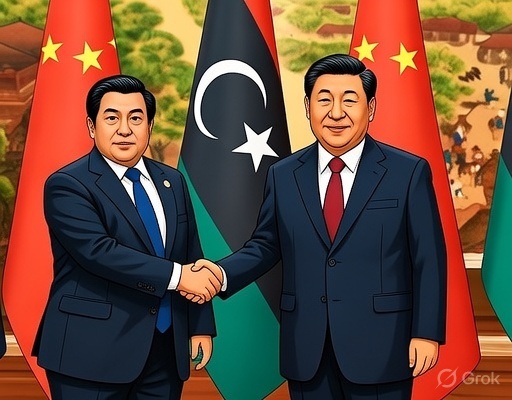
The reopening of the Chinese embassy in Tripoli on November 12 is not an isolated diplomatic gesture but a signal of a broader strategy: sustaining China’s presence in North Africa as an economic and logistical actor, avoiding direct political involvement in Libya’s internal dynamics while positioning itself in Tripoli ahead of possible future regional realignments.
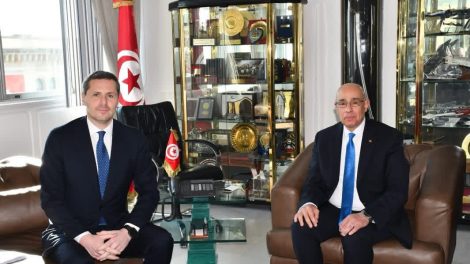
Fist of fury: China’s return was symbolically formalised on November 12, when Chargé d’Affaires Liu Jian met senior officials from the Libyan Ministry of Foreign Affairs of the Government of National Unity, receiving clear signals of openness to deeper cooperation in economic, technological and infrastructure sectors.
Why it matters: The dispatch of an ambassador strengthens the political signal of China’s return, indicating Beijing’s intention to establish a fully operational diplomatic presence to accompany and protect the relaunch of its economic initiatives in the country.
- This move comes at a time when Washington, according to the US National Security Strategy, seeks to prevent the emergence of new regional hegemonies by strategic competitors, first and foremost China.
- Libya thus becomes a testing ground for global competition in the wider Mediterranean, where US, Russian, Turkish and European interests intersect, while also putting Italy’s ability to defend its interests in a key theatre under scrutiny.
State of play: On the ground, China’s return to Libya is already visible through a series of concrete activities. State-owned enterprises such as China Civil Engineering Construction Corporation are working to revive infrastructure contracts dating back to the Gaddafi era, particularly in the railway sector.
- At the same time, strengthened logistical connectivity is taking shape through new commercial routes to the Misrata Free Zone, a central hub for access to the Libyan market and Mediterranean trade routes.
- In parallel, technology groups such as Huawei have resumed operations after a period of suspension, obtaining authorisations both in Tripolitania and Cyrenaica, including for the rollout of 5G networks.
- Taken together, these initiatives outline a distributed economic presence designed to engage with all Libyan power centres and remain relevant under any future institutional settlement.
China’s pragmatic approach. As noted by Chiara Di Scala, Beijing presents itself as an economic partner to all parties, more interested in projects and delivery than in military alliances. In practice, China plants economic footholds across all centres of power in Libya to remain present in any future political configuration.
China’s diplomatic return should primarily be read as an effort to regain room for manoeuvre in a dossier that has mainly remained frozen for more than a decade. According to Andrea Ghiselli, China foreign policy teacher at University of Exeter and Head of Research at ChinaMed, the reopening of the embassy in Tripoli signals Beijing’s intention to re-establish itself as a recognisable political interlocutor in Libya, without committing to a rigid alignment.
- China, Ghiselli argues, operates in a still deeply fragmented environment, where there were also past indications of interest in the country’s eastern faction.
- The appointment of an ambassador, therefore, does not point to exclusive alignment with the Tripoli government, but rather to an effort to manage the Libyan file more actively while keeping channels open with all relevant actors.
- In this context, Libya appears less central than other North African dossiers — such as Morocco — yet remains a valuable test case for China’s ability to combine diplomatic presence, political caution and economic ambition in a highly volatile environment.
Between the South China Sea and the Mediterranean. The Libyan dossier fits into a broader Chinese maritime posture. As Admiral Giuseppe Caffio observed in an analysis published by our sister website, Formiche, Beijing is completing its transition from a continental power to a global naval power, structuring its strategy along two distinct tracks.
- In the South China Sea, China acts as an assertive territorial power; in the Mediterranean, by contrast, it operates as an economic-logistical power, leveraging ports and commercial routes to consolidate a strategic and informational presence.
What we’re watching: China’s return does not take place in a vacuum. Turkey and Russia remain central actors on the military and security fronts, while Beijing adds an economic dimension that may generate both tactical convergences and new competition.
- For Europe — and for Italy in particular — the choice is becoming increasingly clear: remain observers or build a credible alternative in Libya’s reconstruction. China, for its part, has already begun to position itself.