General Portolano conveyed the Italian Armed Forces’ official condolences to General Caine and to the U.S. military leadership following the jihadist attack, which occurred while U.S. personnel were conducting a “key leader engagement” in the Palmyra area—once a stronghold from which jihadist groups had previously challenged Syrian regime forces.
What happened: According to U.S. Central Command (CENTCOM), the assault was carried out by a single attacker affiliated with the Islamic State, who was subsequently killed.
What Italy says: Defence Minister Guido Crosetto also expressed condolences to the U.S. Armed Forces and to the U.S. Secretary of Defence, underlining Italy’s closeness to the families of the victims and wishing a swift recovery to the wounded.
- His remarks fit within the framework of a structured and continuous security partnership between Rome and Washington.
Between the lines: Exchanges of this kind between allied military chiefs are part of routine defence relations and serve to maintain direct personal contact.
- This element goes beyond strategic alignment, operational coordination and interoperability. The broader context, however, helps shape their political and military relevance.
- In this case, the Portolano–Caine dialogue took place amid renewed attention to the jihadist threat in Syria and across the Middle East, highlighted both by the Palmyra attack and by Washington’s reinforced counterterrorism alert-sharing with partners.
The broader context: In the same period, the United States reiterated — also through the National Counterterrorism Centre — the intensification of intelligence sharing with allies to prevent terrorist threats, particularly those linked to jihadist networks operating across the Middle East, Africa and digital spaces. This approach reinforces the role of military partnerships as both tools of prevention and response.
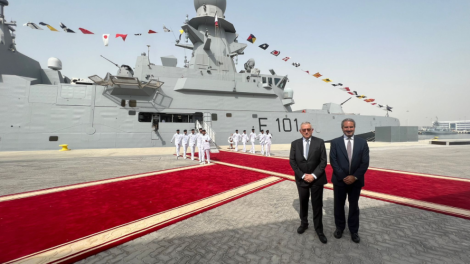
Zoom in – Qatar as a hub. A concrete example of this operational integration is the international exercise Ferocious Falcon 6, concluded two weeks ago in Qatar at the Al Qalayil training area.
- The drill involved forces from Italy, the United States, France, the United Kingdom, Turkey and Qatar, to strengthen interoperability and joint response capabilities in the Gulf region, where CENTCOM’s operational hub is located.
- How it worked: Organised by Qatar’s Ministry of Defence and, for Italy, by the Joint Operations Command (COVI), the exercise combined a Command Post Exercise focused on headquarters integration, a Field Training Exercise with live-fire activities, and an international seminar on key contemporary military challenges.
- Italy also contributed on the technical side, with a focus on Electronic Warfare and the protection of the electromagnetic spectrum.
The bottom line: The Portolano–Caine exchange, taking place in the aftermath of a jihadist attack on U.S. forces in Syria, where Italy wants play a role in the reconstruction projects, together with joint activities such as Ferocious Falcon 6, illustrates how U.S.–Italian military cooperation unfolds continuously—through institutional contacts and operational integration—bridging planning, deterrence, crisis management and shared security responsibilities.
(Photo: X, @CENTCOM)