

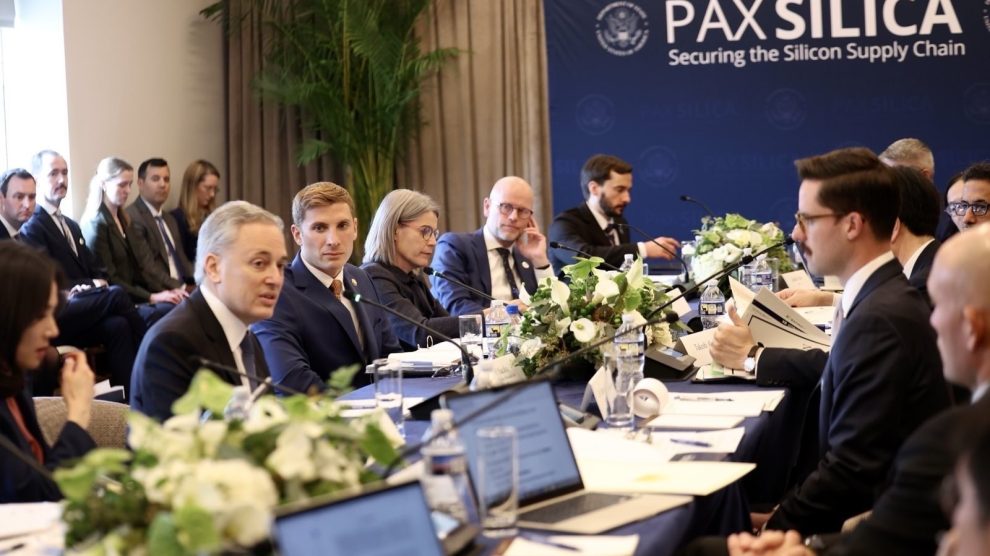
Pax Silica is the new strategic architecture through which the United States is aligning its Indo-Pacific allies around the physical foundations of the AI economy.
What’s on the table: Compute, silicon, critical minerals, and energy are treated as shared strategic assets—comparable to oil and steel in the 20th century.
- The underlying assumption is straightforward: leadership in artificial intelligence will determine economic power, security and military strength.
Driving the news: The initiative is explicitly Indo-Pacific–centric. Japan, Republic of Korea, Singapore, and Australia are framed as indispensable pillars of the AI supply chain: advanced manufacturing powerhouses, technological hubs, and critical mineral suppliers without which the “rails of the 21st century” cannot be built.
- At the inaugural Pax Silica Summit on December 12, these partners were brought together alongside European and Middle Eastern actors, including the Netherlands, the United Kingdom, Israel, and the United Arab Emirates.
- Guest contributors included representatives from Taiwan, the European Union, Canada, and the OECD.
- The focus was on scaling production, supporting long-term offtake arrangements, coordinating responses to overcapacity and dumping, and reducing coercive dependencies across the AI stack.
In Helberg’s words
- During the virtual press briefing, Helberg described Pax Silica as a historic inflexion point. “This is the first time that countries are organising around compute, silica, and minerals and energy as a shared strategic asset,” he said, calling it a watershed moment unfolding amid “the greatest reorganisation of the global economy since probably the invention of electricity.”
- The goal, he stressed, is “making sure that America and its partners build the rails of the 21st century,” adding that “if the 20th century ran on oil and steel, the 21st century is going to run on compute and minerals, and so we’re aligning our supply chains accordingly.”
- That logic extends to the broader strategic competition. “Our strategy is to create a competitive edge so steep, so insurmountable that no adversary or competitor can scale it,” Helberg said. “That’s why our goal is to make America the arsenal of AI in this century.”
- He linked Pax Silica to massive industrial mobilisation—hundreds of billions of dollars in investment, the most significant U.S. industrial buildout in more than 150 years—and to a new consensus replacing the old Washington Consensus.
- “Economic policy flows from national security. The countries that lead in AI and in technology will have the larger economy and the stronger military.”
Between the lines: China was never mentioned directly during the briefing, yet its shadow loomed large. The emphasis on de-risking, diversified supply chains, and the concentration of critical minerals makes the strategic intent clear without naming Beijing.
- Taiwan occupies a special position. While not a formal signatory, it participated in key sessions and remains central due to its dominance in advanced chip manufacturing. The Philippines, meanwhile, is seen as a potential future partner as Pax Silica expands beyond its initial core.
What we’re watching: Pax Silica is now moving from declaration to implementation. Expect tighter policy coordination, joint investments, and new infrastructure projects across minerals, manufacturing, compute, energy, and logistics.
- The Indo-Pacific will remain the primary theatre where the U.S. and its allies seek to secure the AI economy—and, by extension, the balance of global power.
(Photo: state.gov)