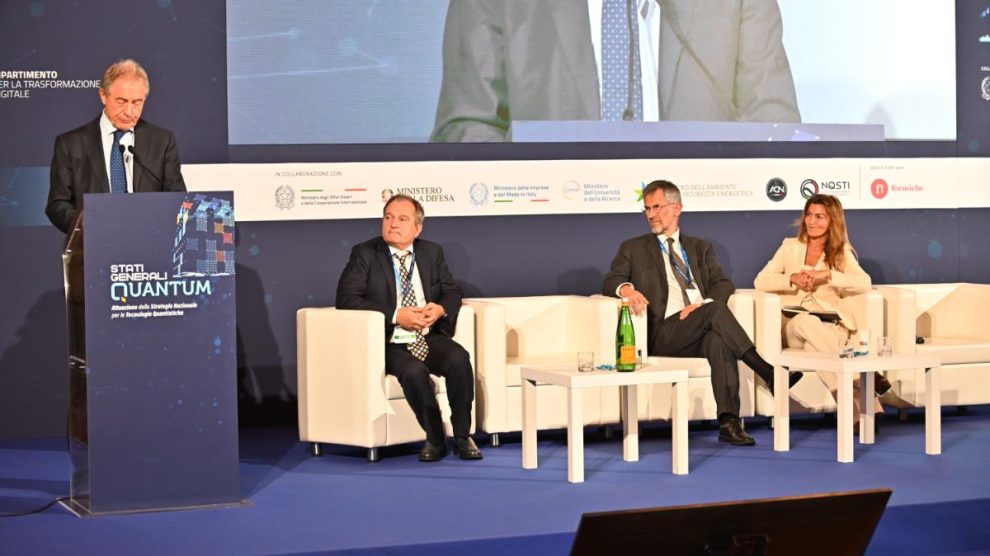
At the recent Quantum States General in Rome, ministers, academics, and industry leaders called for a coordinated national approach to quantum technologies. Decode39 and our sister website Formiche.net were media partner of the event.
The move: Defence Minister Guido Crosetto proposed a centralised National Quantum Polo to unify research, industry, and institutional efforts.
- The model draws on DARPA’s rapid prototyping framework, aiming to translate Italy’s existing quantum expertise into actionable capabilities. Key priorities include quantum computing, sensing, simulation, and communication.
- Concrete industrial developments, such as the establishment of IonQ Italia, a subsidiary of the U.S. quantum leader IonQ, complement the initiative. L
- With local R&D, hardware integration, and post-quantum cryptography capabilities, IonQ Italia exemplifies how international players are embedding operations within Italy.
- This not only strengthens the industrial ecosystem but also highlights the crucial role of private investment in enhancing national capabilities.
Why it matters: Quantum technology is no longer a laboratory curiosity. It underpins next-generation cybersecurity, infrastructure resilience, industrial competitiveness, and emerging defence capabilities.
- Minister Crosetto emphasised that mature quantum capacities “change the world in which [a nation] protects its systems and its competitive advantage,” linking technological sovereignty to national security.
-
Industry Minister Adolfo Urso and Environment and Energy Security Minister Gilberto Pichetto Fratin emphasised applications in energy optimisation, environmental modelling, and industrial process management, highlighting the broad societal and economic scope of quantum.
- Italy’s comparative advantages—its deep academic roots, existing supercomputing infrastructure, and strong scientific community—could allow the country to transition from research excellence to practical industrial deployment.
- Realising this potential, however, depends on mobilising private capital, venture investment, and international partnerships alongside public funds.
Strategic convergence: The initiative enjoys broad institutional and political support. Government ministries, research institutions, and industrial stakeholders are converging around the Polo concept, reflecting rare cross-sector alignment.
- Alessio Butti, Undersecretary for Technological Innovation, described quantum as a “transversal infrastructure” that impacts defence, healthcare, and industry.
- Public-private alignment and collaborative frameworks, such as Q-Alliance, which brings together local universities, industry, and international partners.
- Stakeholder mapping conducted by Urso’s ministry involved 52 participants, including start-ups and venture capital funds, demonstrating that private investment is central to building a scalable, sustainable ecosystem.
The bigger picture: Globally, quantum investments are dominated by the U.S. and China, deploying billions annually, leaving Europe trailing in industrial deployment despite research strengths.
- Italy occupies an intermediate position: advanced scientific expertise, operational supercomputers, and emerging industrial networks, within a European funding framework that differs structurally from the large-scale investment models adopted by global peers.
- While public funds through the PNRR provide a foundation, mobilizing private capital is essential to expand infrastructure, develop industrial applications, and integrate international partnerships.
- The National Quantum Polo aims to centralize priorities, infrastructure access, and funding, creating a platform where public and private resources can synergize effectively.
Political fault lines: As the initiative moves forward, several policy questions remain open. Ensuring sustained private investment and long-term strategic coordination will be particularly important as PNRR (the national post-pandemic recovery fund) resources are progressively phased out.
- Debate continues over the level of state oversight required versus academic freedom and industrial autonomy. Ensuring that small, highly specialized start-ups and foreign partnerships remain under strategic alignment is crucial for technological sovereignty.
What it signals: The proposed Polo marks a decisive step toward transforming Italy’s quantum capabilities into a strategic national asset.
- If implemented effectively, it could enhance technological sovereignty, strengthen industrial ecosystems, and position Italy as a European hub in a fast-emerging global competition.
- The integration of international players and the mobilization of private capital demonstrate a pathway to scale that public funds alone cannot achieve.
- In a rapidly evolving global landscape, quantum leadership remains attainable, but timing will be a critical factor as international competition continues to intensify.
- Italy’s approach illustrates a model of integrating science, industry, and state strategy in pursuit of technological and geopolitical influence.