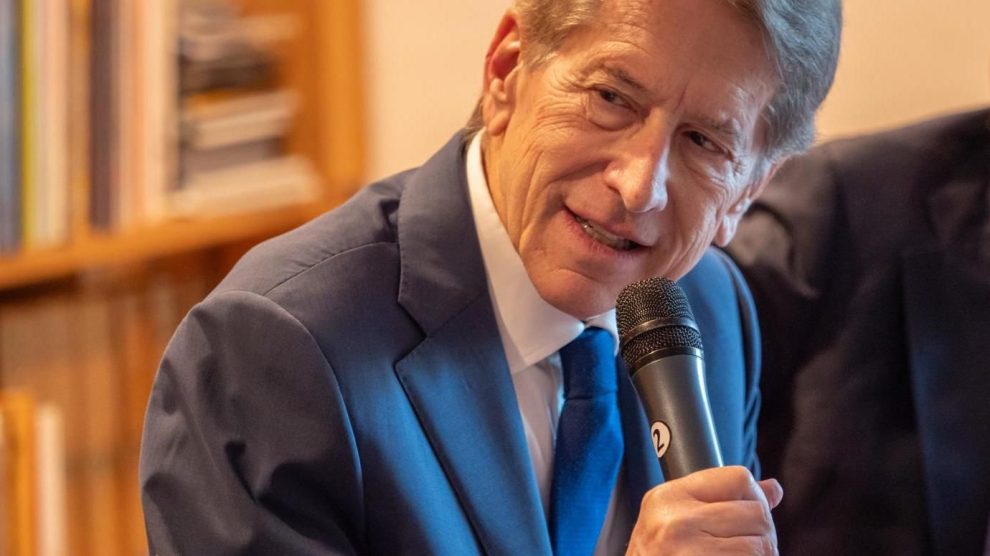
On the occasion of the European Council (EUCO) focused on the European Union’s main strategic dossiers – from support for Ukraine to long-term financial assistance for Kyiv, from the management of frozen Russian assets to the future of the EU-Mercosur agreement, and the broader debate on European strategic autonomy – Senator Terzi reflects on Italy’s role in fostering European convergence, on the balance between deterrence and legality in the response to Russia’s war against Ukraine, and on the positioning of the European Union in a geopolitical context marked by strategic competition, external pressure, and a redefinition of transatlantic relations.
Why he matters: He is the former Minister of Foreign Affairs and current Chair of the Italian Senate’s Committee on European Union Policies. Widely regarded as one of the most experienced Italian parliamentarians in foreign policy and international security, Terzi offers a political and institutional analysis of the EUCO’s outcomes.
Q: Within the framework of this European Council, support for Ukraine was discussed in a hostile climate, marked by significant pressure from authoritarian actors, particularly Russia. How do you assess Italy’s contribution in this context?
A: I assess Italy’s contribution as essential. On the Ukrainian issue, our country has never wavered; on the contrary, as demonstrated by the conclusions of this latest European Council, Italy has helped set the European direction.
- The majority resolution approved by the Senate on Wednesday, following Prime Minister Meloni’s communications, is fully reflected in the EU’s own conclusions.
- The Meloni government has consistently reaffirmed its firm support for Kyiv and for the Ukrainian people, who have been fighting a brutal Russian aggression for nearly four years. Italy has also always been at the forefront in supporting Ukraine’s accession to the European Union.
Q: The European Council, which has just concluded, found common ground on funding for Ukraine over the next two years…
A: The European Council’s response is crucial, at least for two reasons. The first is cohesion. The lengthy negotiations have paid off, and the €90 billion loan to Ukraine, based on the EU budget, is now a reality.
- It seemed impossible, yet the 27 European leaders agreed on a standard debt instrument, within the framework of enhanced cooperation (Article 20 TEU), linked to an instrument based on Article 212 TFEU.
- Today’s Europe is decidedly more united than it was just a few months ago. This was far from guaranteed, and I believe Italy, under Prime Minister Meloni’s leadership, played a central role in this positive shift.
- There is now greater awareness that the Russian threat is real and represents a risk to our security and beyond, and that it must be addressed without making concessions to President Putin.
- The European Parliament’s final approval in recent days of the ban on Russian gas – a position long supported by the ECR – fits squarely into this context. The EU is regaining courage and freeing itself from the chains of dependency, in all its dimensions.
Q: The idea of using frozen Russian assets to finance Ukraine has faded. Prime Minister Meloni described this as a matter of common sense.
A: As Prime Minister Meloni has clearly explained, the assets will remain frozen and may be used if, at the end of the war, Russia fails to pay reparations. This is an entirely sound solution.
- What matters most is that financial support for Ukraine over the next two years is guaranteed – and that has been achieved. Regarding the use of Russian assets, there were significant legal concerns.
- On the one hand, international law and the principle of legality must be respected; on the other, a point repeatedly stressed by Prime Minister Meloni, it is equally essential to safeguard the financial and monetary stability of our economies. The European Council successfully found a balanced solution.
Q: While farmers from across Europe were converging on Brussels with their tractors, the EU opted to postpone the signing of the Mercosur agreement. Yesterday also saw a phone call between Prime Minister Meloni and Brazilian President Lula, who had initially issued an ultimatum – “now or never” – before changing his stance.
A: Postponing the signing of the agreement with the Mercosur countries – alongside avoiding the use of frozen Russian assets – was a priority for Italy, and we can say with pride that Prime Minister Meloni achieved this objective as well. Italy was, in fact, the decisive swing factor.
- Prime Minister Meloni never took an ideological or hardline position on the agreement; our stance has always been a conditional “yes.” Today, Italy’s voice has been heard, and work will now continue introducing adequate safeguards, including reciprocity guarantees for the agricultural sector.
- This was an important step, because everyone recognises the economic, strategic, and political significance of the EU-Mercosur agreement. We are living in a period of evident geopolitical tension, and for the EU, opening up to new markets is crucial.
- At the same time, however, it is essential to protect our internal market and our agriculture. The discussion among European leaders was constructive and meaningful. Once the necessary guarantees are clarified, Italy will be firmly in favour of signing what would be a historic agreement with the South American bloc.
Q: Looking at 2025 as a whole, what role do you see for the EU in the geopolitical landscape, particularly in light of a solid relationship with the United States that nevertheless calls on Europe to act more autonomously on security matters?
A: The relationship between the United States and Europe is solid – it could not be otherwise – and it is also aligned. President Putin had hoped otherwise, but he has failed and will continue to fail in his attempt to divide Europe and the West. As Prime Minister Meloni stated clearly at Atreju, “we have never loved foreign interference, regardless of where it comes from; we have always preferred a costly freedom.”
- Today, the EU is fully aware of this reality. It has a clear understanding of the nature of Putin’s Russia: hybrid threats, the systematic use of disinformation and interference across Europe and in EU candidate countries, including Ukraine, and drones violating our airspace. All of this is unacceptable.
- The European Council’s conclusions are unequivocal: Europe aims to decisively strengthen its defence readiness by 2030, reduce strategic dependencies, and address gaps in critical capabilities, including in the space domain, through a comprehensive, 360-degree approach.
The bottom line: According to Senator Terzi, there is an increasingly firm European determination to become a strong pillar within the Atlantic Alliance. At the same time, strengthening the broader Mediterranean region will be essential.
- “In this regard, it is highly significant that the European Council has called for the rapid and effective implementation of the Pact for the Mediterranean, ‘to address shared regional challenges and opportunities in a spirit of co-ownership, mutual interest, and shared responsibility’.”
- “When we think of initiatives such as the Mattei Plan for Africa or IMEC, once again, it is clear how Italy, under the Meloni government, plays an essential and leading role.”