

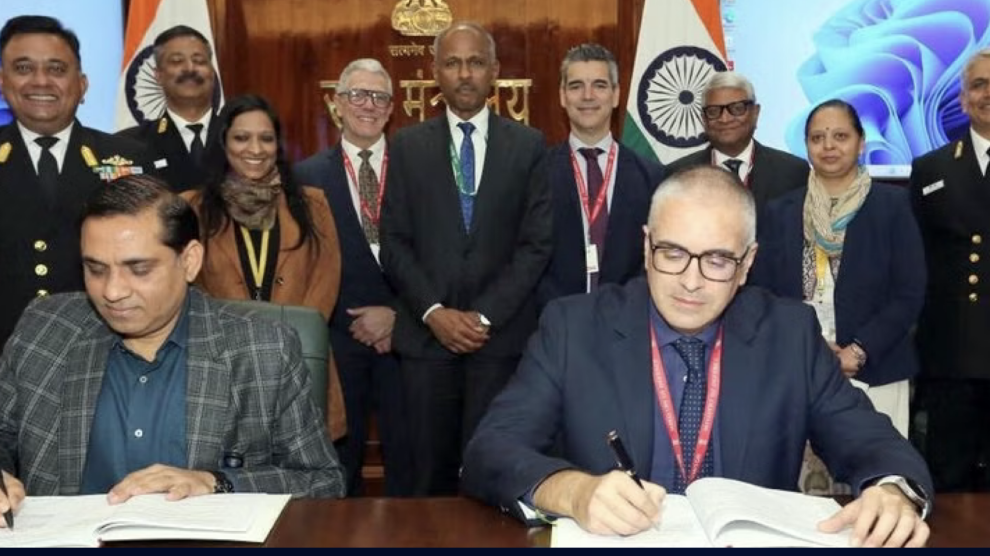
Fincantieri, through its subsidiary WASS Submarine Systems, has secured a contract worth over €200 million to supply heavyweight torpedoes to the Indian Navy.
The deal covers submarines already in operational service and represents the most significant order ever awarded to WASS.
- What’s included:
- Supply of Black Shark Advanced (BSA) heavyweight torpedoes
- Launch systems
- Maintenance equipment
- Spare parts and operational support
The systems will equip six Scorpène‑class submarines currently in service with the Indian Navy.
What they’re saying: Fincantieri CEO Pierroberto Folgiero described the agreement as “a fundamental strategic step for Fincantieri in India, a market of central importance to our long-term international growth strategy and one of the most dynamic naval hubs globally.”
- “Strengthening our presence in India means building lasting industrial and institutional partnerships in a region that is playing an increasingly central role in global maritime security.”
- “We are proud to deepen our cooperation with the Indian Navy and to position Fincantieri as a reliable, long-term partner in this strategic geography. as a fundamental strategic step for the group in India, pointing to the goal of building long‑term industrial and institutional partnerships.”
Production & timing: Manufacturing will take place in Italy, at WASS’s Livorno facility. Deliveries are scheduled between 2028 and 2030, with direct spillovers across Italy’s domestic defence‑industrial supply chain.
- The Black Shark Advanced (BSA) is already in service with the Italian Navy and six other international navies, confirming its status as a global benchmark in terms of performance, reliability, and low operating costs.
- The BSA stands out for its innovative operational capabilities and advanced technological features, embodying Italy’s international leadership in the field of undersea defence.
The context: Defence cooperation is part of a broader Italy–India relationship that has continued to deepen in 2025, combining political alignment and industrial partnerships.
- Rome views New Delhi as a strategic partner across the Indo-Mediterranean, while India seeks trusted suppliers in high-end defence technologies.
- In this framework, Fincantieri acts as a key vector of Italy’s international policy, with capabilities that directly match India’s strategic naval needs.
The bigger picture: India is emerging as one of the world’s most dynamic naval defence markets, driven by fleet expansion, power projection in the Indian Ocean and a strategic push to reduce technological dependence on China.
- Localisation and technology transfer have become standard requirements for defence programmes—an area where Italian industry has built long‑term credibility.
- As Claudio Cisilino, EVP Operations, Corporate Strategy and Innovation, has noted, India remains an “exciting end market” for the group within this evolving security environment.
Strategic overlay: The deal fits into Fincantieri’s broader positioning along the Indo‑Mediterranean axis, where shipbuilding, infrastructure and security are increasingly intertwined.
- Corridor security:
Beyond shipbuilding, Fincantieri is investing in the protection of critical infrastructure, including subsea cables, energy pipelines, ports and logistics hubs.
- These corridors are no longer just trade routes but integrated physical and digital systems that must be monitored and protected.
The bottom line: India and maritime security are two sides of the same strategy.
- For Italy, strengthening global supply chains today means not only building ships, but protecting the underwater and digital flows that underpin economic power and geopolitical competition.