Rising protests, mass repression, and mounting international pressure are pushing Iran into one of the most fragile phases of its post-1979 history. As civilian casualties climb and Tehran hardens its response, Europe is reassessing both its diplomatic posture and its tolerance for ambiguity.
In this context, Italy’s foreign minister, Antonio Tajani, has proposed designating Iran’s Islamic Revolutionary Guard Corps as a terrorist organisation, marking a significant shift in Rome’s approach.
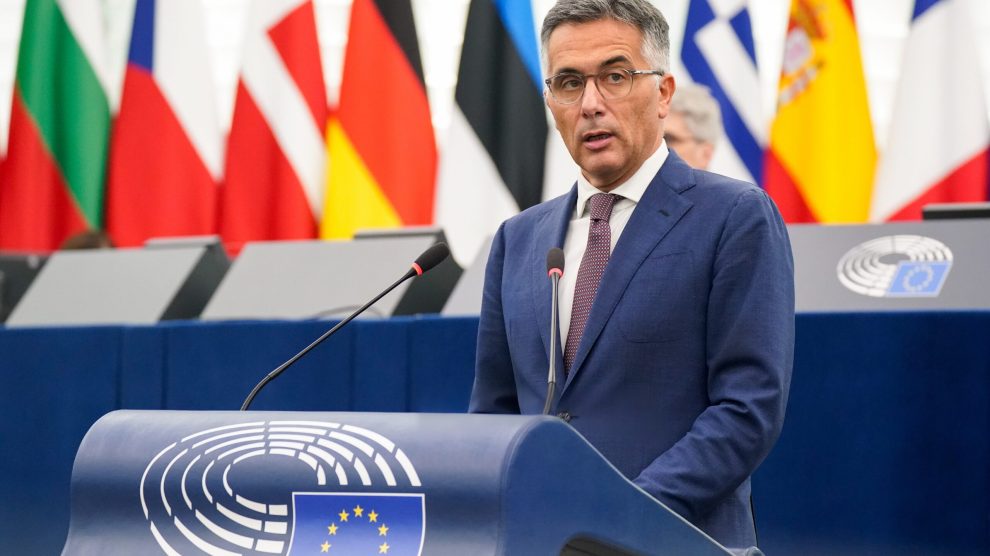
Why he matters: Massimiliano Salini is a member of the European Parliament for Forza Italia and has long focused on defence, security and foreign policy. He sits on parliamentary delegations for the Mediterranean and North Africa, placing him at the intersection of EU diplomacy, regional security, and transatlantic coordination.
Q: Foreign Minister Tajani’s proposal to list Iran’s Revolutionary Guards as a terrorist organisation marks a departure from Italy’s traditional posture. What is the strategic significance of this move?
A: It is a clear novelty in Italian foreign policy, particularly in relation to Iran. Historically, Italy—along with countries like Germany and the Netherlands—has consistently sought to maintain channels of dialogue with Tehran, including through economic relations, while remaining firmly anchored in the Western and Atlantic frameworks.
- Diplomacy, by definition, seeks to preserve dialogue even where it seems unlikely. Italy has always done this. That is why this initiative, announced last week within the European People’s Party group, represents a significant shift. It aligns with a growing Western—and especially American—assertiveness in the region and could be a prelude to further developments in the coming days.
Q: Faced with mass civilian casualties, how should the European Union respond? Is Europe preparing for a weakening of the Iranian regime?
A: The use of force has become a central issue in today’s geopolitical debates, and Iran is no exception. What is happening there cannot be addressed solely with the classic tools of peacetime diplomacy. Iran is witnessing one of the most brutal internal crackdowns against protesters, and this paradoxically reflects a real weakness at the top of the Islamic Republic.
- Internal divisions and tensions make any top-down pacification increasingly implausible, especially in a country already suffering a severe economic and humanitarian crisis. Any stabilisation will require careful external involvement. That is certainly our hope.
Q: Does this imply the possibility of direct intervention?
A: The important point is not unilateral action, but multilateral responsibility. A clear EU stance, combined with the American military presence, is a positive development. Any use of force must be collective, anchored in international law, and consistent with the obligations assigned to states by the United Nations.
- Too often, excessive prudence—or paralysis within the UN system—has allowed dictators to prevail, partly due to systematic vetoes by Russia and China in the Security Council. Force may unfortunately be unavoidable, but it must be used together, not by one country against another. Otherwise, the very foundations of peace are undermined.
Q: Is a regime change in Iran realistic in the short term?
A: It remains to be seen whether the path will be outright regime change or a form of managed transition. One name circulating within Iran’s power structure is Ali Larijani, secretary of the Supreme National Security Council. He was previously blocked from running for president, but today he is deeply involved in the repression.
- At the same time, his ambiguous relationship with Supreme Leader Ali Khamenei has led some to view him as a potential figure to manage a controlled transition—at least in theory—toward a more gradual political opening. Speaking of a democratic horizon may sound unrealistic, but diplomacy often works with imperfect and uncomfortable options.
Q: What role can Italy realistically play in such a volatile scenario?
A: Italy is a central actor in this theatre. Consider recent statements by Hezbollah, warning that any intervention against Iran would trigger their involvement as Tehran’s allies. Italy is deeply engaged in UN interposition forces between Lebanon and Israel, working to prevent escalation between Israel and Hezbollah.
- Italy has long been perceived as a relatively reliable interlocutor, even in highly complex theatres—from Iraq to Lebanon. This gives Rome a particular responsibility: to act decisively, while also supporting a credible process of accompaniment aimed at preventing further bloodshed and, above all, avoiding the disillusionment of the Iranian people.
Q: Could this crisis also generate destabilising side effects, such as new migration flows?
A: That risk is almost inevitable. In addition, the Kurdish dimension must be taken into account. The Kurdish issue cuts across Iran, Syria and Turkey and remains one of the most complex fault lines in the region.
- In recent years, Kurdish forces have also been guarding around 25,000 ISIS detainees, many of whom hold European passports and have formed families while in detention.
- In a scenario of military intervention or state collapse, these detainees could become a bargaining tool vis-à-vis the West.
- This adds another layer of complexity to an already extremely fragile situation, requiring the highest level of diplomatic coordination and strategic foresight.
The bottom line: Italy’s shift on Iran reflects a broader European reckoning: dialogue alone is no longer sufficient when mass repression meets systemic instability. The challenge now is to combine firmness, multilateralism and international law—without triggering a wider regional implosion whose consequences would extend well beyond Iran.