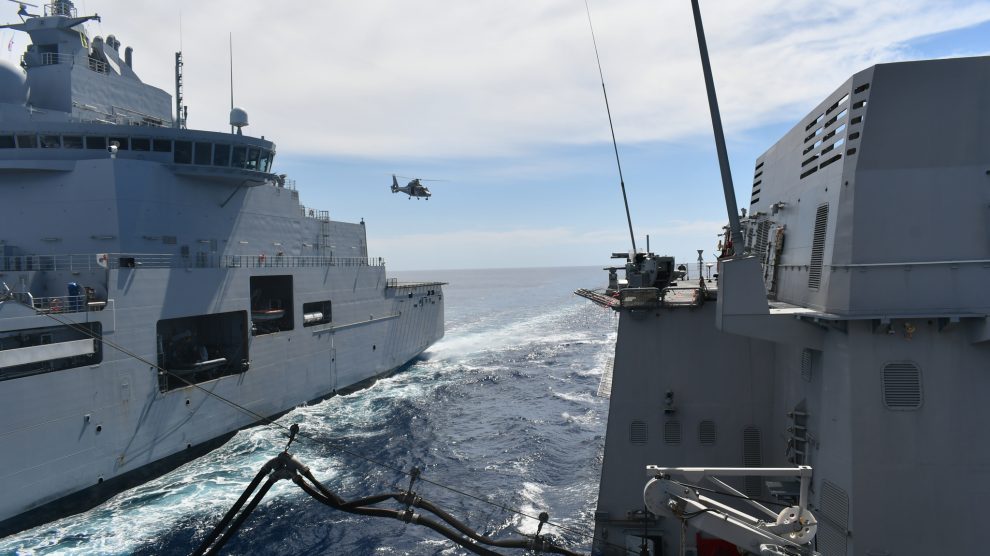
Hosted by Operation EUNAVFOR MED Irini at its headquarters in Rome’s Centocelle Air Base, the closed-door meeting brings together the leadership of the EU’s missions in the Mediterranean (Irini), the western Indian Ocean (Atalanta) and the Red Sea (Aspides).
Why it matters: The aim is to tighten coordination across theatres increasingly viewed by European planners as interconnected, amid persistent friction at sea involving Russian naval activity, shadow-fleet shipping and attacks on commercial routes.
What they’re saying: Rear Admiral Marco Casapieri, commander of Irini and host of the meeting, described the gathering as a chance to align on responses to common challenges affecting all three missions, including non-state actors and the use of civilian vessels for military purposes. “Our mutual priority is to strengthen maritime safety, security, and stand united in facing the challenges of our time,” he said at the opening of the proceedings.
What is happening: The meeting comes amid heightened maritime vigilance in the Mediterranean. In recent weeks, NATO, EU and Italian naval units have stepped up monitoring of Russian vessels and submarines transiting — or lingering — in the region, underscoring concerns about hybrid threats and the protection of critical infrastructure along routes linking Europe to the Middle East and Asia.
A widening arc of instability. European officials increasingly see the Mediterranean not as an isolated theatre but as the western anchor of a maritime corridor that runs through the Suez Canal to the Red Sea and the Indo-Pacific.
- This corridor links Europe’s trade and energy routes to Asia, making disruptions along it strategically significant. Instability in Libya and attacks on shipping near Bab el-Mandeb have reinforced the need for closer operational alignment among EU naval missions.
What they’re saying:
- Vice Admiral Ignacio Villanueva, commander of Operation Atalanta, said the mission continues to support commercial shipping and safeguard sea lines of communication across its area of operations.
- The Rome meeting, he noted, offers an opportunity to strengthen synergies among European naval deployments pursuing shared objectives.
- Rear Admiral Vasileios Gryparis, who leads Operation Aspides, described the EU’s naval presence as a long-term commitment to freedom of navigation and maritime stability rather than a temporary crisis response.
- European operations in the Red Sea and Indian Ocean, he said, are intended to ensure that vital trade routes remain open despite rising security risks.
What’s on the table. The two-day meeting is structured around thematic panels designed to move beyond consultation toward practical coordination.
- The first panel focuses on maritime domain awareness, with particular attention to Russia’s so-called shadow fleet and the protection of critical maritime infrastructure such as subsea cables and offshore energy assets. The topic reflects growing concern that opaque shipping networks and ambiguous naval movements could threaten energy flows and communications links across the Mediterranean basin.
- A second panel examines challenges beyond EU waters, including hybrid threats and strategic risks along key maritime routes from the Red Sea to the Indian Ocean. Discussions address how geopolitical tensions and attacks on commercial vessels are reshaping naval escort missions and the protection of shipping lanes.
- The third panel concentrates on mutual support mechanisms, interoperability and best practices among the three operations. Commanders and their staffs are reviewing training, exercises and common protocols to enable forces deployed under different mandates to operate more seamlessly together.
Interoperability as the central objective. If there is a unifying theme to the Rome meeting, it is interoperability — improving how separate missions share information, coordinate deployments and respond to crises across a vast maritime space.
- European naval operations have traditionally functioned in parallel, each focused on its specific mandate. But the spread of instability across connected sea lanes has highlighted the need for a more integrated posture.
- Enhancing information sharing and operational interoperability could allow the EU to act more quickly when threats emerge.
The bottom line: Radm Casapieri emphasised that closer cooperation among the missions would help protect not only shipping but also the broader security of European citizens. “Every effort we make together helps protect our people, our seas and our common future,” he said.
- The gathering in Rome marks the first attempt to institutionalise coordination among operational commanders. Whether it leads to more permanent joint planning remains to be seen.
- Still, the message is clear: Europe’s naval forces are preparing to operate as parts of a more cohesive security architecture across the Mediterranean and beyond.
(Photo: X, @EUNAVFOR_MED)