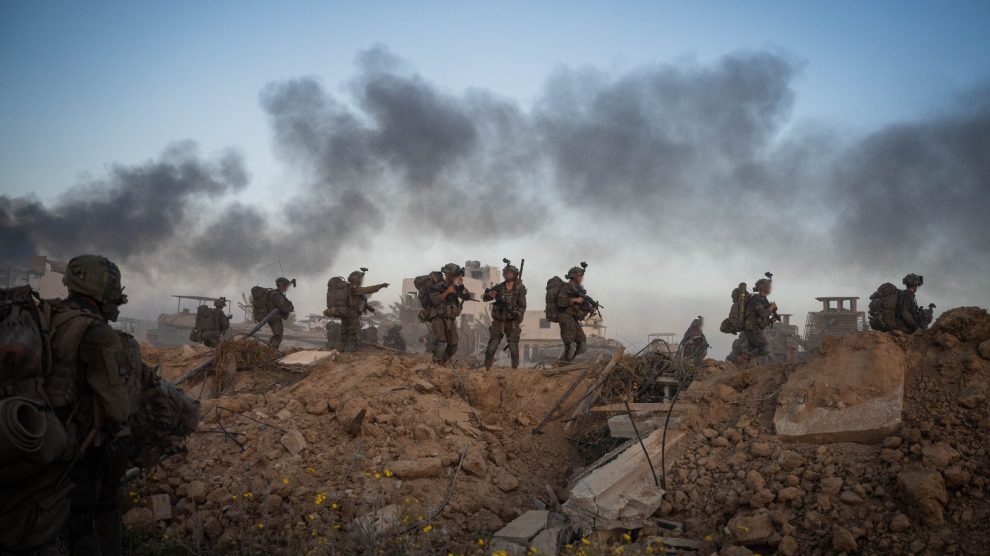
Defense tech is no longer a niche, nor a temporary response to geopolitical crises. It is now a fully fledged ecosystem made up of capital, founders, major industrial partners, and operational demand, all converging in a space set to grow rapidly.
Why he matters: Isaac “Yitz” Applbaum is Chairman at Kinetica Ventures.
- He is a venture capitalist with over 20 years experience in investing in early stage technology companies..
Q: Why has defense tech become such an important issue for venture capital today? Is this a temporary response to geopolitical tensions, or a structural shift?
A: It is a structural shift. I have been deeply involved in investing in deep tech and dual-use technologies for a long time, and what happens when a market matures is that the venture community gathers around areas where there is strong growth, major economic upside, and strategic relevance.
- Today we are in what I would call a perfect storm, with more conflicts, more threats, more bad actors, and at the same time a dramatic change in the nature of warfare. It is no longer only about major traditional platforms.
- A growing part of warfare is becoming more distributed, faster, and more sophisticated.
- Over the last 36 months, demand has become exponential, and the ability of technology to address these problems has also improved significantly.
Q: What is the most important difference compared with just a few years ago?
A: The key difference is that today there is an ecosystem. Five years ago, that ecosystem did not exist. There was not enough capital, not enough experienced managers, founders, board members, acquirers, or first movers. Today, all of those pieces are coming together.
- The leading venture firms that helped build major software revolutions are now building around defense tech as well. Alongside the traditional primes, new large-scale players are emerging with enormous ambition. When all those elements combine, value is created very quickly. In my view, this is still only the beginning.
Q: How can defense tech support venture-scale returns?
A: It can do so if the sector is built the right way. In fintech or cyber, innovation often comes from the bottom up, with a founder building something and then convincing the customer that they need it. In defense, the model is different. Here, the process is much more top-down because you need to understand what is actually needed on the battlefield.
- That means listening to generals, officers, and large prime contractors who understand real operational demand. But you also need a bottom-up element because many founders have direct battlefield experience, they know the problem firsthand, and they understand where rapid innovation is possible.
- If you combine those two dimensions and put capital into the system, you can build companies that scale very quickly.
Q: What are the essential ingredients for building a successful company in this space?
A: You need operational experience, industrial vision, and access to capital. If a company wants to understand what to build, it has to work with people who truly understand systems, military demand, and how procurement and sales work.
- At the same time, it has to empower founders who have seen the problem in the field over the last months or years.
- When you bring together people who know real warfare, people who spent decades in the military, and people who understand the perspective of large industrial partners, then you have the ingredients for a credible company that can grow fast.
- In many cases, we are seeing companies start at seed stage and raise substantial capital very quickly because they already have customers and demand.
Q: What are the most common mistakes first-time founders make in this sector?
A: The first mistake is moving too fast. In defense tech, you cannot always move with the same speed and the same assumptions you would apply in other sectors.
- The second mistake is believing you know more than the end user. In many parts of the innovation economy, that mindset can work: “We are smarter, more creative, we know how to do it better.”
- In defense, that does not work nearly as well. You cannot simply walk into a general’s office and claim your technology will work. You need more listening, more learning, more knowledge of the system, and more structure around what you are building. In this sector, founder arrogance can quickly become a liability.
Q: How do startups balance speed of iteration with reliability, trust, and compliance?
A: Today, it is possible to iterate much faster than in the past. There was a time when systems had to be perfect from the outset, with long procurement cycles and multiple layers of validation.
- Some programs still require that, but not all of them. In many urgent operational contexts, you can work directly with field commanders who need a solution now.
- Ukraine’s drone war is a good example, because iteration happens in weeks rather than years. The first version may work 50 percent of the time, the second 80 percent, and the third 90 percent.
- That is not the right model for every platform, but in many cases it allows you to save lives while the system continues to improve.
Q: What do founders coming from software or cyber tend to underestimate?
A: They need to understand that this is not just a matter of transferring the same mindset from one sector into another. In cyber, entrepreneurs are making fewer mistakes now, partly because many of them are second- or third-time founders. The real challenge is building a bridge between different mentalities.
- Procurement still matters, but the more important point is that the relationship with the customer is changing. It is no longer just a defensive negotiation in which each side protects its own interests. Increasingly, what we are seeing is co-creation, co-development, and co-iteration.
- Time to market matters too much, and security matters too much. That is why collaboration is stronger today, and it is helping products reach the market much faster.
Q: Looking five years ahead, what will be the most important shift?
A: We will see many more neo-primes, meaning new major defense companies that are not tied to the old model of traditional contractors.
The bottom line: “Today there are still very few of them. Five years from now, there could be twenty or thirty, with extremely large valuations,” said Mr Applbaum.
- “There will be more capital, more market cap, and much greater capacity to create, iterate, and sell. But that is only part of the story. As happened in cyber, the sector will also gain experience and maturity.”
- “And above all, the dual-use dimension will become even more important: many technologies that start in defense will have major civilian and industrial applications as well. That is how you build not only a stronger defense sector, but an entirely new innovation economy.”