
What happened: Six major economies condemned Iran’s attacks on commercial vessels, energy infrastructure and its “de facto closure” of the Strait of Hormuz.
- From the statement: “We condemn in the strongest terms recent attacks by Iran on unarmed commercial vessels in the Gulf, attacks on civilian infrastructure including oil and gas installations, and the de facto closure of the Strait of Hormuz by Iranian forces.”
- The statement calls for an immediate halt to mine-laying, drone and missile attacks, and any obstruction of commercial shipping.
- It frames freedom of navigation as a core principle of international law under UNCLOS.
- It warns that disruptions will hit global energy supply chains — with disproportionate effects on vulnerable economies.
Zoom in: Italy’s positioning. Italy is not just a signatory — it is structurally exposed. A significant share of its energy imports transits through Hormuz.
- Rome has consistently framed maritime security as a national and European priority, linking it to industrial resilience and supply chain stability.
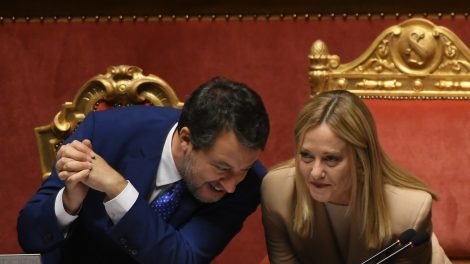
- The Italian government has elevated the crisis to the highest institutional level, with President Sergio Mattarella convening past week the Supreme Defense Council to assess geopolitical, nuclear and energy risks, while coordinating with EU partners and the G7.
- At the same time, Italy is positioning itself within a broader de-escalation effort. As Riccardo Alcaro (IAI) notes, Rome — alongside European and Gulf partners — has little interest in a prolonged war with high economic costs and uncertain outcomes, and could help promote a coordinated diplomatic initiative.
A clear line: According to Italian sources, access to the Strait of Hormuz is contingent upon establishing a ceasefire and implementing a broader multilateral initiative.
- Recognizing the significance of safely reopening this vital waterway, it is essential for all parties involved to collaborate toward this objective.
- The involvement of the United Nations is crucial, as it can offer the necessary legal framework to support a peaceful and effective multilateral approach to achieve the reopening of Hormuz.
The legal and strategic framing:
- The today’s joint statement explicitly anchors its position in UN Security Council Resolution 2817, elevating the issue from regional escalation to a matter of international peace and security.
- “We express our deep concern about the escalating conflict. We call on Iran to cease immediately its threats, laying of mines, drone and missile attacks and other attempts to block the Strait to commercial shipping, and to comply with UN Security Council Resolution 2817.”
- Freedom of navigation is a fundamental principle of international law, including under the United Nations Convention on the Law of the Sea.
- “By emphasizing UNCLOS, the signatories are reinforcing a rules-based maritime order — implicitly countering Iran’s attempt to weaponize chokepoints.”
What this means: The Hormuz crisis is being reframed as a systemic challenge, not a localized confrontation.
- This framing opens the door to broader multilateral involvement — politically and potentially militarily.
What they’re saying: The group calls for a “comprehensive moratorium” on attacks against civilian infrastructure, including oil and gas facilities.
- They underline readiness to support “appropriate efforts” to ensure safe passage through the Strait.
Driving the news: from condemnation to action? The reference to “preparatory planning” suggests that discussions are already underway on concrete measures — likely including naval deployments, escort missions, or enhanced surveillance.
The big picture: The Strait of Hormuz remains one of the world’s most critical chokepoints, handling roughly a fifth of global oil flows. Any sustained disruption would reverberate across energy markets, inflation dynamics and geopolitical alignments.
The bottom line: Italy is leveraging the Hormuz crisis to reinforce a long-standing strategic message: maritime security is economic security. By aligning with key partners while maintaining its Mediterranean centrality, Rome is positioning itself not just as a stakeholder — but as an actor in shaping the response to one of today’s most consequential global flashpoints.
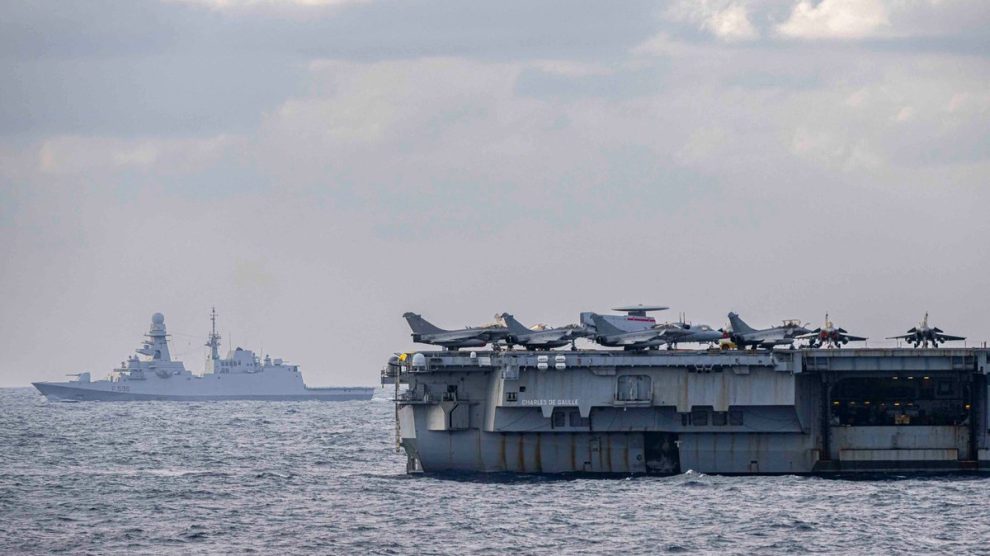
(Photo: X, @ItalianNavy)