
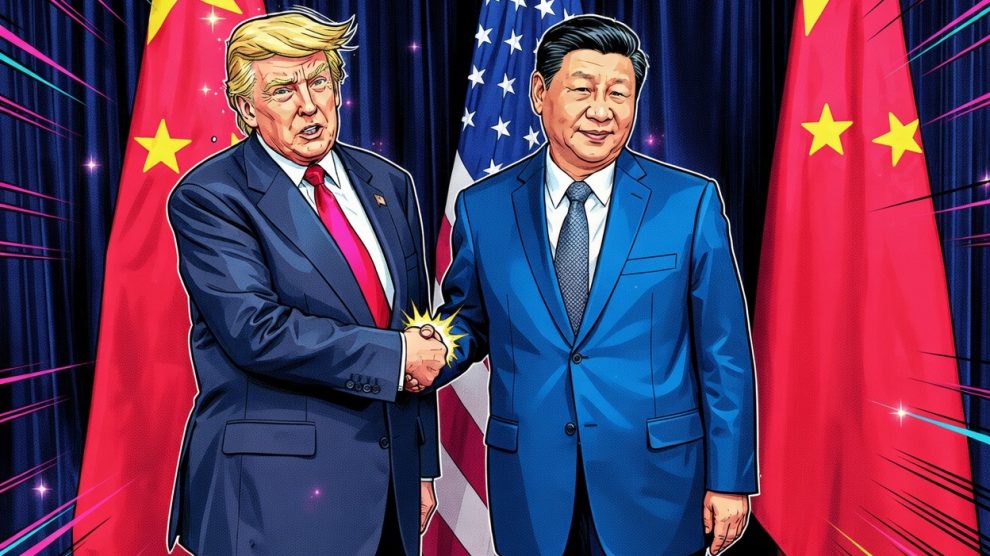
U.S. President Donald Trump has signaled that his planned meeting with Chinese President Xi Jinping—initially expected at the end of March—may be delayed, as the war with Iran continues to dominate Washington’s strategic agenda. Beijing, for its part, appears to remain in contact with the U.S. side and could be open to a rescheduling.
In this context, the meaning of U.S. strategy in Asia—and the actual prioritization of the Indo-Pacific—appears increasingly uncertain.
This is the focus of a conversation with Oriana Skylar Mastro, a fellow at Stanford’s Freeman Spogli Institute and one of the leading U.S. scholars on Indo-Pacific security, published in the newsletter Indo-Pacific Salad, curated by Emanuele Rossi for our sister media Formiche. Read the full conversation by subscribing to Indo-Pacific Salad.
Mastro’s argument is direct: the U.S. approach to China today is less about intensifying competition and more about managing it.
- “In this moment, the United States is heavily focused on the war in the Middle East,” she explains. “To deal with other global issues, the Trump administration is seeking a kind of détente with China, to reduce friction, instability, and unexpected crises.”
- From this perspective, even a high-level summit with Beijing—despite its symbolic weight—serves a functional purpose: stabilizing the relationship to free up strategic bandwidth.
- “The goal is to do some sort of reset, to set aside the relationship with China in the short term and allow the United States to focus on other priorities.”
The implication is structural. The United States competes globally, while China concentrates its efforts regionally.
- “The United States will always have simultaneous priorities across multiple regions,” Mastro notes. “China, by contrast, is competing essentially on one dimension—the Indo-Pacific.”
- This asymmetry complicates long-term deterrence, especially as U.S. resources are diverted.
- “In the long term, the use of U.S. resources in the Middle East reduces the likelihood that the United States will be in the best position to deter China when Beijing decides to use force.”
The Guarini Institute event. These questions will be at the center of a roundtable hosted by the Guarini Institute for Public Affairs on March 23 at 3:00 PM, titled “Trump and the Future of United States’ Role in Asia.”
- The event will assess whether U.S. strategy reflects retrenchment or reprioritization toward the Indo-Pacific, and what this means for regional stability, deterrence, and China’s strategic calculus—particularly in Taiwan and the South China Sea.
The allies’ dilemma. The evolving U.S.–China competition is also reshaping the strategic position of allies. Countries such as Italy have traditionally sought to balance their security relationship with Washington while maintaining economic ties with China. But U.S. expectations are changing.
- “Many countries, like Italy, try not to provoke China,” Mastro observes. “But when they fail to take U.S. security concerns into account, Washington does not feel reassured that allies are truly aligned.”
- Recent remarks by Republican Senator Lindsey Graham underscore this growing tension. After speaking with Trump, Graham said he had “never seen the president so angry,” criticizing European allies for failing to contribute adequately to keeping the Strait of Hormuz open despite benefiting directly from it.
- For Mastro, part of the increasingly assertive U.S. posture stems from a deeper concern.
- “Many actions that some consider aggressive or provocative derive from the desire to re-establish a deterrent position. In Washington, there is concern that U.S. power and influence are eroding.”
This shifts part of the burden onto allies. “We often talk about the United States reassuring allies. But allies also need to reassure the United States that Washington’s priority position in their policies is not at risk.”
- That reassurance, she suggests, is not always evident: “This is not what many countries are doing. The United States understands the commercial needs of countries like Italy,” she notes. “But the United States is also a major trading partner—and that is often overlooked.”
- The result is a reversal of a long-standing strategic question: “For a long time, the question was how to maintain the security relationship with the United States without upsetting China. Today, the question is becoming: how do you maintain a relationship with China without upsetting the United States?”