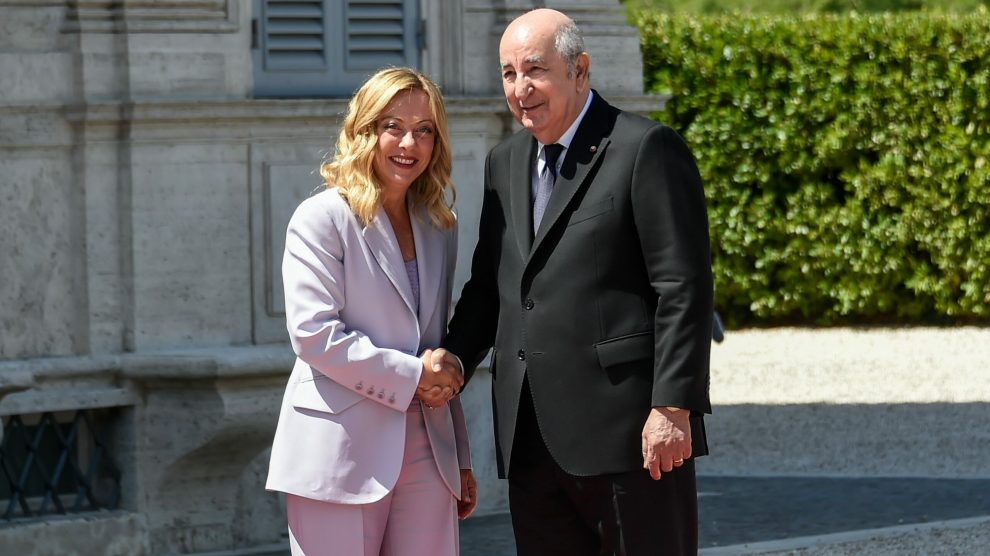
What’s happening: Italian Prime Minister Giorgia Meloni is set to visit Algeria on Wednesday, at a time when military actions on the Strait of Hormuz are reshaping energy security calculations across Europe.
Why it matters: The visit underscores Italy’s strategy to deepen partnerships with alternative energy suppliers as geopolitical risks threaten global supply routes and price stability.
The big picture: Algeria has become Italy’s largest gas supplier, with roughly 20 billion cubic meters (bcm) imported annually. Azerbaijan, via the Trans Adriatic Pipeline (TAP), provides an additional 10 bcm, covering about 15–16% of Italian demand.
- Together, these flows reflect a broader push by Rome to diversify away from more volatile supply corridors, particularly in times of crisis.
- In this context, Algeria plays a central role not only for Italy but increasingly for Europe’s wider energy resilience strategy.
Decoding the relationship: Italy–Algeria ties are anchored in a 2003 Treaty of Friendship, spanning energy, defense and development cooperation.
- Recent developments signal an expansion beyond hydrocarbons: joint focus on green hydrogen (South H2 corridor), plans for a new Algeria–Italy subsea electricity cable, and cooperation on critical raw materials and methane emissions reduction.
- A bilateral summit in 2025 resulted in more than 40 agreements across energy, industry and technical cooperation, highlighting the scale of engagement.
The corporate backbone: Energy cooperation is driven largely by Eni and Algeria’s Sonatrach.
- A $1.35 billion project is underway to develop the Zemoul El Kbar field, under long-term agreements extending up to 30 years, with potential extensions. Additional upstream expansion includes participation in Reggane II.
- Eni has been active in Algeria since 1981 and remains the leading international operator in the country, with production exceeding 130,000 barrels of oil equivalent per day.
Zoom in: beyond gas. The partnership is gradually shifting toward energy transition and infrastructure connectivity.
- The South H2 corridor aims to link Algerian green hydrogen production with Southern Europe, while a planned electric interconnector would deepen integration between North African and European grids.
- These projects align with Italy’s broader Mattei Plan, which positions the country as a bridge between Europe and Africa.
Between the lines: The timing of Meloni’s visit reflects how geopolitics is accelerating geoeconomics diplomacy.
- Disruptions or perceived high risks in chokepoints like Hormuz tend to increase the strategic value of pipeline-based and Mediterranean routes.
- Italy is leveraging its geographic position to consolidate long-term supply relationships while expanding into next-generation energy projects.
What to watch: Whether new agreements are announced during the visit, particularly on hydrogen and infrastructure. How pricing dynamics evolve as new gas flows enter the European market. The extent to which Italy can translate bilateral ties into a broader EU-level energy strategy.