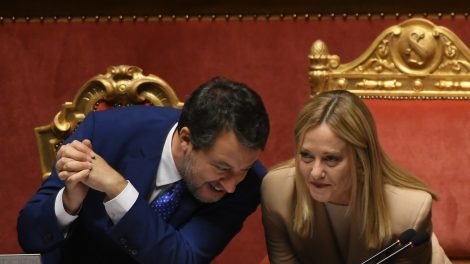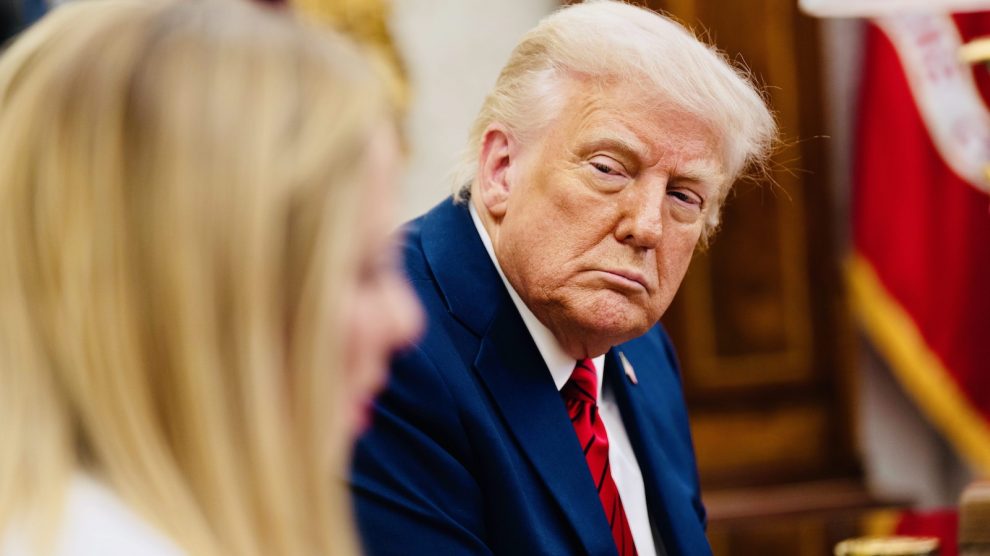
Why it matters: Italian voters have rejected the government’s constitutional overhaul of the judiciary, dealing a political setback to Prime Minister Giorgia Meloni and exposing broader signs of erosion in public confidence. Part of this shift may also reflect a growing distance between Italian public opinion and the policies of U.S. President Donald Trump — a dynamic that could have indirectly weighed on Meloni, widely perceived as politically aligned with Washington.
The big picture: The referendum on judicial reform has turned into more than a vote on institutional design. With turnout at 58.9% — significantly higher than recent electoral benchmarks — the outcome reflects a mobilized electorate and a test of confidence in the government.
- The “No” prevailed with 53.7%, rejecting a reform that included the separation of careers between judges and prosecutors, the split of the High Council of the Judiciary (CSM), and the creation of a new disciplinary body.
- While the government framed the reform as necessary to ensure fairness in trials, opponents argued it risked increasing political influence over the judiciary without addressing structural inefficiencies, particularly the length of civil proceedings.
Between substance and signal: The vote was not purely political. According to polling, 69% decided on the merits, versus 28% sending a political signal.
- Still, the signal matters: 34% of “No” voters framed it as a message to the government — effectively a partial confidence test ahead of next year’s elections.
- The likely misstep was procedural: opting for a polarizing referendum instead of seeking a broader parliamentary compromise.
A generational fracture: One of the most striking elements of the vote is the age divide.
- Voters aged 18–34 rejected the reform by a wide margin (61.1% “No”), while the 35–54 cohort also leaned against it (53.3% “No”). Only among voters aged 55 and above did the “Yes” slightly prevail (50.7%).
- The data point to a clear generational misalignment: younger voters — who will shape Italy’s political future — are moving away from the government’s institutional agenda.
Political consequences — limited but real: Despite the defeat, the referendum does not translate into an immediate political crisis.
- A majority of Italians (54%) believe Meloni should remain in office, while only 26% support her resignation. The Prime Minister had already distanced her political fate from the outcome.
- However, the vote represents a warning signal. It highlights a potential gap between the government’s reform agenda and public priorities — and suggests that consensus may be thinner than electoral results alone would indicate.
Beyond justice: a shifting mood The referendum result appears to fit into a broader pattern of public opinion — including a reaction to the current international context (from Gaza to Ukraine, Iran) and the perception of U.S. leadership.
- Recent polling (Euromedia) shows that 53.6% of Italians oppose a potential military mission in the Strait of Hormuz, while 58.1% favor withdrawing Italian troops from the Middle East, where a military crisis is ongoing following the war launched by the United States and Israel against Iran.
- The data suggest that the U.S.-Israel escalation and the unclear strategic line of the Trump administration are contributing to a more cautious — and in some cases skeptical — public attitude.
- This sentiment likely played a background role in the referendum, reinforcing distance from the government’s positioning.
- These figures point to a growing skepticism toward U.S. international engagement and a more fragmented alignment with the government’s foreign policy positioning.
The bottom line: The referendum marks an important political test for Meloni’s government. While it may not be immediately destabilizing, it reveals underlying tensions in public opinion and a possible erosion of trust.
- At the same time, shifting attitudes toward international crises — including declining support for transatlantic engagement, partly linked to the unclear strategic direction of the U.S. administration and partly to growing anti-American and anti-Western narratives, also fueled by hybrid, disinformation campaigns — could pose longer-term challenges for Italy’s positioning.