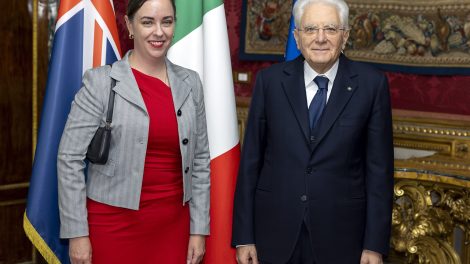
Italian Prime Minister Giorgia Meloni held a phone call today with UK Prime Minister Keir Starmer “to exchange assessments on the security situation in the Strait of Hormuz.” According to a statement from Palazzo Chigi, “in underlining the international community’s interest in safeguarding freedom of navigation, Meloni and Starmer agreed to maintain close coordination on initiatives aimed at de-escalation and ensuring the security of commercial routes in the area.”
Italy aligns with London on de-escalation. Italy’s position was further outlined by Foreign Minister Antonio Tajani, who joined the London-convened international meeting via videoconference. Rome signaled its willingness to consider participation in multilateral initiatives—provided they are backed by a clear United Nations mandate—to ensure safe passage through the Strait.
- Tajani reiterated Italy’s line: immediate de-escalation, a return to diplomatic dialogue, and full coordination with European and international partners.
A broad coalition to reopen a strategic chokepoint. The UK-led meeting, coordinated by the British foreign secretary, brought together around 40 countries, including Italy, France, Germany, Canada, Japan, and the United Arab Emirates.
- Its stated goal is to identify diplomatic and political options to reopen the Strait of Hormuz, a critical artery for global energy flows now severely disrupted by the war involving the United States, Israel, and Iran.
- Iranian attacks on commercial vessels, coupled with the threat of further escalation, have effectively halted traffic through one of the world’s most strategic geoeconomic choke points, with immediate repercussions on oil prices and supply chains. Industry data indicate dozens of direct attacks on civilian shipping in recent weeks, resulting in casualties among crews and a sharp drop in transit volumes.
Capabilities gap and limits to military options. The breadth of the coalition signals an effort to build a response that goes beyond the traditional Euro-Atlantic framework, incorporating Gulf actors and emerging countries.
- Yet a central question remains: capabilities. None of the participating states appears willing to forcibly reopen the Strait while hostilities continue and Iran retains significant denial capabilities, including anti-ship missiles, drones, and naval mines.
- In this context, the prevailing line—articulated by Starmer and shared by several partners—is to avoid direct military escalation. Instead, the focus is on preparing, potentially with the involvement of military planners, a post-conflict maritime security framework combining naval presence, diplomatic engagement, and cooperation with the shipping industry.
The US factor and pressure on Europe. The summit also sends a political signal to Washington. US President Donald Trump has ruled out direct involvement in securing the Strait, arguing that it is not the responsibility of the United States to guarantee the route’s safety.
- This stance reflects a broader trend of reduced US engagement and increased pressure on European allies to take on greater responsibility.
- French President Emmanuel Macron echoed a similar note of operational caution, describing a military effort to force open the Strait as unrealistic and potentially counterproductive, given Iran’s capabilities and the risks to civilian shipping. Hence the emphasis on direct diplomatic engagement with Tehran as the more viable path.
A test for global maritime security. Overall, the Hormuz crisis is increasingly shaping up as a critical test for global maritime security and for Europe’s ability to act cohesively in a high-intensity environment.
- Freedom of navigation—a cornerstone of the international order—is now entangled with power dynamics, military constraints, and shifting transatlantic balances, underscoring how control over trade routes has become central to global strategic competition.