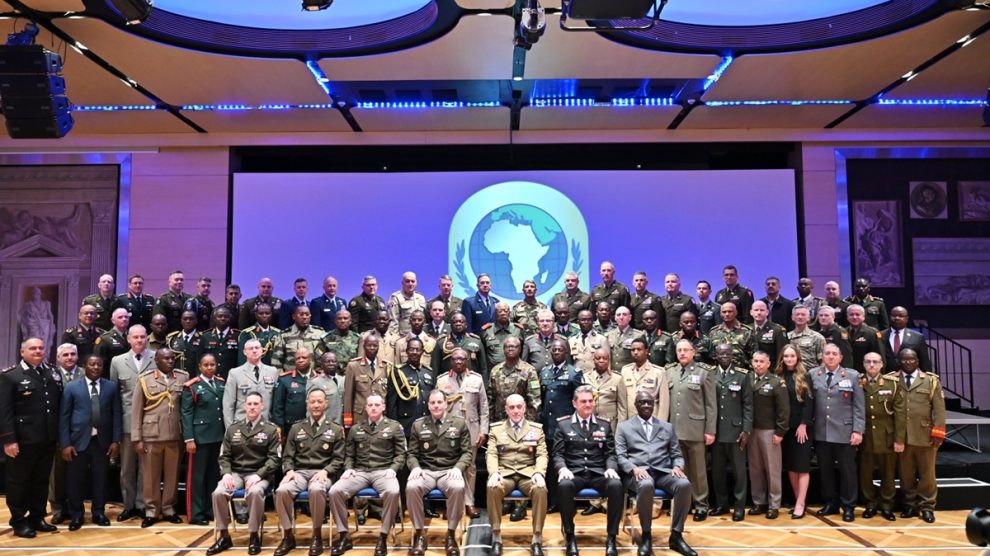
At first glance, the African Land Forces Summit 2026 resembled a standard U.S.-led military gathering: uniforms, bilateral meetings, panels on counterterrorism and training. More than 40 countries and over 300 senior leaders convened for what has long been a staple of U.S.–Africa security engagement.
A summit that looked familiar — but wasn’t. A summit that looked familiar — but wasn’tYet the composition of the room told a different story.
- Alongside generals and defence officials were venture capitalists, artificial intelligence startups, data firms and cryptocurrency advocates.
- Traditional defence contractors were present, but no longer dominant. The balance had shifted.
- This was not simply a military forum. It was a marketplace.
“Trade, not aid”: a doctrine takes shape. The summit reflects a broader reorientation under Donald Trump, whose administration has moved to dismantle the architecture of traditional development assistance and replace it with a more transactional model.
- Where U.S. engagement in Africa once centred on aid, training and institutional support, it is now increasingly framed around:
- commercial deals;
- technology transfer;
- private investment.
- Senior U.S. military officials have been explicit. The guidance is “trade, not aid”. The Pentagon is not retreating from Africa, but recalibrating its role — from provider to broker.
The fusion of security, capital and technology. The Rome summit formalised a model that had been emerging in fragments: the integration of defence, industry and finance into a single operational framework.
- At its core lies the concept of dual-use technology — systems that serve both civilian and military purposes. Artificial intelligence, data platforms and digital infrastructure are no longer peripheral tools but central components of security strategy.
- Crucially, this integration extends beyond technology. Capital is now embedded in the process. Investors are brought into the same space as military planners and defence firms, with the explicit aim of generating scalable partnerships.
- The result is a new ecosystem:
- armed forces define operational needs
- companies develop solutions
- investors enable deployment
- In this model, security becomes not only a strategic objective, but also an investable domain.
A platform for private statecraft. The implications are structural. What is emerging is a form of privatised statecraft, in which private actors assume roles once reserved for governments.
- Rather than delivering aid or long-term institutional support, the United States is facilitating connections:
- between African militaries and U.S. firms;
- between governments and financial capital;
- between security challenges and market solutions.
- The state’s role shifts accordingly — from direct actor to orchestrator.
- This approach aligns with a broader geopolitical logic. It seeks to leverage the speed, scale and innovation capacity of the private sector, particularly in areas where competitors such as China have established strong positions, from infrastructure to resource extraction.
Rome matters: Italy’s bridging role. The choice of Rome as host city is not incidental. It marks the first time the summit has been held in Europe, signalling a deliberate attempt to broaden the framework beyond a purely bilateral U.S.–Africa axis.
- Italy’s role is central to this shift. Through its evolving Africa strategy — most notably the Piano Mattei — Rome has positioned itself as a bridge between Europe and the African continent, promoting a model of cooperation that combines energy, infrastructure and development with a more equal partnership narrative.
- Hosting the summit in Italy reflects a convergence of approaches:
- the U.S. emphasis on investment-driven engagement;
- Italy’s attempt to redefine cooperation through strategic partnership rather than aid.
- It also embeds African security discussions within a wider Euro-Atlantic context, linking Mediterranean stability, supply chains and geopolitical competition.
Opportunity meets uncertainty. For U.S. companies and investors, the model offers clear opportunities. Africa is framed as a high-growth region where security needs intersect with commercial potential — from defence technologies to mining and digital infrastructure.
Yes but… Some uncertainty remains as private actors adapt to a space traditionally led by governments, with the closer alignment between policy and business creating both opportunities and open questions.
- At the same time, some African partners underline the importance of continuity and reliability, noting that commercial solutions may not fully replace longstanding forms of security cooperation built on sustained support and trust.
Italy’s approach: partnership and interoperability. Italy’s Chief of Army Staff, Carmine Masiello, framed Rome’s approach around interoperability and shared security.
- “The cooperation between allied and partner countries is an essential element: only through interoperability, the development of common capabilities and structured collaboration can we build an effective and resilient collective security system, contributing to the stability of the wider Mediterranean and to the growth of a secure, prosperous Africa capable of playing a leading role in global security.”
- On Africa, General Masiello called for “a peer-to-peer approach, based on the recognition and promotion of the extraordinary characteristics and potential of African peoples — a model that values local priorities and fosters jointly developed solutions, grounded in humility, respect and shared responsibility.”
A recalibrated presence. The African Land Forces Summit in Rome illustrates a broader transformation in U.S. foreign policy. Washington is not withdrawing from Africa, but redefining how it engages.
- The emerging approach replaces aid with access, and partnership with transactions. It seeks to align security objectives with market mechanisms, embedding geopolitical competition within economic frameworks.
- Whether this model can deliver both influence and stability remains an open question. What is clear is that the rules of engagement are changing — and that in Rome, the United States offered a glimpse of what comes next.
(Photo: Italian Army)