
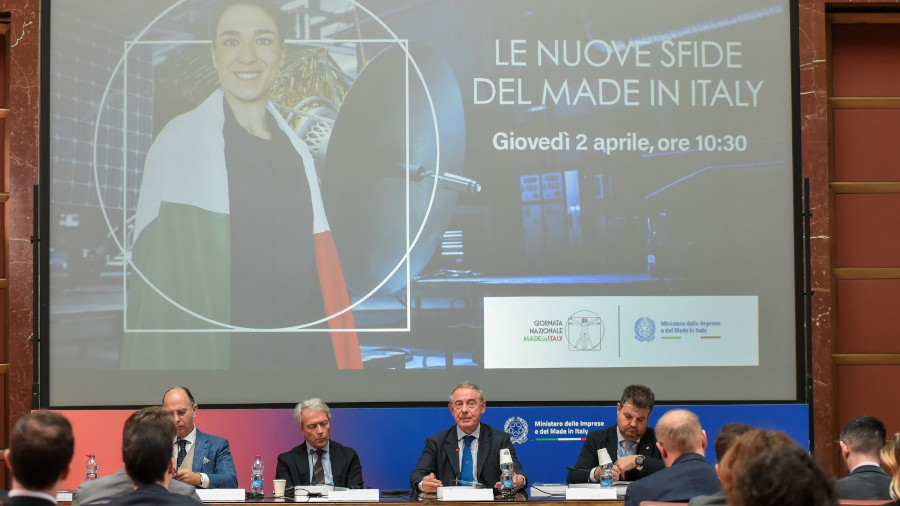
Italy’s industrial system continues to demonstrate resilience in an increasingly unstable global environment, according to a new report presented at Palazzo Piacentini ahead of the National Made in Italy Day on April 15.
A System Under Pressure, Yet Resilient. The study, “Le nuove sfide del Made in Italy,” was developed by the Ministry of Enterprises and Made in Italy and coordinated by Marco Fortis, vice president and director of the Fondazione Edison.
- It was presented by Industry Minister Adolfo Urso, who framed it as a starting point for assessing both the strengths and vulnerabilities of Italy’s productive system.
Strong Export Performance. “This report […] is intended as a starting point for a broader discussion on the potential and challenges of our production system,” Urso said.
- “Its strength lies in the diversification of high-quality production and export markets, which has allowed Italy — even in the difficult context of 2025 — to stand alongside Japan among the world’s leading exporters and to record nearly 20% growth in foreign investment.”
- The report outlines how Italy has consolidated its position among the world’s top exporters, ranking fourth globally alongside Japan. With a trade surplus of $122 billion — the third highest worldwide after China and Germany — and a 20% increase in foreign investment over the past three years, the country continues to punch above its weight in global trade.
Structural Challenges Remain. At the same time, Urso warned that structural challenges remain, particularly rising energy costs and the impact of geopolitical instability, including tensions in the Persian Gulf.
Diversification as a Strategic Asset. In this context, Fortis emphasized the robustness of Italian exports even amid external pressures. He noted that despite U.S. tariffs in 2025, Italy recorded the strongest export growth in dollar terms among G7 countries, outperforming even China.
- Fortis highlighted how diversification remains a key strategic asset. Italy’s ability to spread risk across both products and markets has helped mitigate the impact of global disruptions, while new sectors — including shipbuilding, pharmaceuticals, aerospace, and cosmetics—are gaining ground alongside traditional strengths such as mechanical engineering, fashion, agri-food, and furniture.
Beyond the “Five A’s”. The report situates these trends within a broader global landscape marked by persistent instability, from the Russia-Ukraine conflict to tensions in the Middle East and ongoing trade frictions. Yet, despite these pressures, the Made in Italy brand continues to demonstrate strong adaptability.
- This resilience is visible not only in the traditional “five A’s” — food (in Italian: alimentazione), fashion (abbigliamento), design (arredo), automotive, and automation — but also in high-tech sectors ranging from pharmaceuticals and the space economy to the blue economy, defense, and cultural industries.
A Strategic Vision for 2030. The findings reinforce Italy’s position as a reliable and attractive economic system. The country is the only G7 member to return to a primary budget surplus since 2024, supported by solid trade performance and rising employment levels.
- The report also feeds into the broader strategic framework outlined in the White Paper “Made in Italy 2030,” contributing to a long-term vision of industrial policy centered on competitiveness, innovation, and the strengthening of national supply chains in a rapidly evolving global context.
(Photo: Mimit)