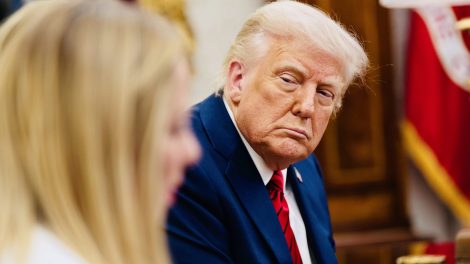
Decoding the news. The meeting between Elly Schlein and Pedro Sánchez, Donald Trump’s return to the White House and the attempt by European progressives to coordinate against the sovereignist right are pushing the debate beyond Rome.
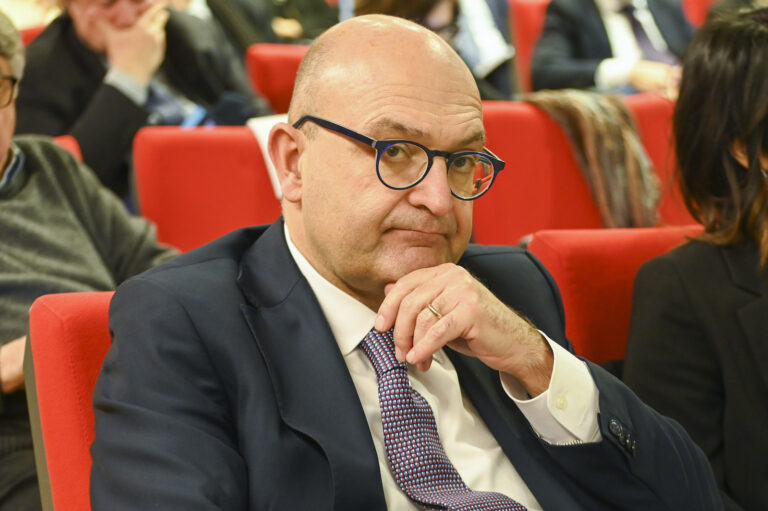
- Senator Antonio Misiani, a member of the Democratic Party’s national secretariat, reads the future of Italy’s centre-left through this broader geopolitical lens: a Europe less dependent on Washington, more capable in security and industrial policy, and an Italian election in 2027 that could reverberate well beyond the country’s borders.
- In the background, Pope Leo XIV’s encyclical on artificial intelligence adds another layer to the debate, bringing together technology, labour, war and human dignity.
What’s happening. In the background is the Rome meeting between Elly Schlein and Pedro Sanchez, which followed an initiative promoted in recent weeks by the Demo foundation on Europe, Italy and the United States.
- Then there is the Pope’s encyclical on AI, which reopened the debate on the primacy of the human person over technology and on the risk of new social inequalities. In this context, Decode39 spoke with Senator Antonio Misiani, a member of the Democratic Party’s national secretariat.
Q: The dialogue among progressive leaders seems to have intensified in recent weeks. What phase are we in?
A: There is a strong need, among progressive forces, to talk to each other and build a common front against what has now become a real international far-right network.
- We saw it from the Barcelona summit to the initiative in Toronto with Canadian Prime Minister Mark Carney.
- Leaders such as Pedro Sanchez, Carney, Elly Schlein and other progressive figures must build a shared response. The sovereignist right is organizing globally, and it would be a mistake to confront it separately.
Q: Does the Rome face-to-face between Elly Schlein and Pedro Sanchez fit into this context?
A: Yes, and it is a politically significant development. Sanchez represents one of the most important countries in Europe, and his meeting with Schlein has a precise meaning.
- It is not a good signal; instead, Prime Minister Giorgia Meloni did not receive him. In any case, within the European progressive camp, there is also close attention to what may happen in Italy in the coming years.
Q: A few weeks ago, Demo’s reformist area promoted an initiative precisely on the relationship between Europe and the United States. How much does Trump’s return weigh today?
A: The relationship between Italy and the United States is historical, cultural and human before it is even economic, and it must be preserved beyond governments and the political colours of the moment.
- But we must be aware that America’s strategic focus is shifting toward the Indo-Pacific. This is an inevitable paradigm shift, and it also entails a gradual loosening of the transatlantic bond as we have known it in recent decades.
- That is why Europe must take its destiny into its own hands and become stronger on the major strategic issues: energy, security, industrial policy and common defense.
Q: Is Italy’s 2027 vote also being watched closely outside the country?
A: Absolutely. The Italian elections will carry weight beyond Europe’s borders. The outcome is open, and the centre-left has a concrete chance of winning.
- The results of recent years show that the country is politically open and competitive. If progressives were to win in Italy, it would matter not only for our country but also for Europe, because it would show that sovereignists can be defeated.
Q: What indications have the latest local elections delivered?
A: We will make the final assessment after the runoffs. Of course, Andrea Martella’s defeat in Venice is disappointing. It was a city we considered competitive after eleven years of centre-right government, and there was confidence that a different result could be achieved.
- At the same time, however, we won important cities such as Pistoia and Avellino. I would say these local elections confirm that the balance of power between the centre-right and the centre-left remains substantially unchanged.
Q: What impression did Pope Leo’s encyclical on artificial intelligence leave on you, and what message does it send to politics?
A: It is a reflection of great depth and stature. I was also struck by the silence of some CEOs of the large American big tech companies on the issues raised by the Pope.
- The encyclical does not demonise artificial intelligence, but it reaffirms the primacy of humanity over technology. And it raises a huge issue: the social consequences of this transformation.
- I am thinking of data workers, of new forms of exploitation, of those who risk becoming the new slaves of the digital economy.
Q: Is politics doing enough?
A: So far, only partly. This text should push everyone to reflect seriously and to build answers from both a political and regulatory point of view.
- There is also an aspect I find particularly disturbing: the use of artificial intelligence in warfare. It is an aberration to think that a machine could choose targets, just as it is an aberration – as the pontiff also argues – to imagine that there can be such a thing as a just war.