
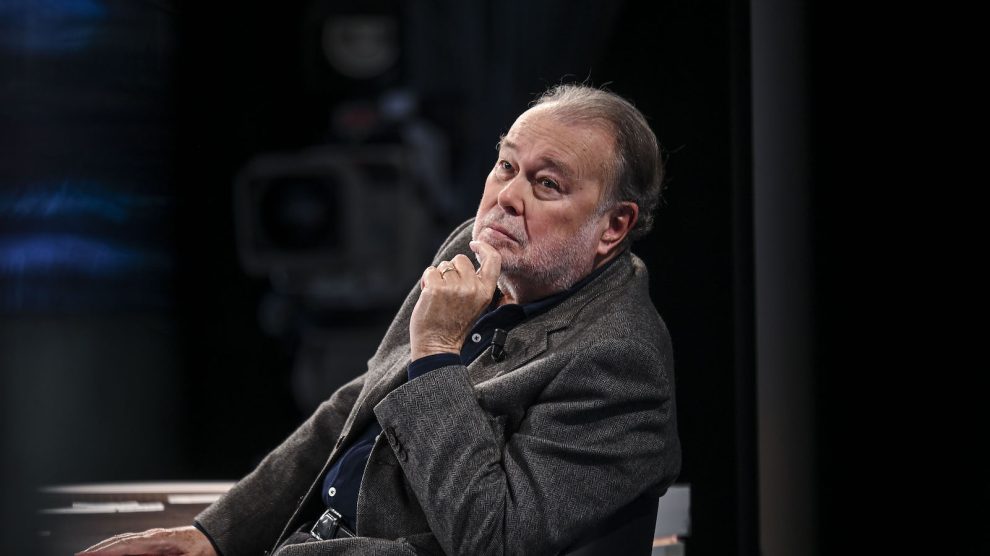
According to Claudio Petruccioli: “Another right-wing government would be damaging for Italy, but so would a broad-left government unable to express a credible and coherent position on the major international issues. The next five years will be decisive for Europe’s future, and we cannot afford ambiguity.”
A: I cannot say it surprised me. But let me start with a premise. I am not a member of any party: I am a voter, and I look at politics through the concerns of a voter. In the coming years, Italians will be asked to choose who governs the country during a decisive phase for Italy, Europe, and the world.
- Yet I know many people who do not know whom to vote for. On one side there is the center-right led by Giorgia Meloni; on the other, a center-left that appears divided, with political leadership seemingly oscillating between Elly Schlein and Giuseppe Conte. Many moderate and reformist voters see limits and inadequacies in both camps. Picierno’s decision must be understood in this context. She is not the only person to have left the Democratic Party in recent years and months, but her departure has a particular significance.
A: She did not say she wanted to switch sides. She said that things cannot continue this way and that the issue is not merely winning elections, but asking with what governing project. In my view, she raised a real issue: the credibility of a potential broad-left government on fundamental matters such as Ukraine and Europe.
- The two issues are closely linked, and for me they are an essential criterion in political choice. Many people, including those who share her concerns, have asked her a legitimate question: “And then what?” What political perspective follows the criticism? That question applies to Picierno, but it also applies to those who have remained in the Democratic Party while arguing that the battle must be fought from within. However, I think the real point is something else.
A: What is the red line? If the Democratic Party manages to correct its course and clearly affirm a pro-European and Atlanticist line, that would be good. But if it does not, how far will reformists be willing to follow its strategy? The answer coming from the Schlein leadership is essentially this: to defeat the right, the coalition must remain united, and therefore Conte’s positions must be taken into account. But the issue is not whether to stand with Conte or against him.
- The issue is which line prevails within the coalition. If a clear line prevails on Ukraine, Europe, and European defense, then Conte would eventually have to decide whether to accept it. If, instead, in order to keep the coalition together, the Democratic Party continues to chase the positions of the Five Star Movement, then the problem becomes serious.
- This is why the question “and then what?” does not concern only Picierno. It also concerns those who have stayed in the Democratic Party. If the political line does not change, what is the limit beyond which reformists are no longer willing to follow the party?
A: As I see it, another right-wing government would be damaging for Italy, but so would a broad-left government unable to express a credible and coherent position on the major international issues. The next five years will be decisive for Europe’s future, and we cannot afford ambiguity.
A: I agree. But I prefer to start from the most concrete questions. The question put to Picierno (“and then what?”) is legitimate. But it must apply to everyone. Those who argue that they should remain in the Democratic Party and change it from within must explain how they intend to do so, and above all on what content.
- Take the clearest example: Ukraine, Europe, and European defense. What is the broad-left’s position on these issues today? What position should a credible government have for Italy and for Europe? Before discussing new political identities, these questions need answers. Without a clear answer, the problem of governing credibility remains unresolved.
A: If all these people, who on many issues are essentially saying the same things, managed to build a common initiative, it would certainly be better than the current situation. I do not think it would by itself solve all problems. One must be realistic about the limits of each actor.
- However, it could represent a stronger and more visible political presence, capable of forcing everyone else to engage with issues that are often avoided today. In that sense it would be useful, because it would introduce into the debate a voice capable of raising clearly and firmly the concerns that many voters feel, but that politics too often prefers not to confront.