
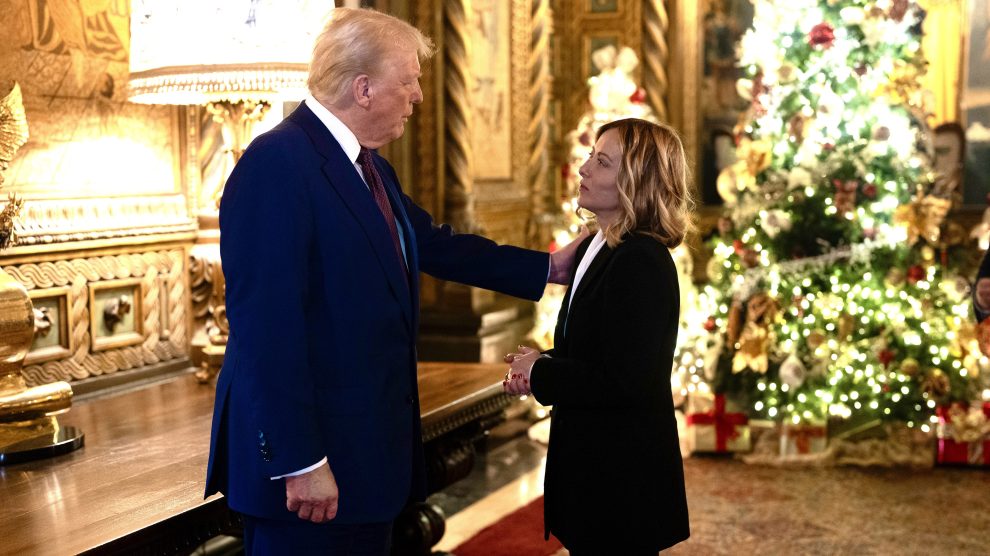
The public dispute between Donald Trump and Giorgia Meloni has generated headlines on both sides of the Atlantic. Yet behind the exchange of statements lies a more consequential debate about the future of U.S.-Italy relations and the expectations Washington places on its European allies.
Beyond Personalities. For Alexander Gray, the key question has little to do with personalities.
- “Personal disputes between leaders come and go, but larger policy questions and alignment—or misalignment—of national interests determine the trajectory of a bilateral relationship over the medium and long term,” says Gray, Chief Executive Officer of American Global Strategies and former Deputy Assistant to the President and Chief of Staff of the National Security Council during Trump’s first term.
The Iran Question. Speaking with Decode39, Gray points to what he considers a more important issue than the recent exchange of public criticism.
- Despite being widely viewed as ideologically close to the Trump administration, Italy chose not to grant the United States access to strategic facilities during Operation Epic Fury, the military campaign against Iran. “This is a substantial policy disagreement,” Gray argues.
- In his view, the decision effectively placed Rome alongside governments in London, Paris, and Madrid that have often adopted more critical positions toward Washington. “Several Western European governments have repeatedly complained about the United States shifting its focus away from European security priorities, only to deny the United States access to key infrastructure in Europe during a crisis,” he says.
- According to Gray, such decisions risk reinforcing skepticism within Washington regarding the priorities of Western European allies and may contribute to broader discussions about the future of America’s military presence on the continent.
- “More than clashes between leaders, these are the dynamics that will likely define the U.S.-Italy relationship in the years ahead,” he concludes.
NATO and Burden Sharing. A related perspective comes from Carla Sands, former U.S. ambassador to Denmark during the first Trump administration.
- “Since I wasn’t in the room when the exchange took place, I can’t comment on what was said,” she says. Anyway for Sands, the real test will be the future of NATO and the long-running debate over burden sharing within the Alliance.
- “Regarding NATO, radical changes have to take place and quickly. I’m sure that message will be communicated during the meetings. Europe is still falling short. This is a bipartisan issue in the United States.”
- Currently Chair of the Foreign Policy Initiative and Distinguished Senior Fellow for Energy Policy at the America First Policy Institute, Sands notes that concerns about European defense spending extend well beyond the current administration and enjoy support across the American political spectrum.
The bottom line: These comments highlight a broader reality. While disputes between leaders may dominate news cycles, Washington’s expectations regarding allied contributions to collective security have become increasingly central to the transatlantic conversation.
What we’re watching: That is why the upcoming NATO Summit is likely to matter far more than the latest political controversy. Defense spending, burden sharing, deterrence against Russia, growing concerns about China, and the future role of European allies will all feature prominently on the agenda.
- Viewed through that lens, the Trump-Meloni dispute appears less as a defining moment in bilateral relations and more as an episode within a larger debate about the future of the transatlantic alliance itself.