
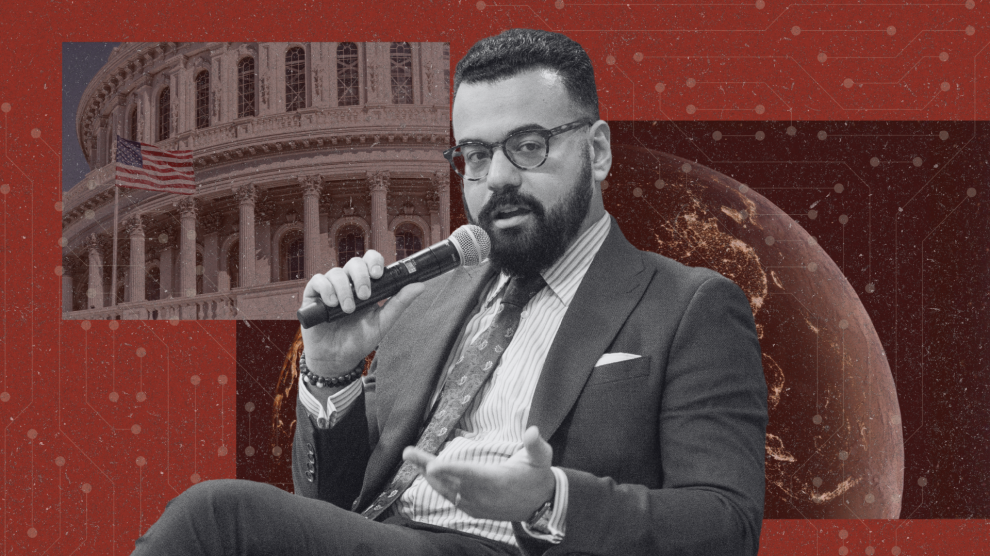
Mohammed Soliman sits in his office at McLarty Associates in Washington, surrounded by artifacts and objects that reveal how his mind works. Nearby sits a beautifully detailed scale model of the “La Belle of Saint Louis,” a Mississippi River paddlewheel steamboat, its gingerbread Victorian architecture rendered in miniature with meticulous craftsmanship. On another wall is a framed 1950s BOAC airline poster, “Fly to Egypt,” featuring artist Xenia’s mid-century illustration of Cairo’s minarets and domed structures. On his desk, his own book, West Asia: American Grand Strategy in the Middle East, sits next to a well-worn copy of Roy Jenkins’ biography of Churchill and Philip Jodidio’s survey of contemporary American architecture. On the bookshelf at the center of his office, the collection runs deep on the machinery of modern power: OpenAI, Nvidia, semiconductors, Indo-Pacific strategy, you name it.
He is not yet forty, but Soliman has become one of Washington’s thoughtful voices on a question that will define American power for the next quarter-century: What does American strategy actually look like when military geography no longer determines the contest for global influence?
At a moment when American grand strategy seems trapped between two inadequate alternatives—the Atlanticist insistence that Europe remains central to American interests, or the restraint school’s argument that America should simply do less everywhere—Soliman offers a third path: a vision of American power that is neither interventionist nor isolationist but instead deeply focused on the technological and geoeconomic foundations of American capacity, and, most importantly, on the American working class that has borne the burden of ill-advised foreign wars over the past 25 years. He believes America should commit to building trusted networks of allies and partners rather than reverting to old-fashioned, European-style spheres of influence, because he expects the world to become multipolar and power more diffuse.
“The fundamental shift we’re living through,” Soliman explained in a this conversation with Decode39, “is that geography is no longer destiny. Technology is. Where your semiconductors come from, where your AI infrastructure is hosted, where your critical minerals are processed. These now shape what you can do militarily, economically, diplomatically. America’s strategic footprint is being redrawn not by where we have bases, but by where we have leverage in technology and supply chains.”
A Bridge Between Worlds. Soliman’s journey to this position is itself revealing. As a director at McLarty Associates—one of Washington’s most influential international consulting firms—and as a senior fellow at the Middle East Institute, he occupies a rare perch: someone equally comfortable discussing semiconductor fabrication with venture capitalists and the Iran war with regional experts. His work on what he calls the “West Asia” strategic system has become increasingly influential in policy circles, but for reasons that often surprise outsiders.
- Where traditional Middle East expertise focuses on terrorism, sectarian conflict, and humanitarian crises, Soliman insists on seeing West Asia differently: as a strategic connector, a region whose position between the Indo-Pacific and Europe makes it crucial to any coherent American grand strategy. The great-power competition that will define the next decades, he argues, cannot be understood as simply a two-dimensional Pacific contest between America and China. It is a three-dimensional system in which the security of energy flows, port access, and strategic chokepoints in West Asia becomes as consequential as naval superiority in the Taiwan Strait.
- “People still think of regions as separate,” Soliman said. “The Middle East is a region of crises. The Indo-Pacific is where the real contest is. Europe is America’s traditional ally. But this compartmentalization is exactly wrong. What’s happening is that these regions are becoming integrated into a single Eurasian system. The question is whether America understands this before others do.”
- This insight emerged partly from his work on Iran policy during the Obama and Trump administrations, where he watched American strategy lurch between opposite poles—from the nuclear deal’s attempt at grand accommodation to maximum pressure and ill-fated war. But it hardened into systematic thinking after he began studying the relationship between technological capacity, energy security, and geopolitical leverage.
- When the war in Ukraine began, Soliman’s argument suddenly seemed less academic. The contest for energy in the Middle East, he had written, would become more consequential as Europe sought alternatives to Russian gas. Taiwan, as the world’s dominant producer of advanced semiconductors, suddenly seemed more vital to global security than almost anyone had recognized. And the vulnerabilities in the American technological base—the reliance on Chinese processing and on Taiwan for chips—became impossible to ignore.
Technology as the New Geography. Soliman’s core argument starts with a deceptively simple observation: for most of the postwar era, American strategy could be understood through a geographic lens. Where did the Soviet Union pose threats? In Europe, along the iron curtain, and in regional proxies across the Global South. Where did American military presence need to be concentrated? Wherever geography suggested conflict was most likely.
- But technology has scrambled this map. “Consider semiconductors,” Soliman explained. “Sixty years ago, this wouldn’t have mattered. Today, who controls advanced semiconductor production essentially determines who can build AI systems, who can produce advanced weapons, who can innovate faster than competitors. Taiwan produces 92 percent of the world’s advanced chips. That’s not a strategic fact because of Taiwan’s geography in the traditional sense. It’s a strategic fact because of what Taiwan manufactures.”
- The implications are profound. Traditional military presence in a region now matters far less than secure access to the technological infrastructure that region produces or transits. An American base in the Middle East is valuable not primarily for its ability to project power into regional conflicts, but for what it enables in terms of energy security and the maintenance of sea lanes through which the technological supply chain flows.
- This reframing suggests a completely different American strategic footprint than the one that has evolved over the past seventy years. Instead of asking “where do we need military presence?” the question becomes “where do we need to ensure access to critical technology and resources?” The answer, Soliman argues, points toward a strategy built around what he calls “trusted networks,” coalitions of partners with shared interests in maintaining access to critical technologies, securing supply chains, and preserving the institutions that enable global commerce and innovation.
- “The old Cold War model was spheres of influence,” Soliman noted. “You had your side, they had theirs, and the goal was to keep them separate. That’s finished. What replaces it isn’t a single global order maintained by one power, but rather a series of overlapping networks, technological networks, supply chain networks, security partnerships, that are more resilient precisely because they don’t depend on any single power maintaining hegemony. They depend on maintaining access and ensuring that no hostile power can dominate the critical chokepoints.”
West Asia as Strategic Reality. This brings Soliman to what he believes is the most under-recognized geopolitical reality of the coming decades: the emergence of West Asia as a single strategic system. It’s the idea that shot Mohammed to fame in his widely read book, West Asia, the term itself is novel, but the insight is profound.
- Traditionally, the Indian Ocean and Mediterranean have been understood separately. The Indian Ocean is where the contest with China unfolds, where sea lanes carry the bulk of global commerce, where energy flows from the Middle East to Asia. The Mediterranean is a European lake, where NATO maintains presence, where historical rivalries among European powers have been managed through multilateral institutions.
But this division is increasingly artificial. Energy flows from the Middle East service both Asian and European economies. Supply chains for critical technologies route through both regions. Strategic competitors—China, Russia—are now active in both spaces. A conflict in Taiwan affects energy prices and European security. A disruption in the Strait of Hormuz affects Asian economies and European geopolitics.
- “The connecting tissue,” Soliman said, “is West Asia, understood as the critical hinge between two strategic systems. What happens in the Arabian Gulf affects naval access to the Indian Ocean. What happens in the Red Sea and Suez Canal affects Mediterranean commerce. Control the chokepoints in West Asia, and you have leverage across the entire system.”
- This has direct implications for American strategy. For decades, American presence in the Middle East was justified primarily in terms of counterterrorism and regional stability. Soliman’s framework suggests a different rationale: maintaining access to the energy and chokepoints that connect the Indo-Pacific, where American security interests are vital, to Europe, where American commitments remain important.
- “The mistake we made,” Soliman argued, “was treating Middle East policy as separate from our Asia strategy. We thought we could pull off the pivot to Asia without building an order in West Asia that lets us do more with less, so we could actually pivot, instead of scrambling to send every carrier group to the region at every flare-up.”
- This is not an argument for a return to the interventionist approach of the 2000s. Soliman is explicit that large-scale military intervention in the region must be avoided. In West Asia, he makes clear that the defining geopolitical mistake of the 21st century in the Middle East was the invasion of Iraq. He also warns against a war with Iran, the very war Trump later launched, and Soliman, a leading voice opposing it, links America’s positioning in Asia to Iraq and its consequences. The aftermath of the Iran war, he argues, will make or break American power in Asia.
The Prioritization Problem. The question becomes: given limited resources and genuine constraints on American power, what should Washington prioritize?
- This is where Soliman parts ways with the prevailing realist consensus. That school has argued forcefully that America cannot afford to be overextended, that Asia must be the priority, and that European powers should do more to defend themselves against Russia. There is truth to this, Soliman agrees. American military resources are finite. The contest with China in the Indo-Pacific is genuinely consequential.
- But Soliman believes that framework is still too two-dimensional. It treats Asia as the decisive theater and Europe as secondary, suggesting that America should concentrate resources in the Pacific and let Europe manage Russia. This, Soliman argues, misses the fact that the Indo-Pacific and Europe are increasingly parts of a single strategic problem. Energy security, technological supply chains, and great-power competition link them inextricably.
- “The mistake,” Soliman said, “is thinking you can just pick one theater and focus there. You can’t. What you actually need to do is think about the technological and economic fundamentals that underpin competition across multiple theaters, and then concentrate resources on protecting those fundamentals.”
- This requires what Soliman calls “strategic prioritization with connected thinking.” The immediate tactical priority—the next 25 months—should be preventing catastrophic failures in any single theater. This means ensuring that Taiwan is not invaded, that Europe is not overrun by Russia, and that the Middle East does not dissolve into a regional war that disrupts energy flows. These are baseline requirements.
The strategic priority—the next 25 years—should be fundamentally different. It should focus on four critical investments.
- First, rebuilding American technological capacity, particularly in semiconductors and AI infrastructure. “We cannot afford to be dependent on Taiwan for 92 percent of advanced chips,” Soliman said bluntly. “It’s not just a national security problem. It’s an economic problem. The future of American innovation, American industry, and American competitiveness all depend on having a domestic technological base.”
- Second, ensuring access to critical minerals and energy resources. “This is where the Middle East becomes crucial,” Soliman explained. “Not because we’re going to fight wars there, but because energy security and access to the rare earths and minerals that go into everything from batteries to semiconductors require strategic partnerships in the region. That requires presence, it requires respect, it requires not treating the region as secondary to everything else.”
- Third, strengthening alliances in the Indo-Pacific, but not through increased American military presence. Instead, through technology partnerships, supply chain integration, and defense cooperation that builds the capacity of Japan, South Korea, Taiwan, and Australia to defend themselves, all backed by the enablers only America can provide: the nuclear umbrella, munitions and pre-positioned stockpiles, and resilient connectivity like Starlink. “The goal is not for America to be everywhere,” Soliman said. “The goal is for America to enable allies to be capable, extend the nuclear umbrella, keep them stocked with ammunition, give them the connectivity that keeps them in the fight, and then provide the air cover, literally and figuratively, if deterrence fails.”
- Fourth, and perhaps most importantly, reindustrializing America itself. “This is where everything connects,” Soliman said. “If America doesn’t rebuild its manufacturing base, if we don’t develop a supply chain that’s less dependent on China, if we don’t create the technological capacity to lead in AI and semiconductors, then all the military presence in the world doesn’t matter. We’re defending something that’s already hollowed out.”
The Frontier Question. At 250 years, America is asking fundamental questions about its identity and its future. One of those questions concerns what has historically animated American ambition: the frontier. For centuries, Americans have understood themselves through the image of the frontier. The zone of human possibility where what has not yet been can be brought into being.
- Soliman believes the frontier remains, but it has been relocated. It is no longer primarily geographic. “We’ve closed the terrestrial frontier,” he said. “There’s no more empty space to expand into. But we’ve opened a technological frontier. The competition in AI, in semiconductors, in biotechnology, in space. This is where the real frontier is. And the question for America is whether we can compete on that frontier, whether we can innovate faster than our competitors, whether we can maintain the technological edge that we built during the last fifty years of global dominance.”
- But there is also an internal frontier, which Soliman believes is equally important: the renewal of American society itself. “The reason I’m focused on reindustrialization,” he said, “isn’t just because it’s strategically necessary. It’s because the frontier spirit requires the possibility of improvement, of social mobility, of beginning again. When large parts of America have experienced decades of deindustrialization, when working-class communities have been hollowed out, when the pathway to middle-class security has been severed, you’re closing the internal frontier. You’re telling people that the future is worse than the past, not better. That’s corrosive to national purpose.”
- This is where Soliman’s thinking connects to the broader conversation about American renewal at 250. The strategic competition with China is consequential. The management of relations with Russia and Europe matters. But underneath all of this is a question about American legitimacy and American purpose.
Rebuilding Legitimacy Through Strength. The erosion of American credibility abroad has been widely noted and lamented. American leaders speak about defending democracy while supporting autocrats. talk about leading the world while being unable to manage dysfunction at home.
- Soliman believes the root cause is straightforward: America is no longer perceived as a rising power with something to offer. It is perceived as a declining power trying to maintain a position it can no longer sustain.
- “Legitimacy comes from success,” Soliman said. “It comes from the belief that working with you produces better outcomes than working against you. American legitimacy in the postwar period was built on the fact that we were strong, we were growing, we were innovative. We had things that other people wanted. Our technology, our markets, our security umbrella. So it was rational for others to align with us.
- “But if America is perceived as declining, as hollowed out, as unable to manage its own society, then the rational calculation changes. Why align with a declining power? Why accept constraints on your own strategy to support American-led institutions? The answer is: you don’t, if you think there’s an alternative.”
This points to a conclusion that bridges strategy and domestic policy: American restoration abroad requires American restoration at home. It requires rebuilding the technological and industrial base that was the foundation of American postwar power. It requires creating pathways for social mobility and economic opportunity that have been closed for decades. It requires demonstrating that American democracy can deliver results, can manage competition, can improve people’s lives.
- “You can’t have a coherent grand strategy if you’re fundamentally weak at home. You can’t maintain alliances if you’re perceived as ungovernable. You can’t compete technologically if you don’t have an educated workforce and functioning institutions. The restoration of American power, foreign and domestic, has to be simultaneous.”
The Role of Middle Powers. Another aspect of Soliman’s framework is the role that middle powers can play in supporting American strategy. Countries like Italy, increasingly see themselves as connectors between Europe, the Mediterranean, and the Indo-Pacific. South Korea and Japan are crucial to the technological ecosystem that American security depends on. India is emerging as a counterweight to China. Germany is reasserting its role as Europe’s leading power.
- The old model of American strategy was hierarchical: America made decisions and allies complied. The new model, Soliman argues, should be networked: America provides the technological and security foundation, but power is distributed among trusted partners who share interests in maintaining the system.
- “Italy is a perfect example,” Soliman said. “For decades, Italy was seen as a secondary European power, important for NATO presence but not crucial to American strategy. But if you understand the Mediterranean as a crucial part of a connected Indo-Mediterranean system, Italy’s position becomes strategic. It controls ports. It has presence in North Africa. It bridges Europe and the Middle East. If Italy sees itself as a connector and invests in partnerships across the Mediterranean and toward Asia, that multiplies American leverage without requiring direct American military presence.”
- This is true across multiple regions. Australia is becoming the linchpin for supply chain security in the Indo-Pacific. The UAE and Saudi Arabia are developing capabilities that connect the Middle East to Asia. Poland is reasserting itself as a European power capable of checking Russia. Canada is investing in Arctic capability that matters to great-power competition.
- “The network model is more resilient than the hierarchical model,” Soliman explained. “If everything depends on American power, then American weakness affects everything. But if power is distributed among many capable partners, with America providing the technological and security foundation, the system is more robust. That’s what we should be building.”
The Next 25 Years. What does Soliman believe American grand strategy should actually be in the next quarter-century?
- His answer is clear: America should aim to maintain its position at the center of the global technological and economic system, should do so through networks of trusted partners rather than through direct American hegemony, and should ground this approach in genuine restoration of American capacity at home.
- This requires specific investments: in semiconductor manufacturing, in AI research and infrastructure, in energy security partnerships, in rebuilding alliances on a more reciprocal basis than the Cold War model allowed. It requires accepting that other powers will have greater regional influence than they did during the immediate postwar period, but ensuring that no single power dominates any critical region.
- It requires understanding that competition with China does not mean eliminating Chinese influence or attempting to contain China as the Soviet Union was contained. Instead, it means maintaining the balance of power in the Indo-Pacific so that China cannot impose its will on neighbors, while leaving space for coexistence and even cooperation where interests overlap.
It requires rebuilding American legitimacy through domestic renewal. Reindustrialization, restored social mobility, functioning democratic institutions. Without this, no amount of military spending or diplomatic skill can restore American influence.
- “The next 25 years will determine whether America remains at the center of the global system or whether we become a power among powers, influential in some regions but not dominant globally,” Soliman said. “I don’t think decline is inevitable. I think we still have the assets, the technology, the alliances, the potential to maintain our position. But only if we understand what’s actually changed in the world and rebuild our grand strategy accordingly.”
A Realism for the Age of Complexity. What makes Soliman’s thinking consequential is not that it is radical or revolutionary. In many ways, it synthesizes insights that have been developing in foreign policy circles for years. What makes it important is that he articulates a coherent vision that transcends the false choices that have dominated recent debate between interventionism and restraint, between Europe and Asia, between military and economic power.
- His framework suggests that American grand strategy in the next era should be built not on the attempt to dominate globally, but on the commitment to maintaining the technological and economic superiority that allows America to remain at the center of global systems that multiple powers depend on. It should be built on networks of allies rather than spheres of influence. It should be grounded in genuine American capacity: technological, industrial, social rather than on borrowed power or assumed commitment.
- And it should be connected to a vision of American domestic renewal, because strategy without domestic legitimacy is ultimately strategy without power.
On the days of America’s 250th anniversary, as the nation grapples with questions about its role in the world and its future at home, Soliman’s realism offers neither the false comfort of those who believe American dominance is inevitable nor the resignation of those who believe American decline is. Instead, it offers a harder message: that America can maintain its position, but only through genuine reconstruction of both its strategic approach and its domestic foundations.
- Whether the nation has the will to pursue this path remains an open question. But if America is to navigate the next 250 years successfully, Soliman’s framework is likely to be one of the most influential in shaping how that navigation occurs.