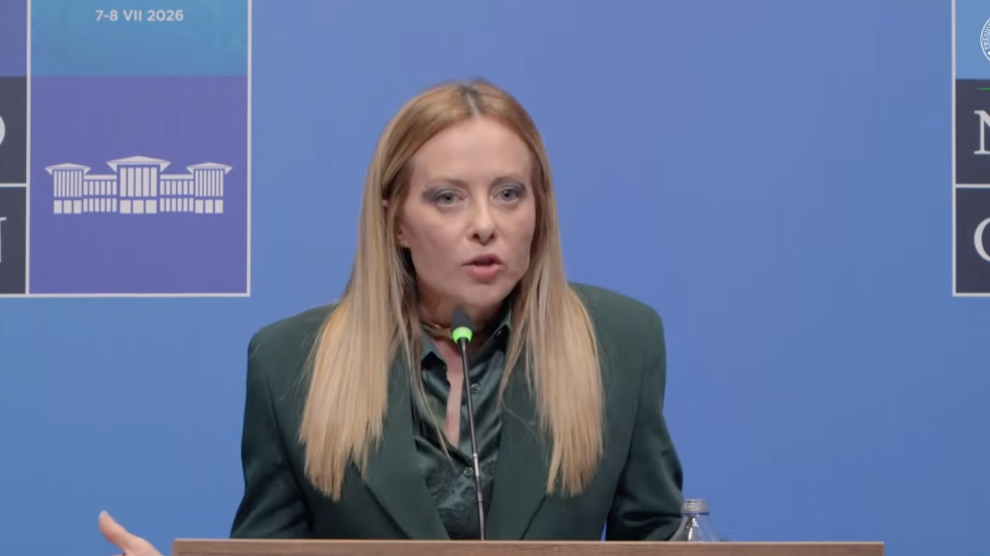
Prime Minister Giorgia Meloni used the NATO summit in Ankara to warn allies that Western security depends on reducing strategic supply-chain vulnerabilities to China and other Asian countries.
The charts: The Italian leader distributed charts to all 32 NATO members detailing Western dependencies across critical minerals, semiconductors, pharmaceuticals and fertilizers, Marco Galluzzo reported in the Corriere della Sera.
Why it matters: Meloni’s message takes an issue increasingly central to Italy’s economic diplomacy — securing critical minerals and strategic supply chains — directly into the transatlantic security debate.
- China dominates global production of six of the 12 critical raw materials considered “defence-critical” by NATO, according to the figures cited by Meloni and reported by Galluzzo.
- Beijing controls more than 70% of global production of gallium, graphite and tungsten, and 88% of global rare earth refining capacity.
- Meloni also highlighted Western vulnerabilities in semiconductors, pharmaceuticals and fertilizers.
The big picture: Meloni’s intervention fits into a broader diplomatic push. She has discussed rare earths with Canada, at the G7, and with the leaders of Japan and South Korea during their recent visits to Rome. Critical minerals have also become a key pillar of Italy’s current transatlantic dialogue with the United States.
- As Decode39 previously reported, Italy has increasingly placed critical minerals at the center of its strategic diplomacy, seeking partnerships and investments aimed at diversifying supplies and strengthening industrial resilience.
- That effort has included Eni’s push into lithium and graphite investments and Italy’s broader diplomatic engagement on critical mineral supply chains.
Between the lines: The message from Rome is that NATO’s security agenda cannot stop at defense spending.
- Meloni’s presentation linked military security to the resilience of the industrial supply chains underpinning defense, technology, healthcare and agriculture.
Bottom line: Italy’s critical minerals diplomacy is moving from bilateral partnerships and investment initiatives to the NATO table — with Meloni pushing allies to view Western supply-chain dependencies as a collective security challenge.