The defense tech sector is becoming increasingly established in Italy as well: an industrial ecosystem whose hallmark is technological integration by design.
This paradigm shift, driven both by startups and young entrepreneurs, aims to capture the transformations underway in the international landscape and turn them into value creation and employment opportunities in the country.
Why it matters: Among these highly innovative companies is Veco Robotics, a family-owned Apulian company specializing in robotics. From military robots to artificial intelligence, through to the crucial role of younger generations, Airpress explored this transformation with Federico Costantini Vergallo, the company’s CEO and president of the Young Entrepreneurs Group of Confindustria Lecce.
Q: Let’s start from the beginning: how was Veco Robotics founded?
A: The company was founded by my grandfather, Francesco Gilberto Vergallo, almost seventy years ago, in 1959. He was a carpenter and, before starting the company, he began selling machinery for carpenters, moving from the user side to the supplier side. From there to robotics, a great deal of progress has been made.
- Over the course of three generations, the company gradually expanded, extending its distribution activities to industrial machinery for metallurgy and steelmaking, until it became, in the early 2000s, an established company in Apulia. With the second generation, my parents Savia and Francesco, the first robotics experiments began, mainly involving automated welding systems.
- That was when my brother Sergio Costantini and I joined the company; we represent the third generation today. After returning from my studies in China, between 2019 and 2020, we decided to significantly accelerate our focus on robotics, which had started as an embryonic project as early as 2017–2018. Defense has always been among our customers and, with the emergence of the first robotic solutions and drones, it was natural to offer our support in this field as well. This is how, in 2020 and within the Vergallo Group, the Veco Robotics division was created.
- Today it is the Group’s best-known and most representative entity in this sector. We are a fully Italian, family-owned company: my brother and I are the two managing directors, while our father, Francesco Costantini, remains part of the company’s governance structure.
Q: What are the distinctive features of your technologies?
A: We develop robotic solutions, but our corporate mission does not end with offering just another platform. We aim to build a unique identity into the very DNA of every solution we propose, allowing it to stand out clearly in the market. It is not enough for us to deliver a technically excellent product: we want it to carry a distinctive element capable of creating value.
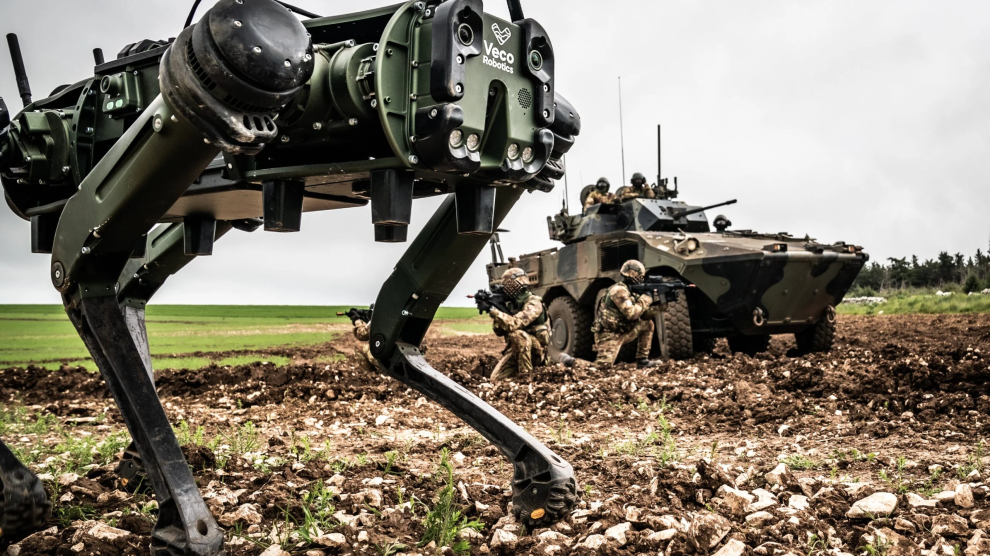
- This is an approach we try to maintain consistently across our entire portfolio, from remotely piloted systems to more complex platforms such as Cesare.
Q: The Cesare quadruped robot is probably your best-known product. What can you tell us about this robot?
A: The first thing that stands out is that it has four legs, unlike tracked or wheeled robots. This is the most media-friendly aspect, the one that attracts attention because it resembles a dog and naturally sparks interest.
- However, from a technical perspective, this is obviously not its main feature. What really matters are the highly advanced artificial intelligence programs onboard, which allow the end user to perform operations that were previously almost unimaginable with other robotic systems. For many years we pursued this approach in a pioneering way, anticipating a direction that has only recently begun to spread more widely.
Q: Speaking of AI, how much has the rise of artificial intelligence influenced the robotics sector?
A: It has been fundamental. When I was living in Shanghai in 2019, it was already common to see robots operating in hotels and restaurants, without customers being surprised by them. If we placed a robot in a restaurant in an Italian city today, people would immediately be distracted, taking photos and videos, because it would still be perceived as something exceptional.
- This shows how, compared with other countries, we are relatively less prepared to embrace a certain technological and cultural transformation. And this does not only apply to people’s reactions, but also to the mindset with which companies approach these technologies from an entrepreneurial perspective.
- Having had the opportunity and privilege to travel extensively broadened my perspective and helped me understand that things are not simply black and white. There are other ways of embracing innovation, and what we consider normal here is not necessarily normal everywhere else.
Q: Last week Cesare took part in a NATO test, which was followed live from the Ankara summit. How did this demonstration come about?
A: We were directly invited by the Italian Army, with which we have been collaborating for some time in the field of robotics. Our first public appearance with Cesare dates back to September 2024, during the Stella Alpina exercise. Since then, the product has undergone many updates, precisely thanks to a close collaboration that I consider fundamental for the entire defense and industrial sector. The closer industry and Armed Forces work together, the better the results.
- It is similar to a football player who cannot perform without the company that manufactures his boots. The more time the player and the footwear manufacturer spend together, the more the boot will be tailored to the player’s needs. The more synergies are created with end users — those who actually operate the product in the field — the more the product can be calibrated according to their real requirements.
- We have not achieved perfection, because perfection does not exist, but it is important to seize these changes quickly. This is why the demonstration you mentioned came almost naturally, within the Armed Forces’ experimentation program, in which we are invited to participate from time to time.
Q: In your opinion, does a genuine Italian “defense tech” ecosystem exist? How would you describe it?
A: There are certainly more and more companies entering this sector and, when an area gains visibility in public debate and the media, it also attracts the interest of investors, funds and resources. At Veco Robotics itself, we have seen this sector grow in importance compared with a share that was previously marginal.
- That said, I believe teamwork is the winning factor in any industrial sector: when companies find common ground and manage to collaborate through synergistic projects and business networks, progress toward the final goal accelerates — delivering the customer a product as quickly as possible and with the highest possible quality.
- The problem is that in Italy this is already difficult to achieve in any sector, and in defense there is an additional level of complexity because many projects are classified and confidentiality is, rightly, a priority.
Q: What does the country system need in order to become more competitive in this field?
A: Above all, we need a centralized framework that truly enables companies to collaborate and create synergies, including in the defense sector. I believe addressing this issue is the right direction for investment.
- The best example in Europe is France, where they have largely managed to set aside personal interests and individualism in order to pursue a common objective, and I believe they are achieving this extremely effectively. In my opinion, this is the kind of national system model that we should be able to replicate in Italy as well.
Q: How pervasive are new technologies in the defense sector, and how quickly are they spreading?
A: They are extremely pervasive because these technologies can be integrated into processes in a simple and intuitive way and, being often disruptive, they significantly reduce the workload for the end operator. Naturally, the right balance is needed between ease of use and proper training, so that operators can make the most of these technologies.
- But when this balance is achieved, the benefits are immediate — and that means we are playing our part effectively. At the same time, however, a different cultural approach is required: one capable of understanding the scale of these transformations and bringing the country into the future.
Q: Can we say, therefore, that young people can lead Italy’s technological revolution?
A: They must. I would even say they almost have an obligation to do so, because otherwise we risk falling behind the rest of the world. I will soon turn thirty, and I strongly believe in the people of my generation, in the young women and men of my age, because we are digital natives and we immediately understand the potential and applications of these technologies.
- The problem is that we are not yet the leadership class, while a significant portion of today’s decision-makers belongs to a generation that is often less willing to make the effort required to truly understand these technologies. That is why I believe young people are the solution.
Q: And are there opportunities for young people?
A: They are beginning to emerge. Let me give you our example: we recently hired a young engineer who had studied engineering in Bari and, unable to find a master’s degree program in robotics in Italy, had to move first to Denmark and then to Barcelona. A few months ago, he was able to return to Italy — and specifically to his home region of Apulia — thanks to our job offer.
- This is just a small example of how these technologies can genuinely create employment opportunities that allow young people to return home and build their future there. These are the people I believe in, and this is why I think they must become more involved, including in politics, to make their voices heard.
Q: Do you think they are capable of doing so?
A: When I look at my peers, I often see widespread resignation: the idea that nothing will ever change, that progress will never happen. When I reread history books, I find the same sentences that were already spoken by previous generations, in the 1960s as well as in the 1980s. I would not want my generation to repeat the same mistake, because the context has changed.
- Today, more and more people have the opportunity to travel, study, go abroad and discover different realities, even remotely through platforms such as YouTube or through books. With all these possibilities available, we cannot afford to repeat the same mistakes we have made in the past as a country. This is a challenge that we must win together, as a nation, and young people must be the protagonists of this transformation.