ROME — NATO’s post-Ankara agenda is shifting more responsibility onto European allies and Canada, with higher defense spending expected to translate into stronger military capabilities and industrial capacity.
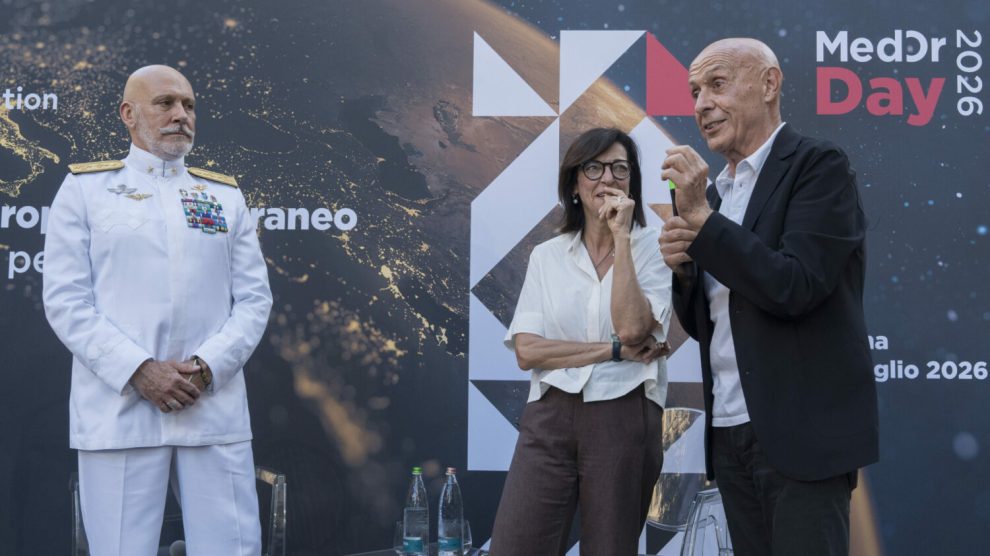
At the Med-Or Day conference in Rome, NATO Military Committee Chair Adm. Giuseppe Cavo Dragone argued that the Mediterranean will be central to that transformation.
Why it matters: European allies and Canada are expected to assume a larger share of NATO’s collective defense responsibilities.
- Defense spending is increasingly linked to military readiness and the expansion of the defense industrial base.
- NATO’s strategic focus is no longer limited to its eastern flank, with the Mediterranean gaining greater prominence.
- Italy positions itself as a bridge-builder through regional relationships and flexible cooperation formats.
The big picture: The sixth edition of Med-Or Day, organized by the Med-Or Italian Foundation chaired by Marco Minniti and directed by Letizia Colucci, used the outcome of the Ankara summit as the backdrop for a broader discussion on NATO’s future.
- The event, titled “Atlantic-Europe-Mediterranean. What Future for NATO?”, featured a conversation between Corriere della Sera deputy editor-in-Chief Fiorenza Sarzanini and Adm. Giuseppe Cavo Dragone, chair of NATO’s Military Committee.
- Their discussion focused on how decisions taken in Ankara could reshape the Alliance’s internal balance, requiring European members to invest more heavily in defense while taking on a larger share of collective security alongside the United States.
Zoom in: NATO 3.0. Cavo Dragone described the emerging phase as “NATO 3.0.”
- “It is a rebalanced Alliance, with a stronger Europe inside a stronger NATO, where European allies and Canada assume greater responsibilities side by side with the United States. It took time, but we are there now, and there is no turning back.”
- According to the admiral, that rebalancing is tied to the commitment to allocate 5% of GDP to defense and security by 2035.
- The objective, he argued, is not simply to increase spending but to convert additional resources into stronger military capabilities and a more resilient defense industrial base.
The take: “The message from Ankara is crystal clear: NATO continues to deliver results, defense investments are growing, military capabilities are being strengthened, the defense industrial base is expanding, and European allies together with Canada are taking on increasing responsibility for our common security.”
Zoom in: Russia, deterrence and Ukraine. Russia remains the Alliance’s primary military challenge.
- Cavo Dragone noted that NATO fighter aircraft have conducted roughly 700 scramble missions over the past two years to intercept Russian aircraft approaching or entering Allied airspace.
- For him, those operations illustrate the practical meaning of deterrence. “Deterrence is not an abstract concept. It is daily work. It is an armed peace. We build strength precisely so that we never have to use it.”
- The admiral also rejected interpretations suggesting Russia no longer represents a threat. “Some fantasists recently had the courage to claim that Russia is not a threat, neither today nor ever. They distorted a statement.”
- On Ukraine, Cavo Dragone argued that military assistance and training should continue even after a possible peace agreement to ensure Kyiv can deter future aggression. “The objective is a Ukraine with a defense architecture capable of preventing a third Russian invasion.”
Zoom out: The Mediterranean moves to the center. The discussion also highlighted the Mediterranean’s growing importance within NATO’s strategic outlook.
- According to Cavo Dragone, the region can no longer be viewed simply as the Alliance’s southern flank. “The Mediterranean is no longer merely NATO’s southern flank. It is a strategic crossroads linking Europe, North Africa, the Levant, the Gulf, the Red Sea and sub-Saharan Africa.”
- Regional crises increasingly affect maritime routes, critical infrastructure and industrial supply chains, reinforcing the need for stronger capabilities and closer coordination.
- The admiral argued that no single country or international organization can manage those challenges alone.
Between the lines: Alongside traditional institutions, Cavo Dragone pointed to the emergence of more flexible forms of cooperation built around specific security needs and involving Gulf partners.
- He described them as “variable-geometry networks” — arrangements in which Italy could capitalize on its regional relationships and the Mattei Plan.
- “In the twenty-first century, security is built through the quality of the relationships we are able to create. Few countries are better positioned than Italy to build that security here in the Mediterranean, also thanks to the Mattei Plan.”
The bottom line: The Med-Or Day discussion presented Ankara as the beginning of a new phase for NATO: one in which European allies are expected to shoulder greater responsibility, increased defense spending must deliver tangible military and industrial capabilities, and the Mediterranean becomes an increasingly important arena for Euro-Atlantic security, offering Italy space to strengthen its regional role.