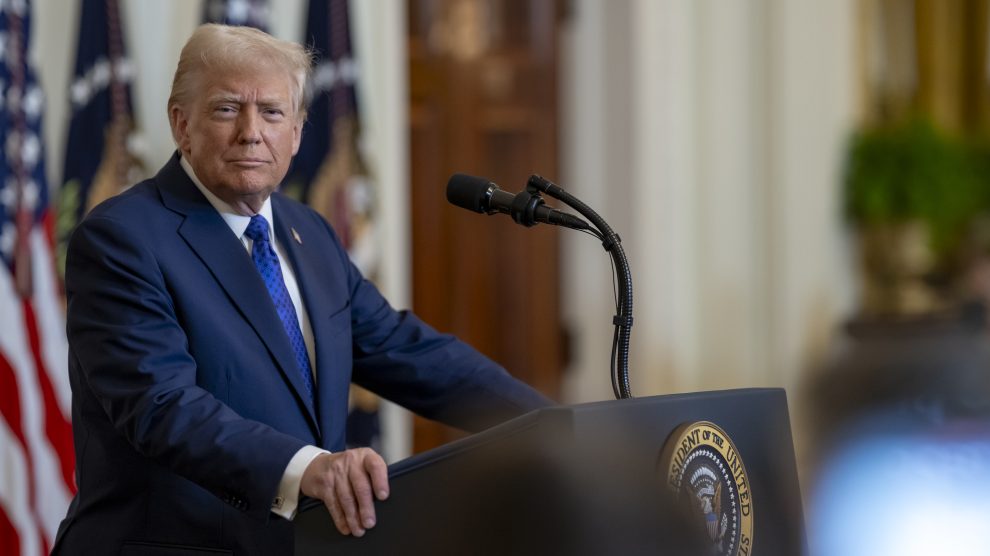
Donald Trump has acknowledged that the war against Iran contributed to Republican losses in the US midterm elections, while insisting that he would make the same decision to launch the conflict again. The admission reflects the political costs of a military campaign that has weighed on his presidency, as Washington continues to search for a sustainable diplomatic solution. Other administration officials, most notably Vice President JD Vance, have also pointed to Iran in their assessments of the electoral defeat.
“Iran was a piece of it,” Trump told the Wall Street Journal in his immediate reaction to the results. Yet the president dismissed any suggestion of regret: “I don’t think about it. I did the right thing. I would have done it again.”
For Brian Katulis, senior fellow at the Middle East Institute in Washington, the president’s remarks expose a deeper problem with American policy towards Tehran: the absence of a coherent strategic direction that has characterised the administration’s approach since the conflict began in February.
- “President Trump has issued confusing statements on the Iran war from the start of the conflict in February, and this is just a continuation of the disturbing pattern of the current president of the United States making public statements that demonstrate his own strategic confusion and lack of a clear plan on Iran,” Katulis tells Decode39.
- “Trump contradicts himself on a nearly daily basis on many different topics – and the Iran war is no different. No one can predict what Trump might do next on Iran – and Trump may not even know himself.”
The domestic cost of the Iran war. The assessment comes as the White House faces the consequences of an election in which the war, its economic repercussions and broader dissatisfaction with a president who had long promised to end America’s “endless wars” in the Middle East have contributed to the domestic political debate.
- “But the message from a strong majority of voters was delivered in this week’s midterm elections: Americans are discontent with how Trump handled the war and the costs it has had on their lives, and they are looking for a peaceful solution, not another round of conflict,” Katulis argues.
- Whether Trump interprets the electoral setback as an incentive to reopen negotiations or responds with another demonstration of military force remains uncertain.
The political implications extend beyond the immediate result. Trump has invested considerable political capital in his confrontation with Iran, but the prolonged crisis has exposed the limitations of an approach heavily dependent on military pressure.
- “If Trump wants to improve his position at home and increase the chances for a stronger legacy, he should look at a wider range of options besides his approach on Iran that has mostly been military strikes without strategy and no clear diplomatic path to secure a lasting agreement,” Katulis says.
What, then, would offer the most credible route towards resolving the Iranian crisis? “The best pathway to resolving the Iran crisis is through coordinated diplomacy with America’s partners in the Middle East, particularly the Gulf.”
- The emphasis on regional diplomacy is significant. Gulf governments have a direct interest in preventing further escalation and preserving regional stability. Their involvement could provide Washington with diplomatic channels and political incentives to pursue an agreement that military pressure alone has so far failed to deliver.
- Whether Trump is prepared to move in that direction remains unclear. The election has nevertheless introduced another consideration into the White House’s calculations, even if the institutional consequences of the Republican setback may prove less significant than some observers expect.
A more assertive Congress, but limited leverage. Ahead of the midterms, Katulis argued in an analysis published by the Middle East Institute that even substantial Democratic gains in Congress might produce only limited changes in US Middle East policy.
- His assessment remains largely unchanged following the vote. “I suspect that things might change in U.S. policy in the Middle East, but not because of anything that the next Congress will do,” he explains.
- “Most changes in U.S. national security come from the executive branch, and Trump has an interest in cleaning up the mess he created with Iran.”
The distinction matters for understanding the next phase of American policy. A more confrontational Congress could intensify scrutiny of the administration’s decisions, challenge its handling of the war and increase the political costs of further escalation. Yet its ability to translate that pressure into effective constraints remains limited.
- Katulis expects lawmakers to take a more active role, but cautions against equating electoral gains with the capacity to impose a fundamental change in presidential policy.
- “The next Congress will be more active in asking tough questions and trying to exercise leverage, but Democrats will need to show more unity on these questions and a lot more Republicans will have to defect from Trump’s agenda in order to have a veto-proof group in Congress that can sufficiently check Trump’s policy approach.”
- Any significant adjustment towards Tehran may therefore depend more on Trump’s own political calculations than on congressional intervention.
The president may have reasons to seek a diplomatic exit, particularly if the conflict continues to erode his domestic standing. But the concentration of decision-making power in the White House leaves considerable uncertainty over the timing and direction of any possible shift.
- For America’s international partners, the prospect of policy changes driven by presidential calculations rather than a stable institutional consensus presents an additional source of uncertainty.
Italy and the Indo-Mediterranean stakes. The consequences of the midterms will also be felt across the Atlantic, where European governments must assess how to manage relations with a politically weakened American administration.
- For Italy, the stakes are particularly significant. Rome’s strategic interests across the Indo-Mediterranean, from North Africa to the Gulf and from the Strait of Hormuz to Bab el-Mandeb, its economic relationships with regional partners and its exposure to international energy markets make developments in US Middle East policy a matter of direct concern.
- Katulis identifies one potentially reassuring consequence of the election: European governments should find more interlocutors on Capitol Hill willing to challenge the White House’s decisions. “European allies like Italy will find more voices in the new Congress who are rejecting Trump’s chaotic approach to the world, and they will find that reassuring,” he says.
Ye but… A Congress more receptive to European concerns does not necessarily translate into a more dependable United States.
- “But the main challenge for the next two years that Europe will face is a Trump administration that is both weaker and less reliable in the world,” Katulis warns.
- The assessment extends well beyond the Iranian crisis. Washington’s handling of relations with Russia and China, alongside its approach towards other actors that have contributed to undermining international stability, will remain a source of uncertainty for European governments.
China, the Gulf and Europe’s strategic uncertainty. The prolonged confrontation with Tehran also raises questions about the wider regional balance.
- China’s diplomatic engagement in the Gulf is becoming an increasingly relevant consideration as regional governments seek to manage their relationships with competing international powers. For Europe, whose interests intersect with those of the United States across the Mediterranean and the Middle East, the prospect of further geopolitical realignments adds another layer of complexity to an already demanding strategic environment.
- Katulis does not offer specific predictions about how Beijing might exploit Washington’s difficulties with Iran. His warning instead concerns the broader unpredictability of American foreign policy and its consequences for allies that have traditionally relied on US leadership.
- “The unexpected moves Trump may try to make with Russia, China, and other countries that have undermined global stability will mean that European countries like Italy will need to rely on themselves and other countries to advance their interests,” he concludes.
What’s next: Two years of uncertainty ahead: The midterm elections may increase political pressure on Trump to find a way out of the Iranian conflict. They are less likely to resolve the uncertainty surrounding American foreign policy.
- For European capitals, including Rome, the immediate challenge will be to maintain dialogue with a Congress more willing to question and challenge the White House, while preparing for another two years of presidential decisions that, as Katulis suggests, may prove difficult to anticipate even for Trump himself.