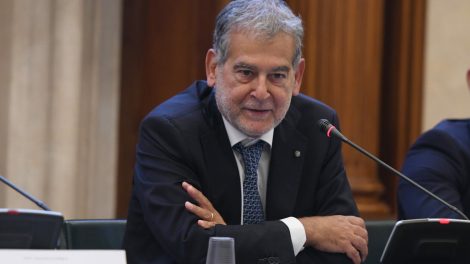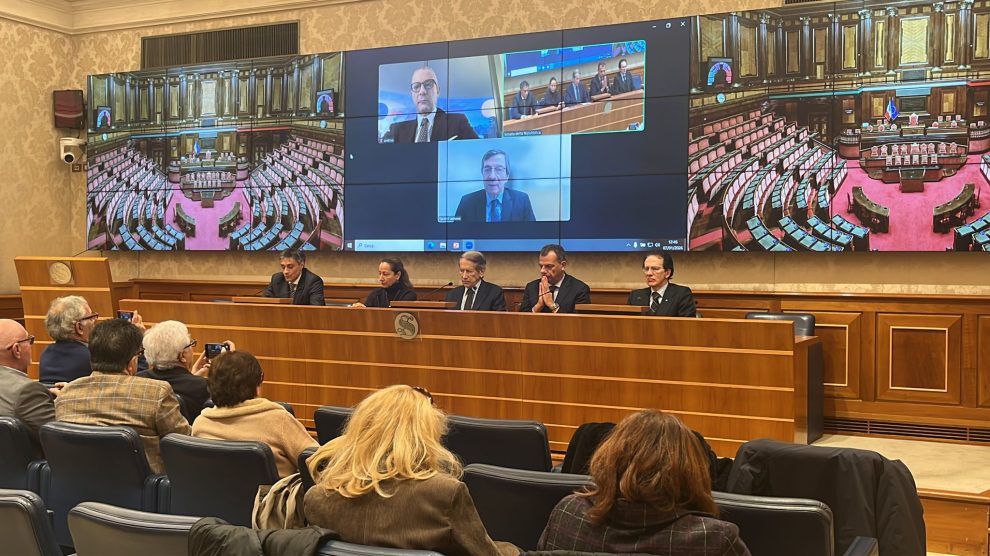
As protests spread across Iran for more than ten consecutive days, the country is facing what may be its most serious systemic crisis since 1979. Speaking on the sidelines of the conference “Supporting Democratic Forces in Iran”, held at Palazzo Madama, Senator Terzi outlined why the current unrest goes far beyond economic hardship — and why the international community can no longer afford ambiguity.
Why he matters: A long-standing advocate for freedom, human rights and the defence of democratic systems, Sen. Terzi has consistently warned against the strategic complacency of the West toward authoritarian regimes. His focus on Iran reflects a broader commitment to exposing transnational repression, defending democratic movements, and safeguarding European and global security from authoritarian interference.
Q: What is happening in Iran today, and why are these protests different from previous ones?
A: For more than ten days, Iranians have been protesting across the entire country. Inflation is above 42%, the rial has collapsed, and the economic system is in free fall. But reducing this to an economic crisis would be misleading. What we are witnessing is a structural collapse of the state itself.
Q: The closure of Tehran’s Grand Bazaar has strong symbolic meaning. Why?
A: Tehran is a city of ten million people, and the Grand Bazaar has closed because there is simply nothing left to sell. This is an extremely powerful signal. In January 1979, the fall of the Shah also began with the closure of the Grand Bazaar.
Q: Is the comparison with 1979 inevitable — and what is different today?
A: The comparison is unavoidable. But in 1979, power was seized by the Ayatollahs. Today, there is a sense that a new hope may be emerging. At the same time, this hope must serve as a warning: we should be wary of those presenting themselves as democratic alternatives while in reality proposing a restoration.
Q: Are we approaching an irreversible breaking point for the regime?
A: History will judge. But it is legitimate to ask whether this is finally that point of no return — the long-awaited moment of freedom for Iran.
Q: How severe is the repression underway?
A: Unprecedented. The repression is brutal and widespread: protests in 130 cities, over a thousand arrests, and more than thirty deaths. The Revolutionary Guards raid student dormitories and private homes, carrying out arbitrary arrests. This is a systemic repression targeting society as a whole.
Q: What does the closure of schools and universities signal?
A: It is the final act of a regime that for years has executed its sons and abused its daughters in the name of religion. Closing schools and universities is an admission that the regime has no future left to offer.
Q: How do you assess President Trump’s warning on defending peaceful protesters?
A: When President Trump stated that if Tehran fires on peaceful demonstrators the United States would come to their aid, those were extremely strong words. They gain even more weight when read alongside recent developments in Venezuela and the arrest of Nicolás Maduro and his wife.
Q: How is Venezuela connected to the Iranian regime?
A: For decades, Venezuela has provided safe haven to the Revolutionary Guards and Iranian proxies such as Hezbollah. It has served as a hub for terrorist networks, drug trafficking, arms smuggling, money laundering, and even militant training.
Q: How deep are the economic and strategic ties between Tehran and Caracas?
A: Iran has invested between $7 and $10 billion in Venezuela and purchased large tracts of land. Until a few days ago, Caracas represented a direct threat to global security — one that has now been significantly weakened.
Q: How would you define the Iranian regime today, in light of these protests?
A: It is a fundamentalist, messianic and criminal regime, with blood on its hands both domestically and abroad. The leadership appears increasingly isolated and fragile. Ayatollah Khamenei has reportedly been moved to a secure location, with speculation of a possible escape to Russia if the situation collapses. Meanwhile, promises of subsidies and rescue plans convince no one.
- The key point is that Iranians are not protesting for bread alone. They are protesting for identity and freedom. As Maryam Rajavi has stressed, the root of the problem lies in the velayat-e faqih system — the authoritarian doctrine imposed by Khomeini. Men and women, young people across all social classes, are now in the streets. When a people rises again, history resumes its course.
Q: What responsibilities does the international community bear?
A: First, we must express firm solidarity with the Iranian people. But solidarity is not enough. Those responsible for decades of repression and massacres must be brought to justice.
- The Islamic Revolutionary Guard Corps should be designated as a terrorist organisation, and embassies complicit in terrorist activities must be closed.
Q: How does this affect Italy specifically?
A: Italy is not immune. Rome is a key hub for recruitment, surveillance, propaganda and sensitive trafficking conducted by Iranian intelligence, often under diplomatic, cultural or academic cover.
- We must remember the 1993 assassination in Rome of Mohammad Hossein Naqdi, representative of the Iranian resistance. Countering these networks means standing concretely alongside the Iranian people.
Q: Looking ahead, what future do you envision for Iran?
A: We hope the time has come for a turning point — for an Iran that contributes to peace and regional security rather than threatening global stability. In this context, Maryam Rajavi’s Ten-Point Plan offers a credible roadmap towards a genuinely democratic alternative.
The bottom line: Iran’s protests mark a systemic challenge to the regime, not a temporary crisis. As repression deepens and the leadership weakens, international inaction is no longer sustainable. For Terzi, supporting the Iranian people now requires clear political choices and concrete pressure on the regime.