Italy is seeking to anchor its role through key partnerships across an increasingly interconnected geopolitical space, in which national and economic security overlap.
Key Takeaways:
-
Italy’s Indo-Pacific is an Indo-Mediterranean strategy, not a regional pivot. Rome is not “turning to Asia” but extending its Global Mediterranean logic eastward, treating the Indo-Pacific as a strategic continuation of the Mediterranean system where maritime security, trade routes, energy flows and industrial supply chains converge.
-
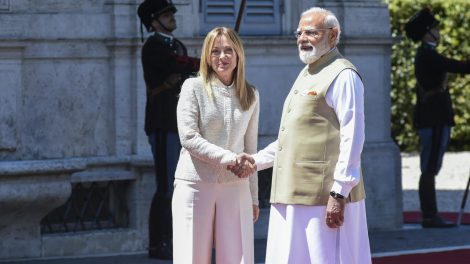
Japan is Italy’s anchor partner beyond Europe. The density of political engagement with Tokyo under Giorgia Meloni, the upgrade to a Special Strategic Partnership, and cooperation on GCAP signal that Italy sees Japan as the primary non-European node for defense interoperability, industrial co-production and technological autonomy.
-
Security engagement is selective but operationally credible. Italy compensates for limited force-projection capacity with high-value naval diplomacy and interoperability, exemplified by the Cavour carrier deployment with Japan’s maritime forces—embedding Italy into Indo-Pacific security architectures without permanent military overstretch.
-
Economic security drives the partnership as much as geopolitics. Cooperation with Japan and South Korea targets systemic vulnerabilities—critical minerals, semiconductors, AI and space—placing Italy within trusted supply-chain ecosystems linked to the U.S.-backed Pax Silica logic and reinforcing EU-Japan frameworks on co-development and resilience.
-
Italy acts as a connector across regions, not a balancer against China. Rome avoids overt confrontation with Beijing while deepening alignment with advanced democracies; through the Mattei Plan, the Lobito Corridor and EU coordination, Italy positions itself as a geo-economic bridge linking Indo-Pacific, Europe and Africa rather than as a frontline Indo-Pacific power.
The bottom line: “Selectivity, however, does not mean disengagement. Through naval diplomacy, defense and industrial cooperation, and targeted partnerships with Japan and South Korea, Italy is embedding itself in the Indo-Pacific’s evolving security and economic architecture in line with its capabilities and focusing where it can add value – prioritizing interoperability, industrial cooperation and political coordination across,” Emanuele and Valbona wrote.