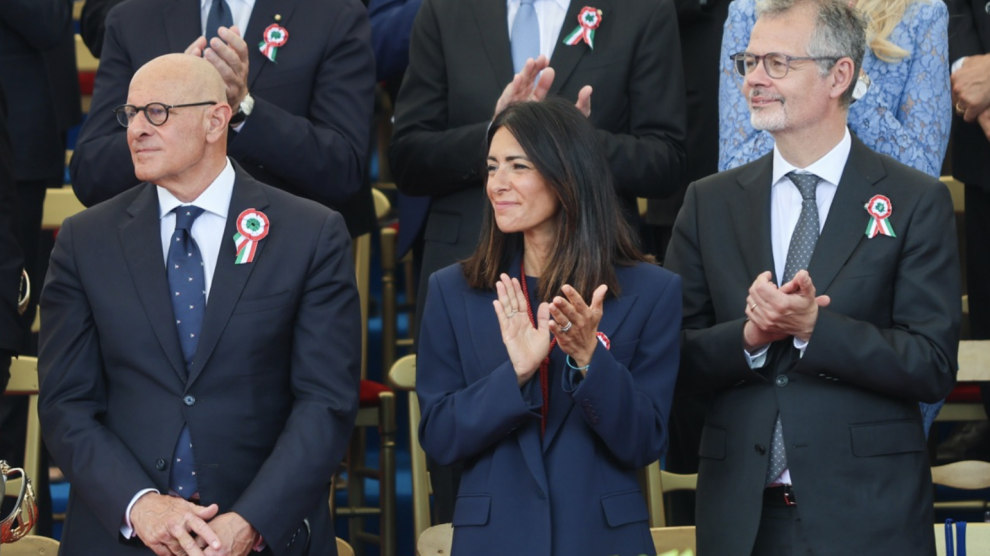
Pina Picierno, a vice president of the European Parliament and one of Italy’s most prominent pro-European voices, has left the Democratic Party (PD), arguing that the country’s main center-left force has lost its reformist identity.
According to sources close to Picierno cited by ANSA, she is expected to join the European Democratic Party (EDP), led by former Italian undersecretary Sandro Gozi and affiliated with the Renew Europe group in the European Parliament.
Why it matters:
- Picierno is one of the highest-ranking Italian politicians in EU institutions.
- Her departure exposes tensions between the PD’s reformist wing and its current leadership.
- The dispute touches on some of the most sensitive issues in European politics, including Ukraine, defense spending and relations with populist movements.
- It reopens a broader conversation about the future of Italy’s fragmented reformist electorate.
Zoom in: The break: In an interview with Il Foglio, Picierno said “the home of reformists no longer exists” inside the Democratic Party.
- “You cannot be ambiguous toward Putinist fascism and extremisms,” she said, calling for the construction of “something new” capable of winning elections. Picierno described her decision as both political and personal.
- “For respect for my political and personal dignity, the time has come to leave Elly Schlein’s Democratic Party,” she said, arguing that the party “has become something different from the one we founded.”
- She also accused the PD of having undergone a gradual “distortion” without a genuine internal debate or congress. “The PD we wanted at the Lingotto no longer exists,” she said, referring to the party’s founding moment under Walter Veltroni in 2007.
- At the same time, Picierno insisted she was not abandoning the values that originally inspired the project: “I remain a democrat. I am not going backwards.”
Between the lines: Picierno’s departure reflects a deeper argument over what reformism means in today’s European center-left.
- Her political profile has long been associated with strong support for European integration, transatlantic cooperation and Ukraine. In her explanation for leaving, foreign policy appeared alongside organizational and ideological concerns.
- The timing is notable. Just one day before Picierno’s announcement, the Democratic Party backed a parliamentary motion calling for a reconsideration of NATO spending commitments and arguing that further increases in defense budgets could prove fiscally unsustainable for Italy.
- Picierno did not link her departure to that vote. But defense, Ukraine and Europe’s security posture have increasingly become among the clearest points of debate between different currents of Italy’s center-left.
- For the party leadership, the issue is framed primarily through budget priorities and social spending. For many reformists, security policy has become part of a wider discussion about Europe’s responsibilities in an era of war on the continent.
Inside the PD. The departure triggered concern among some leading figures within the party.
- Former Defense Minister Lorenzo Guerini said he was “very sorry” to see Picierno leave and called for her decision to be treated “with attention and respect.” “The value of pluralism within the PD is one of its foundations,” Guerini said. “If it is weakened, the whole party suffers.”
- Marianna Madia, another prominent reformist voice, argued that the broader reformist area should seek unity rather than fragmentation. “Voters do not understand fragmentation,” she said, calling for “a single reformist political project” anchored within the center-left.
- Their reactions suggest that Picierno’s departure is being viewed not only as an individual decision but also as part of a larger debate over the coalition’s future direction.
The big picture: Picierno’s exit comes as the concept of riformismo — reformism — has returned to the center of Italy’s political debate.
- In a commentary published Thursday in Il Messaggero, former Prime Minister Romano Prodi argued that reformism remains the most effective response to populist politics, a theme that echoes many of the arguments now emerging within the center-left.
- Picierno herself framed her departure as the beginning of a broader political effort rather than an isolated move.
- She called for the creation of a new, broad political force capable of bringing together voters who have drifted away from the Democratic Party, whether toward the right, the left or political disengagement. “There is a need to restore dignity and a shared perspective to millions of voters,” she said.
The bottom line: Picierno’s departure matters less for its immediate impact on parliamentary numbers than for what it reveals about the unresolved debate inside Italy’s center-left. The question is no longer simply who leads the Democratic Party, but what kind of reformism can compete in an era shaped by war, security concerns and populist pressure across Europe.