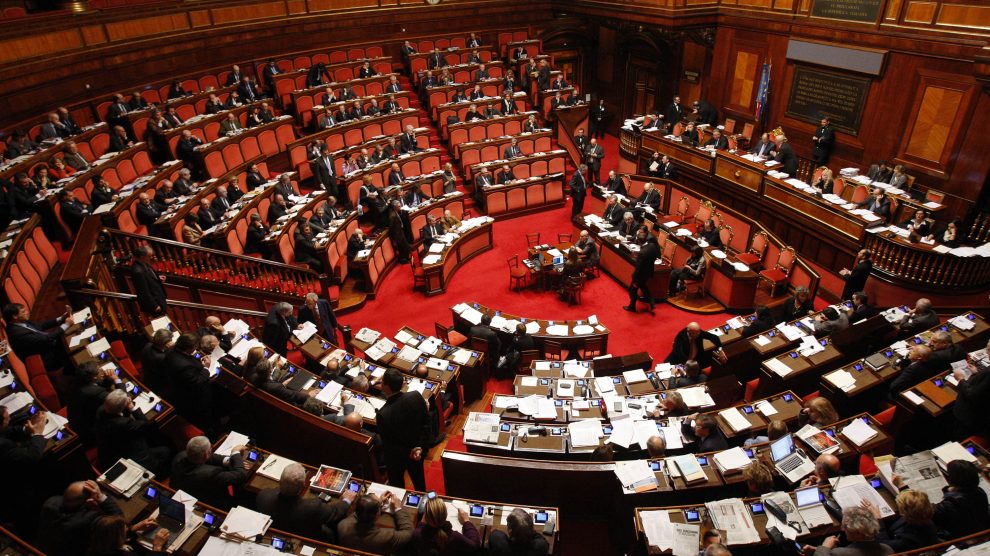
Italy’s Chamber of Deputies has approved the continuation of the country’s international missions, reaffirming the governing coalition’s united backing for Rome’s current foreign and security policy. While the outcome was never in doubt, the parliamentary debate highlighted increasingly distinct visions among opposition parties on Ukraine, NATO and Italy’s role across the Mediterranean and Africa.
Lawmakers voted on the annual package authorizing the continuation of existing military and civilian missions alongside three new operations:
- Two military deployments in Iraq and the Horn of Africa
- A Guardia di Finanza advisory mission supporting Tunisia’s Maritime National Guard.
The governing coalition submitted a joint resolution endorsing the entire package, including military assistance to Ukraine, NATO deployments on the Alliance’s eastern flank, cooperation with Libyan authorities on maritime border management, and the new mission in Tunisia.
- Although the four governing parties framed their support differently — Fratelli d’Italia emphasizing national interest and allied credibility, Forza Italia stressing Italy’s Euro-Atlantic identity, and the Lega focusing on Mediterranean security and migration control — they ultimately presented a unified front.
Why it matters: The vote confirms that Italy’s international military posture continues to enjoy a stable parliamentary majority despite growing political debate over specific theaters of operation.
- Beyond renewing overseas deployments, the resolutions offer a snapshot of competing strategic priorities: support for Ukraine, deterrence within NATO, migration management in the Mediterranean, and security cooperation with North African partners.
Strategic convergence. The most significant convergence extends beyond the governing coalition.
- The Democratic Party, the centrists Italia Viva and lib-dem Azione all broadly support Italy’s Euro-Atlantic orientation, even while disagreeing with the government on specific activities.
- The Democratic Party and Italia Viva opposed bilateral cooperation with Libya and Tunisia and raised concerns over the Niger mission and parliamentary oversight. Azione, meanwhile, backed the full package, including Libya and Tunisia, while acknowledging the political and operational challenges surrounding those missions.
- Together, these parties continue to view Italy’s alliance commitments and support for Ukraine as the foundation of the country’s foreign policy, despite differences over how individual missions should be implemented.
Political fault lines. The sharpest divide concerns Ukraine and NATO.
- The Five Star Movement rejected Italy’s participation in NATO’s training and assistance mission for Kyiv, opposed several operations in Libya and the new Tunisia deployment, and called for the EU’s Aspides naval mission to remain strictly defensive (even under the renewed Houthis’ attacks against maritime security in the Indo-Mediterranean).
- The hard-left alliance Alleanza Verdi e Sinistra adopted an even more restrictive position, opposing most missions in North and West Africa alongside cooperation with Libya and Tunisia, while arguing that diplomacy, humanitarian assistance and development cooperation should take precedence over military engagement.
- The far-right Futuro Nazionale went further still, advocating an end to arms deliveries to Ukraine and urging Italy to shift its strategic focus from NATO’s eastern flank toward the Mediterranean.
The bigger picture. The parliamentary debate suggests that Italy’s foreign policy consensus remains strongest within the governing coalition, but also that the country’s opposition is evolving into two increasingly distinct strategic camps.
- Most notably, the vote underscored the widening gap between the two principal minority parties, the Dems and the Five Star Movement on Italy’s international posture.
- While the Democrats continue to place themselves within the country’s established Euro-Atlantic consensus — even when criticizing aspects of the government’s approach — the Five Star Movement has increasingly positioned itself against NATO’s role in supporting Ukraine and against several of Italy’s military commitments abroad.
- Rather than simply reflecting tactical disagreements over individual deployments, the debate points to competing visions of Italy’s role in European security.
- One camp seeks to refine Rome’s existing Atlantic-oriented strategy; the other increasingly questions the balance between military engagement, alliance commitments and diplomatic alternatives.
What it signals: The vote leaves Italy’s overseas commitments intact while revealing a gradual political realignment beneath the surface.
- The governing coalition remains firmly committed to its current Euro-Atlantic course, while the political minority is becoming more clearly divided between parties that broadly share Italy’s traditional Atlantic outlook and those advocating a more fundamental reassessment of the country’s military, security and alliance commitments.
- As debates over Ukraine, NATO and Mediterranean security continue, that divide is likely to become one of the defining fault lines of Italy’s foreign policy debate.