Republican Sen. Jim Banks is urging Defense Secretary Pete Hegseth to add Weichai Holding Group to the Pentagon’s Section 1260H list of Chinese military companies, citing its state ownership, defense industry relationships and links to China’s military-civil fusion strategy.
Decoding the news: Banks’ case includes a particularly sensitive connection: Weichai engines are used by China North Industries Corporation, or Norinco, in a multiple-launch rocket system supplied to the People’s Liberation Army.
- The senator also points to Weichai’s ownership by Shandong Heavy Industry Group, a state-owned enterprise controlled by the Shandong provincial government, as well as the presence of an internal Chinese Communist Party committee.
- His letter cites relationships with foreign and Chinese defense-linked companies, including Belarus’ MAZ, Russia’s Kamaz and Hubei Sanjiang Space Wanshan Special Vehicle, a subsidiary of the blacklisted China Aerospace Science and Industry Corporation.
Why it matters for Italy: Washington is debating whether Weichai belongs inside China’s military-industrial perimeter just as the same company is consolidating control over an Italian manufacturer with naval capabilities and potentially dual-use technologies.
- Weichai has owned a stake in Ferretti Group since 2012 and currently holds 39.5% of its capital. But its influence now goes considerably further.
- Following a closely fought shareholder vote in May, which Weichai reportedly won with 52% of the votes, directors backed by the Chinese shareholder secured eight of Ferretti’s nine board seats.
- The result leaves Weichai with effective control over one of Italy’s best-known luxury yacht manufacturers without owning a majority of its shares. A further expansion of its stake — potentially leading eventually to full ownership — would raise the stakes again.
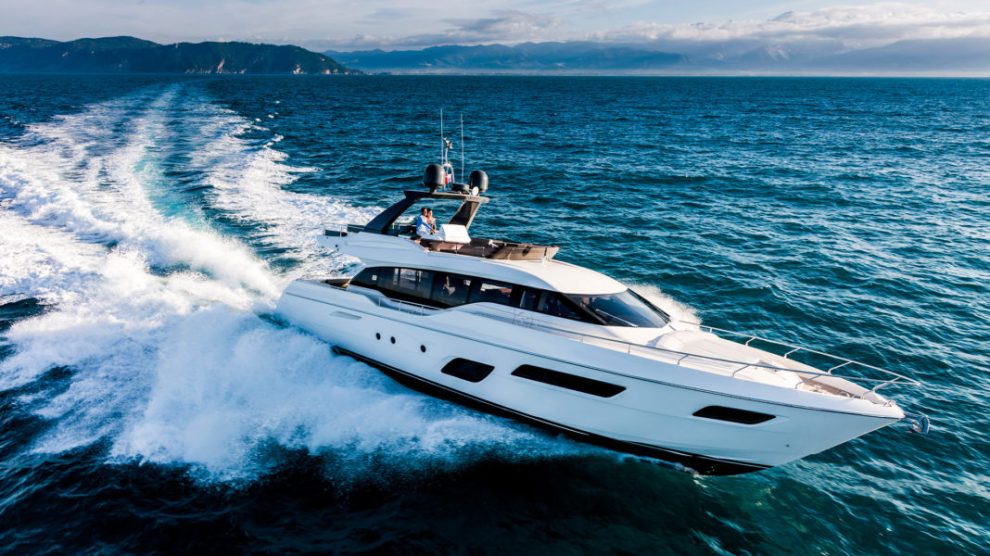
The bigger concern: Ferretti is more than a luxury brand. Its industrial capabilities include high-performance hulls, sensors and navigation systems. The company also builds patrol vessels, giving some of its technology and manufacturing know-how potential applications beyond the civilian yacht market.
- Chinese media have previously reported transfers of advanced Ferretti technology to a nautical industrial hub developed by Weichai in Qingdao, a city that is also home to China’s Northern Fleet.
- That does not establish a transfer of Ferretti technology to the People’s Liberation Army Navy. But greater Chinese control over the Italian company raises the potential risk that naval know-how with dual-use applications could move in that direction.
There is another layer: data. Digital systems installed on sophisticated yachts can collect information on location, routes and vessel use. Ferretti’s customer base includes some of the West’s wealthiest and most influential individuals.
- The possibility that such information could become accessible through a company ultimately controlled by a Chinese state-owned group adds a different security dimension to the industrial question.
Between the lines: The Weichai debate is emerging as Washington is putting renewed strategic weight on shipbuilding capacity.
- The Trump administration is looking for ways to rebuild ground lost in naval shipbuilding and strengthen the industrial capabilities supporting American maritime power.
- That does not establish a direct connection between U.S. shipbuilding policy and Ferretti. But it matters to the backdrop against which the Weichai case is developing: Washington is treating maritime industrial capacity as an increasingly strategic asset while scrutinizing the links between Chinese civilian industry and Beijing’s defense base.
- For Rome, that makes the identity of the company gaining control over Ferretti harder to treat as a conventional corporate governance issue.
What we’re watching: KKCG Maritime, Ferretti’s second-largest shareholder, has challenged the May vote before a Bologna court, arguing that Weichai failed to make all the disclosures required under Italy’s “golden power” rules.
- Those rules give the Italian government powers to impose conditions or intervene in foreign transactions involving assets considered relevant to national security.
- The dispute therefore reaches beyond who controls Ferretti’s board. It poses a more consequential question for the Italian government: whether a company associated primarily with luxury yachts should also be protected as an industrial and technological asset because of the naval capabilities, know-how and data it holds.
The timing makes that question harder to avoid. A Section 1260H designation would not automatically sanction Weichai or prohibit American companies from doing business with it. It would, however, bar the Pentagon from awarding contracts to the company and could increase the prospect of separate action by the U.S. Treasury, with potential consequences for American investment in publicly traded Weichai Power.
The bottom line: Rome does not need to endorse Banks’ assessment of Weichai to take his move seriously. The relevant warning for Italy is that Washington’s treatment of the Chinese group could become substantially tougher while Weichai already controls almost the entire Ferretti board and could seek to expand its ownership further.
- The risks surrounding a future transfer of sensitive naval know-how or access to private yacht data remain potential rather than established. But that is precisely where Italy’s “Golden Power” becomes relevant: as an instrument available to protect national security interests before corporate changes become difficult to reverse.
- The question for Rome is whether to use the room it still has before decisions taken in Washington narrow it.