
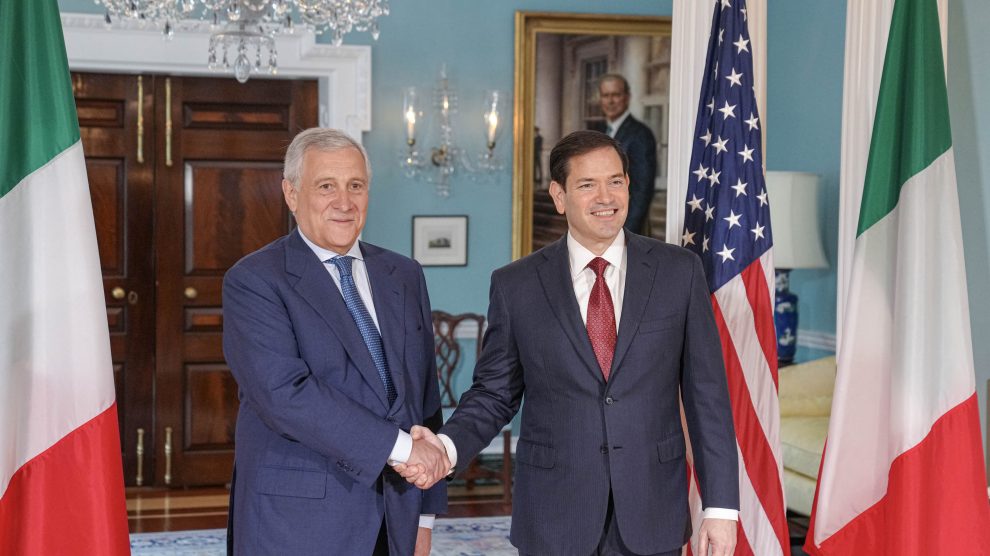
Why it matters. The call underscores the tight alignment between Rome and Washington as both navigate simultaneous crises across Europe, the Middle East and Latin America.
- It comes as NATO weighs a more assertive approach toward Russian hybrid activities — a potential policy shift with broad implications for European security.
The content of the call. About Ukraine, Italy reaffirmed support for the U.S.-led mediation effort aimed at building a credible pathway to peace.
- Gaza: Tajani and Rubio reiterated their backing for efforts to reinforce the truce and accelerate reconstruction through the “Trump Plan,” which both view as essential to stabilizing the Strip.
- Venezuela: Italy is closely following the detention of Alberto Trentini and other Italian nationals. Rubio pledged personal and institutional engagement to secure the release of political prisoners.
- Notably absent: any reference to the rising tensions between Washington and Caracas in recent months.
NATO’s hybrid-threat debate. The call took place as Tajani was in Brussels for a meeting of NATO foreign ministers, where allies discussed the uptick in suspected Russian hybrid operations across Europe.
- Examples of such operations includes (but are not limited to) drone incursions into Polish and Romanian airspace, disruptions at Western European airports and military sites, sabotage of a key rail line between Warsaw and Kyiv.
- During the ministerial, NATO members also reviewed Operation Eastern Sentry, the plan activated after Poland reported Russian drones entering its airspace in September. The initiative aims to bolster defenses and reinforce deterrence along the alliance’s eastern flank.
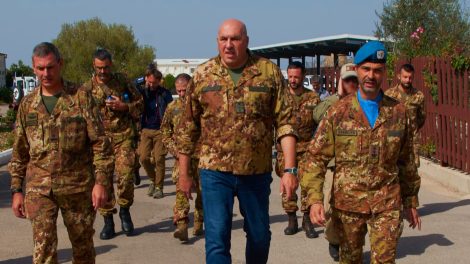
- Days earlier Adm. Giuseppe Cavo Dragone, chair of NATO’s Military Committee, told the FT the alliance is considering moving from a reactive to a “more aggressive or proactive” stance — including potential pre-emptive measures in cyber and other hybrid domains.
- Moscow blasted the comments as “extremely irresponsible,” accusing NATO of courting escalation.
- Tajani intervened in the matter, expressing his solidarity with Cavo Dragone and stating that the admiral’s words had been “instrumentalized.
The Big Picture. Tajani’s call with Rubio is more than routine coordination — it signals that Italy is positioning itself as a reliable transatlantic stabilizer at a moment when crises are converging across three strategic theaters.
- As NATO debates shifting to a more proactive posture against Russian hybrid threats, Rome is aligning closely with Washington’s strategic compass, balancing diplomatic engagement (Ukraine, Gaza, Venezuela) with a willingness to back tougher deterrence measures in Europe.