Decoding the news:
- Tokyo calling: Meloni’s visit comes as Japan increasingly views Italy as a de facto ally for industrial and defence cooperation — from the GCAP fighter program to supply-chain coordination.
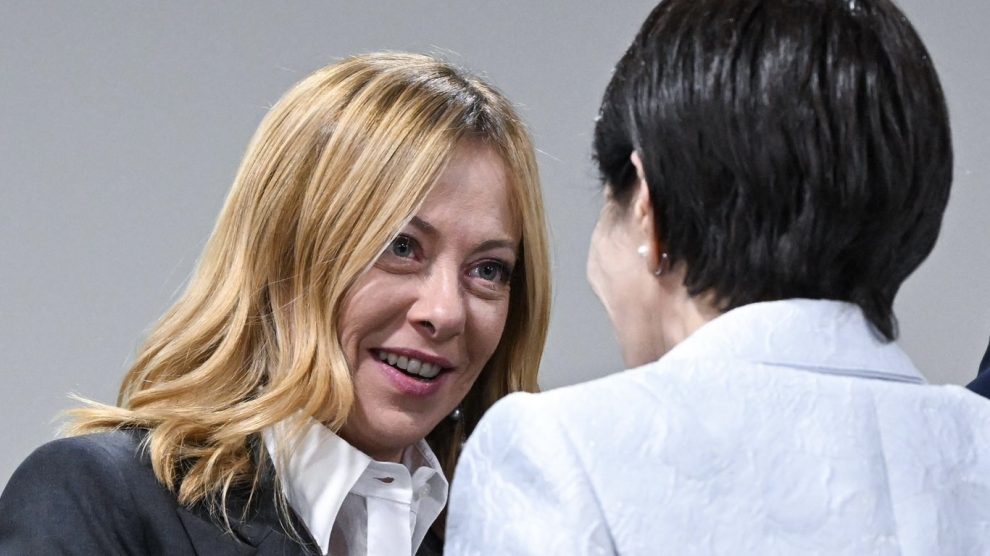
- Her personal relations with Prime Minister Takaichi Sanae — the only two women leaders in the G7 — are building and add another dimension.
- Mumbai momentum: Tajani will lead a business delegation to Mumbai focused on auto components, sport-tech, agrifood, renewables, and pharmaceuticals.
- The mission reinforces ties with Prime Minister Narendra Modi on defence, AI, space, and supply-chain security.
- The South Korea stop: Including Seoul would complete an Asian triangle that mirrors Italy’s emerging footprint in the Indo-Pacific.
The big picture: The Indo-Pacific concept advanced by the late Japanese Prime Minister Abe Shinzo — free, open, rule-based, and grounded in strategic cooperation among maritime democracies — has become the framework guiding Italy’s posture in the region. Japan, India, and South Korea form three interconnected pillars:
- Technology and defence with Tokyo.
- Geoeconomics and industry with New Delhi.
- Maritime security and supply-chain resilience with Seoul.
Italy is steadily building a consistent presence across this strategic arc.
Between the lines: The new U.S. National Security Strategy frames the Indo-Pacific as “the primary geopolitical and economic battleground of the 21st century.” Three elements define Washington’s approach:
- A free and open order: protecting sea lanes and strengthening supply-chain security.
- Enhanced deterrence: more robust military investment and a vigilant strategic posture.
- Strategic competition with China: economic rebalancing, dependency reduction, and countering predatory practices — all in response to Beijing’s expanding assertiveness, underscored in these days by the deployment of hundreds of naval vessels across disputed areas of the Yellow Sea, East China Sea, Western Pacific, and South China Sea.
The focus: Within this framework, the U.S. expects allies to increase their practical and political presence in the region — from freedom-of-navigation activities to the construction of durable partnerships and geoeconomic alliances.
State of play for Italy: Italy’s Indo-Pacific sequence takes on added significance as the United States reshapes the regional architecture:
- Rome is responding to U.S. pressure, contributing politically, industrially, and diplomatically in key areas.
- It is strengthening its direct footprint by leveraging competitive national assets: shipbuilding, aerospace, energy, green technologies, and defence.
- It is reducing vulnerabilities in its supply chains, aligning more closely with G7 partners and Asian democracies.
- It is expanding its leverage within the EU, as Brussels intensifies discussions on de-risking and cooperation with Washington.
What we’re watching: The growing Meloni–Takaichi alignment, the consolidated relationship with Modi, and the developing dialogue with South Korean President Lee Jae-myung (following their first in-person meeting in June) indicate that Italy is not merely conducting diplomatic visits — it is shaping a coherent Indo-Pacific policy.
(Photo: X, @giorgia_meloni)