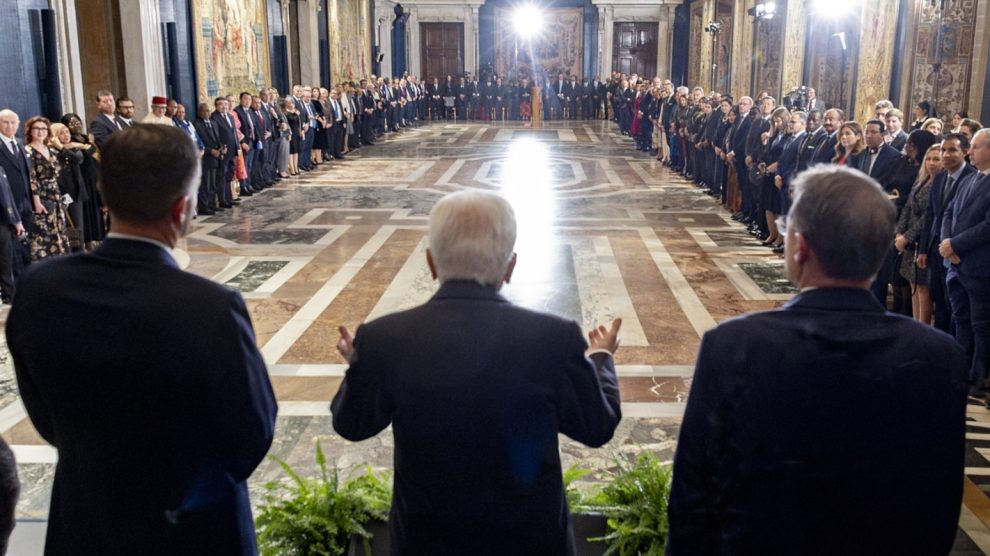
Addressing ambassadors at the Quirinale, Italian President Sergio Mattarella explicitly highlighted the dangers posed by disinformation, manipulation and hostile influence operations, framing them as part of wider “hybrid conflicts” that blur the line between internal and external fronts in the democratic countries.
Mattarella warned that manipulative information flows are fuelling instability, exploiting democratic openness and empowering opaque centres of power beyond effective state control — with direct consequences for political choices and social cohesion.
What’s behind it: The speech comes just a month after the Supreme Defence Council convened with a clear priority on its agenda: the escalation of hybrid threats targeting Italy and Europe.
- According to assessments discussed at the Quirinale, Italy is facing a sharp rise in cyber incidents and hostile activities aimed at critical infrastructure, public institutions and democratic processes. Russia is identified as the primary hostile actor, alongside Iran, China and North Korea (the so-called “CRINK”).
- A key concern is the accelerating role of artificial intelligence in the “cognitive domain,” making disinformation faster, more credible and harder to detect.
The big picture: Italian authorities increasingly view hybrid threats as a systemic challenge spanning multiple domains — cyber, cognitive, space and underwater — with particular vulnerabilities linked to subsea cables, energy infrastructure and digital networks.
- The government and military sector remains the most targeted, reinforcing concerns about attempts to undermine trust, polarise society and weaken democratic institutions from within.
Between the lines: The last Mattarella’s intervention signals continuity rather than alarmism. By echoing the Defence Council’s assessments, the President is reinforcing the idea that Italy is moving from awareness to consolidation — treating hybrid threats as a permanent feature of strategic competition, not episodic crises.
The expert’s take: As noted by ECFR Rome deputy director Teresa Coratella, Mattarella framed hybrid threats as conflicts in which “manipulative information flows, within hybrid conflicts conducted through multiple hostile instruments, link the internal front with the external one” — a definition that mirrors the Supreme Defence Council’s latest assessments.
The bottom line: From the President to the Supreme Defence Council, Italy’s message is consistent: hybrid threats are intensifying, and responding to them is now a core task of national security, diplomacy and democratic resilience.
(Photo: Quirinale.it)