Decoding the news: Italy and Germany are reinforcing their economic and industrial partnership at a time of strategic uncertainty in Europe, using business, infrastructure and defence cooperation to strengthen competitiveness — and subtly rebalance EU power dynamics.
The big picture: Italy will host a high-level Italy–Germany Business Forum on Friday in Rome, alongside an intergovernmental summit, bringing together political leaders, companies and investors from both countries.
- The forum will close with remarks by Italian Prime Minister Giorgia Meloni and German Chancellor Friedrich Merz, underscoring the political weight attached to the bilateral relationship.
Why the business forum matters: Germany is Italy’s largest trading partner and a cornerstone of its industrial ecosystem.
- According to Eurostat data, bilateral trade reached roughly €156 billion in 2024, with Italian exports to Germany at €71 billion and imports at €85 billion. Italy is Germany’s sixth-largest global supplier, reflecting deep and resilient interdependence.
- Italian companies are tightly embedded in German value chains — especially in automotive, advanced manufacturing, chemicals and pharmaceuticals — making the partnership essential not only for national competitiveness, but for the stability of the eurozone’s industrial base.
Tomorrow in Rome: Organised by Italy’s Foreign Ministry and Agenzia ICE, in cooperation with the Italian Embassy in Berlin and German counterparts, the forum will focus on three strategic pillars:
- Advanced industry (automotive, steel, pharmaceuticals);
- Infrastructure, connectivity and energy (transport, logistics, energy networks);
- Defense, security and aerospace;
- A dedicated plenary session will also assess the financial dimension of the partnership, including investment flows, industrial integration and future growth prospects.
Between the lines: Beyond business, the forum reflects a growing political alignment between Rome and Berlin.
- Without presenting itself as an alternative axis, closer Italy–Germany coordination is quietly helping rebalance European dynamics at a moment when the traditional Franco-German engine appears less predictable.
- The convergence is pragmatic, grounded in shared industrial, security and competitiveness interests rather than ideological positioning.
What we’re watching: The forum will be followed by B2B meetings and informal networking, translating political momentum into concrete commercial opportunities.
- For Rome, the message is clear: anchoring Italy’s growth strategy to Europe’s strongest industrial economy remains central — even as Berlin and Rome adapt their partnership to a more fragmented, competitive and security-driven European landscape.
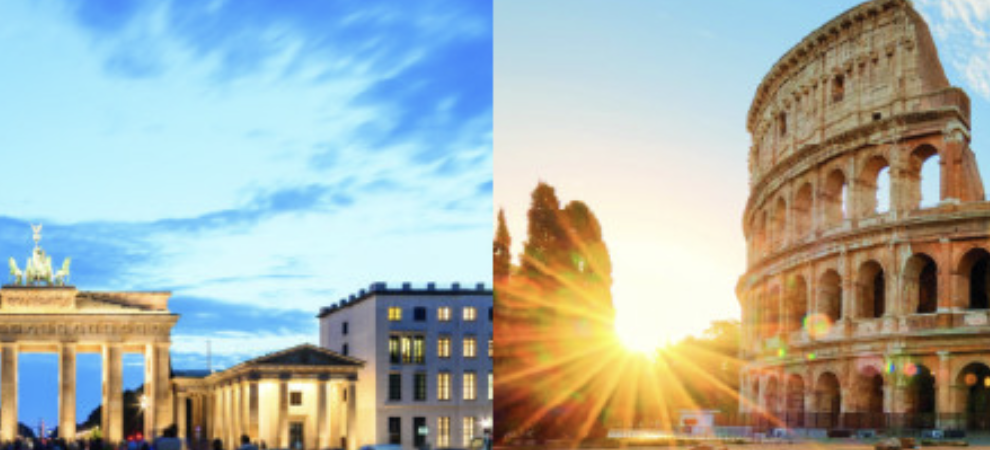
(Photo: ICE)