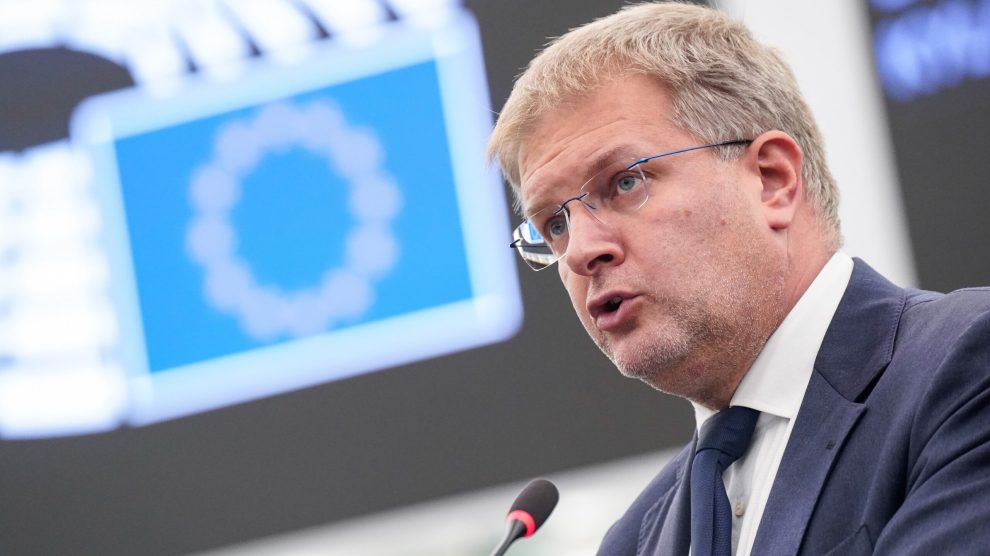
As tensions rise between European leaders and Washington over Greenland and Arctic security, the risk of political escalation among allies is growing. According to Carlo Fidanza, Head of the Fratelli d’Italia delegation at the European Parliament, the core issue risks being overshadowed by personal clashes and rhetorical overreactions. In this conversation, Fidanza argues for a return to politics, NATO coordination, and pragmatic engagement with the United States to address security, critical raw materials, and strategic competition in the Arctic.
Why he matters: Carlo Fidanza is the Head of Delegation of Fratelli d’Italia at the European Parliament. As a senior figure within the European Conservatives and Reformists (ECR) group, he plays a central role in shaping Italy’s and the Italian government’s positions on transatlantic relations, NATO, and European security.
Q: The Greenland issue is increasingly turning into a Macron–Trump confrontation, with the risk of sidelining the core elements of the matter, such as Chinese and Russian interference. Do you share this concern?
A: I did not share the hysterical reactions of some European leaders, which, moreover, due to their personal traits, could only provoke even harsher counter-reactions from Donald Trump. In situations of tension among allies, politics must be brought back to the centre. And politics tells us that Trump is right to raise the issue of Arctic security and the strategic importance of Greenland in light of Russian and Chinese activism.
- We are talking about the security of shipping routes, critical raw materials for our strategic supply chains, satellite monitoring of Arctic traffic, and even the possible installation of the American Golden Dome missile shield. Politics also tells us that the solution does not lie in unilateral and unrealistic initiatives, such as sending a few dozen soldiers for a few hours onto Greenlandic soil, but rather in bringing everything back within the framework of NATO.
- This would allow for a solution that respects Danish sovereignty and Western security. This is precisely what Prime Minister Giorgia Meloni has said from the very first moment, and what was confirmed yesterday by the hypothesis of an agreement negotiated between Trump and NATO Secretary General Mark Rutte.
Q: Giorgia Meloni, working in coordination with London and Berlin, has called for avoiding escalation. What is the advantage of this approach?
A: Everyone knows that Europe has some instruments to respond to American positions. These are the same instruments we used last summer to avert a trade war and conclude the 16 July agreement on tariffs. These countermeasures could hurt the Americans, but in the end, they would hurt Europeans even more. This is why, not out of subservience but out of realism, we must work to lower the tone.
Q: Is there a political effort underway to divide the Euro-Atlantic axis between the US and the EU?
A: Yes. Some so-called Europeanist elites, led by France, driven by an old anti-American reflex, and the left, driven by an ideological anti-Trump reflex.
- Fortunately, once again, Meloni’s line is prevailing: a patient effort of political weaving, constant dialogue with all partners to lower decibels and keep channels open.
- There are those, like Macron, who speak endlessly about Europe while taking paths that risk damaging it, and those, like Meloni, who work to solve problems for the good of Europe and the West.
Q: How should NATO be used as a political framework to address concerns shared by both Europeans and Americans jointly?
A: There is a broad issue of military presence in the Arctic. This includes the possibility for the Alliance, and therefore for the United States, to increase military bases, icebreakers, and naval assets in the region, including the potential use of Greenlandic territory for Golden Dome installations once the system is ready.
- This should be complemented by an agreement on access to critical raw materials, which Greenland possesses in abundance and which are the real object of Russian and Chinese ambitions.
- Extraction is very costly, but a US–Europe agreement within NATO could generate significant benefits for the entire West and for Denmark itself. Trump is often described as a dealmaker: offering solutions that protect security while expanding economic opportunities is exactly the change of pace that a frequently stagnant Europe has yet to deliver.
Q: In this context, what contribution could come from the Arctic Plan developed by the Italian government?
A: Italy intends to be present in the Arctic. This is because a major country has a responsibility to contribute proportionally to global security, even in seemingly distant theatres, and because Italy possesses important expertise in scientific, extractive, and military fields. We are the only NATO country with specialised Alpine troops.
- However, the priority now is the political agreement Italy has advocated, which must be finalised to put an end to weeks of unnecessary tensions.