Why it matters: The EU–India free trade agreement, whose final phase was launched at Tuesday’s summit in New Delhi, is not just a Brussels win. For Italy, it opens a concrete window to scale industrial, technological and strategic cooperation with one of the world’s fastest-growing economies.
The big picture: European leaders and Indian Prime Minister Narendra Modi agreed to move decisively toward finalising the long-negotiated FTA, reframing trade as a pillar of strategic partnership.
- For Rome, the deal fits squarely into a broader push to diversify markets, de-risk supply chains and project Italian industry beyond mature Western economies.
By the numbers: A recent report by Deloitte circulating among policymakers estimates that the EU–India agreement could unlock around €2 billion in additional opportunities for Italian companies, building on an already substantial bilateral economic relationship.
Where Italy benefits most:
- Advanced manufacturing: Italy’s strength in machinery, automation, industrial components and high-value manufacturing aligns closely with India’s push to expand and upgrade its industrial base.
- The FTA lowers barriers and makes Italian firms more competitive as long-term industrial partners, not just exporters.
- Infrastructure and urban development: India’s rapid urbanisation creates demand for transport systems, construction solutions, engineering services and sustainable materials.
- Italian firms are well placed to move up the value chain, offering integrated design and engineering expertise rather than stand-alone products.
- Energy, bioeconomy and sustainability: Cooperation in renewables, energy efficiency, green chemistry and pharmaceuticals stands to benefit from a more predictable trade and regulatory framework.
- For Italy, this also supports diversification of critical supply chains within a European context.
- Digital and tech ecosystems: The agreement is expected to facilitate cooperation in digital services, advanced technologies and skills-intensive sectors.
- For Italian companies, this opens the door to partnerships, joint ventures and deeper integration with India’s talent-rich technology ecosystem.
What Italy is saying: Italy’s ambassador to India, Antonio Bartoli, has framed the EU–India FTA as a test case for a different European approach to global trade.
- Speaking ahead of the summit, Bartoli said Rome hopes the agreement will be built on an agenda that is “ambitious, mutually beneficial and future-proof,” stressing that reliability, trust and complementarity are the foundations of the India–EU partnership.
- Europe’s method, he argued, is peer-to-peer and cooperative — a win-win logic based on persuasion and shared interests rather than a transactional, zero-sum approach.
The view from New Delhi: “This is a landmark FTA that opens up a plethora of opportunities and will be India’s largest to date. The FTA with the European Union can qualitatively transform bilateral ties,” says Dipanjan Roy Chaudhury, Diplomatic Editor at The Economic Times.
- “The Joint India–EU Comprehensive Strategic Agenda, endorsed at the 16th summit held in the Indian capital, aims to strengthen the strategic partnership through decisions and agreements on technology and innovation, security and defence, and the mobility of Indians,” he adds, approaching the issue from a combined media, economic and diplomatic perspective.
- “The objective is to accelerate progress across five key pillars: prosperity and sustainability; technology and innovation; security and defence; connectivity and global challenges; as well as enabling factors such as skills, mobility, business and people-to-people ties. To this end, the two sides have also signed a significant MoU on a comprehensive framework for cooperation on mobility, designed to boost the mobility of Indians to the European continent.”
Between the lines: For Rome, the EU–India FTA is less about short-term export gains and more about positioning Italian industry along one of the most dynamic growth corridors of the global economy.
- It complements Italy’s European and transatlantic ties rather than replacing them — adding strategic optionality at a time of global economic fragmentation.
What to watch: How quickly Italian firms translate the new framework into concrete projects, partnerships and investments — and whether Rome can align trade diplomacy, industrial policy and economic diplomacy to fully capture the deal’s upside.
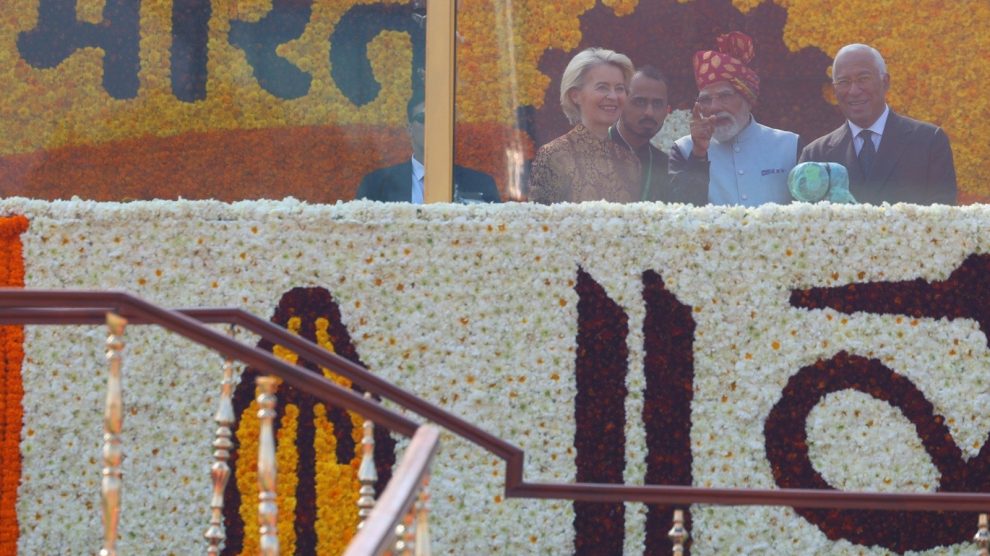
(Photo: X, @narendramodi)