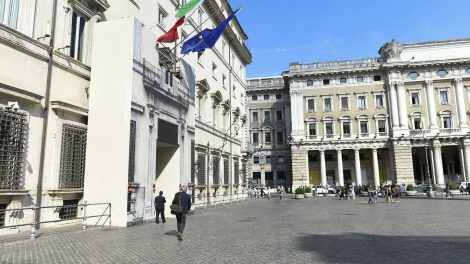

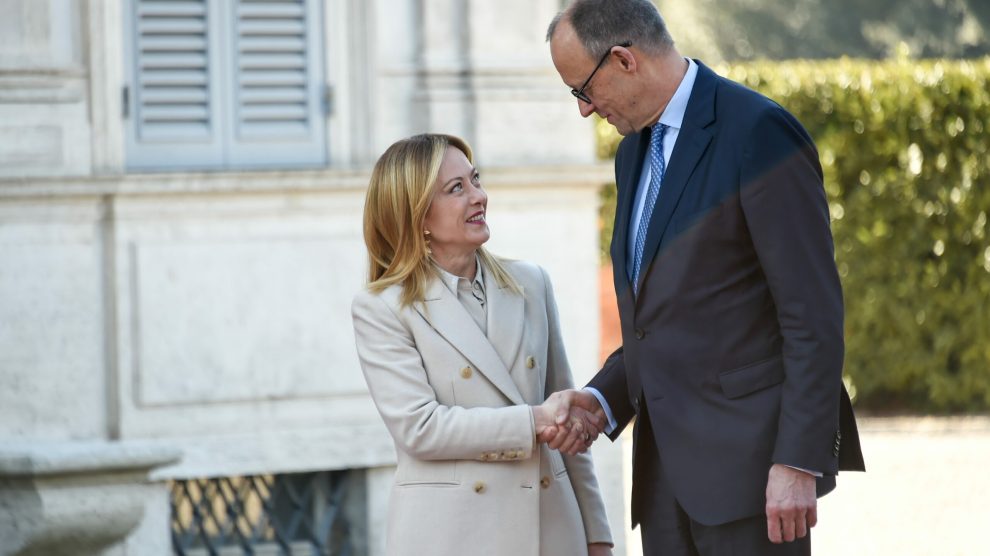
“A year of opportunities and a year of decisions” – this is how German Chancellor Friedrich Merz described 2026 at the end of the bilateral Summit on January 23 with Prime Minister Giorgia Meloni in Rome. And indeed, 2026 holds plenty of new promise for the long and storied relationship between Germany and Italy. 75 years ago, Konrad Adenauer paid his first visit to Italy as Germany’s chancellor, marking the resumption of diplomatic relations after the war but also the beginnings of European integration with his close partner and friend Alcide de Gasperi. In his remarkable speech to the German Bundestag in November 2025, Italy’s President Sergio Mattarella paid tribute to the “percorso straordinario” that Italy and Germany have since travelled together as Europeans and allies.
The success of the government consultations in Rome on January 23rd went far beyond pictures of bilateral harmony in the splendor of Villa Doria Pamphili. Chancellor Merz was accompanied by 10 ministers of his cabinet and the day-long proceedings produced a strong sense of political sintonià on all major strategic questions and a deliberate investment of both leaders and their teams in building a familiarità at political level that will enable new initiatives and projects linking our nations.
The overall message was a strong conviction of both governments to invest jointly into Europe’s strength at a time when the EU’s security, economic and political foundations are under pressure as never before in our lifetime.
Three major lines of action were agreed and will form the basis of our agenda for the months ahead:
Security and Defence: Europe needs to act urgently and firmly in a fundamentally new security context, including against hybrid warfare. Ministers of Defence and Foreign Affairs held their first joint meeting – a so-called “2+2 format” – and the heads of government signed an ambitious Agreement on Enhanced Co-operation on Security, Defence and Resilience. The agreement spells out commitments by Germany and Italy to intensify military cooperation in the areas of training, exercises, operations and capability development as well as closer industrial cooperation in the areas of defence and space with regular dialogues involving our industrial base. The delivery of the first “Lynx” armored infantry vehicles to the Italian armed forces a few days after the summit was visible proof of the great potential of such a collaboration between the EU’s two premier industrial powers.
Competitiveness: The EU single market is the world’s second largest market. To regain Europe’s competitive edge in a context of great power rivalry and rapid technological innovations, Germany and Italy put forward a joint paper as a basis for discussion amongst the EU heads of government at their Leaders’ Retreat on February 12. The key goal is to ensure renewed growth, strategic autonomy, and reduced vulnerability to external shocks through the elimination of regulatory barriers, the deepening of the single market in strategic areas and a differentiated, pragmatic, and rules-based trade policy. The various instruments are known: a dedicated simplification agenda, business- and SME-friendly implementation of EU-initiatives, and especially strengthening the industries of the future.
Fostering European unity: As founding members of the European project and strategic partners, Italy and Germany share a deeply felt responsibility for a strong, democratic and sovereign Europe. The bilateral Summit approved a revised German-Italian Action Plan across all relevant policy fields – from research and agriculture to infrastructure and cultural exchange – with the aim of “enabling the EU to act effectively to protect European values and interests.”
As German Ambassador to Italy I am looking forward to an auspicious year 2026, a rare “year of opportunity” in which the shared interests and the strong political will of our leaders can provide a much-needed spark of energy and optimism for Europe in a challenging geopolitical environment.
In a lecture organized by the Guarini Institute for Public Affairs, Ambassador Thomas Bagger will, this evening at 6:00 PM, analyze the European geopolitical context, the political and personal alignment between Germany and Italy, and the outcomes of the bilateral summit held on January 23, while also looking ahead to 2026, the year marking the 75th anniversary of the resumption of diplomatic relations between the two countries. Our sister website Formiche is the media partner of the event. Participation is by registration only: to attend, participants must use the dedicated registration link.