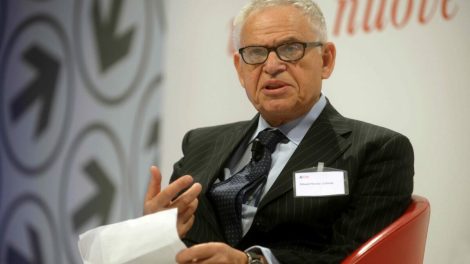
Speaking at John Cabot University (JCU) during a lecture organized by the Guarini Institute for Public Affairs and moderated by Associate Director Prof. Enrico Fardella, German Ambassador Thomas Bagger referred to the India–Middle East–Europe Economic Corridor (IMEC) as one of the areas where Italy and Germany are converging in response to shared de‑risking needs and the push for a more diversified geoeconomic connectivity.
The context: Our sister website Formiche was the media partner of the event, which also offered a close-up view of the increasingly aligned Italian–German leadership dynamic, recently highlighted by the Telegraph.
The big picture:
- Germany and Italy have backed IMEC since the G20 in September 2023.
- For Berlin, the corridor is not just about infrastructure. It is about reconnecting Europe with India and the Middle East at a time of stressed supply chains, contested trade routes and growing geopolitical fragmentation.
- IMEC’s relevance could grow further with the EU–India Free Trade Agreement.
- The expected final signature of the FTA would give the corridor a stronger regulatory and commercial backbone, anchoring long-term geoeconomic ties between Europe and India.
- Why Italy matters:
- Ports as strategic assets: Bagger singled out Trieste and Genoa as natural hubs in a broader Indo-Mediterranean connectivity architecture linking Southern Europe to Germany’s industrial core.
- An already integrated economic axis: The argument rests on the deep integration between Northern Italy and Southern Germany, where supply chains, manufacturing districts and SMEs are tightly interconnected.
- A direct, multimodal link eastward: This north–south axis would give Berlin a more direct and diversified connection to India and Asia — via Italy — strengthening Germany’s Indo-Mediterranean projection.
Zoom out: a rare alignment. From this regional angle, Bagger expanded to the broader state of German-Italian relations, arguing that Berlin and Rome are experiencing a level of political and strategic alignment unseen in decades.
- Italy’s political stability, combined with Germany’s reassessment of its external dependencies, has opened the way for more ambitious cooperation.
- Italy is no longer viewed mainly as a tactical interlocutor inside EU negotiations, but as a long-term strategic partner.
- This reading also framed Bagger’s analysis of the January 23 inter-governmental summit in Rome — later discussed by the ambassador in an editorial for Formiche — as a genuine inflexion point rather than a routine bilateral meeting.
A shared Atlantic reset. That convergence is also visible in how Rome and Berlin are recalibrating their approach to Washington. In an interview with Formiche, Mario Mauro, a former Italian Defence Minister and currently coordinator of the Baltic Sea–Black Sea–Aegean Sea Corridor, argued that Italy and Germany are now focused on building something constructive rather than adopting a reflexively anti-American or grievance-driven posture — a path he contrasted with France’s recent approach.
- The objective, Mauro said, is to restore substance to the transatlantic relationship while placing European strategic autonomy at its core.
Parliamentary convergence in Rome. The alignment outlined by Bagger also extends to parliamentary and institutional channels. Yesterday, the ambassador met with Giulio Terzi di Sant’Agata, former Foreign Minister and current Chari of the Senate’s European Affairs Committee, at the Italian Senate.
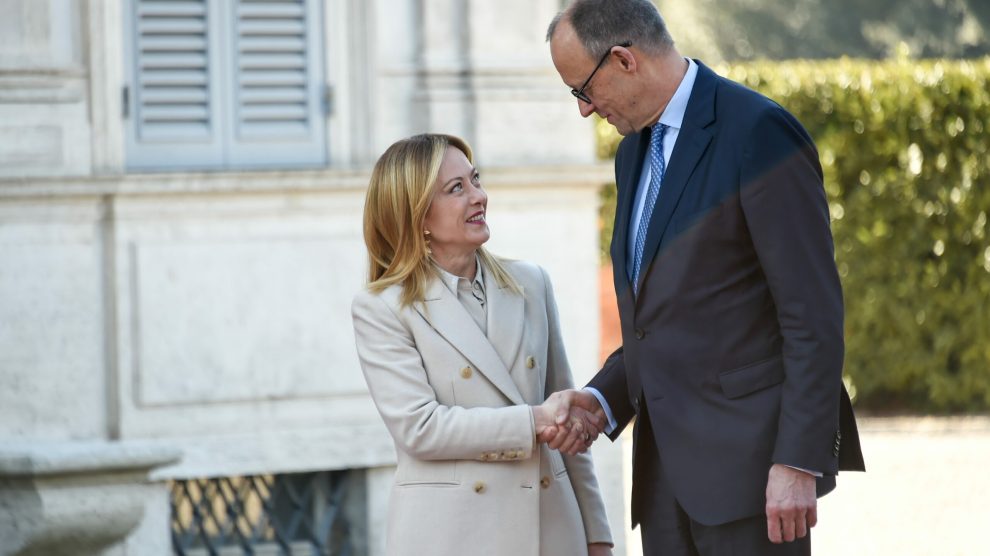
- According to Terzi’s statement, the meeting confirmed strong convergence emerging from the January 23 bilateral summit between Prime Minister Giorgia Meloni and German Chancellor Friedrich Merz, with discussions ranging from EU competitiveness and regulatory simplification to continued financial support for Ukraine, EU enlargement, investments in Africa starting from the Mattei Plan, the role of the United Nations, and reform of EU decision-making mechanisms, including qualified majority voting in foreign policy.
Critical minerals: a coordinated push. The convergence between Rome and Berlin is also translating into concrete coordination on critical raw materials. Today, Italy and Germany have jointly submitted a political guidance paper to the European Commission aimed at strengthening the EU’s approach to critical minerals, reducing strategic dependencies and building secure supply chains for European industry.
- The initiative, launched by Italian Foreign Minister Antonio Tajani and his German counterpart Johann Wadephul ahead of a U.S.-hosted meeting in Washington (the Critical Minerals Summit), follows commitments made at the January 23 bilateral summit and a joint declaration by industry Ministers Adolfo Urso and Katherina Reiche.
- The document calls for closer EU cooperation with the United States, G7+ partners and third countries — notably in Africa, the Indo-Pacific and Latin America — while stressing the need to invest in capacity-building, stockpiling, recycling and technological innovation, acknowledging that de-risking will entail additional, but manageable, costs.
Zoom out: The strategic backdrop. During the JCU’s event, Bagger placed the bilateral convergence against a sharply changing global environment:
- Russia is an increasingly revisionist and aggressive actor.
- China is a systemic rival exerting growing pressure on European economic models.
- Together, these trends are forcing Europe to rethink its post-Cold War assumptions and to prioritise defence, technology, and the reduction of strategic vulnerabilities.
What comes next. The January bilateral summit produced a broad action plan and a new intergovernmental agreement on security, defence, and resilience — spanning cybersecurity, critical infrastructure, armaments, and space — alongside a business forum that confirmed the depth of bilateral trade, nearing €160 billion annually.
The bottom line: For Berlin, effective cooperation ultimately hinges on political trust and long-term commitment — not just crisis management. That trust, Bagger suggested also in an op-ed published by Decode39, is now consolidating with Rome.
- With 2026 marking the 75th anniversary of the restoration of diplomatic relations between Italy and Germany, the two countries see a new window of opportunity.
- From energy corridors to ports, from geoeconomics to industrial and political cooperation, Europe’s southern axis is becoming central — and Germany intends to pursue it with Italy.