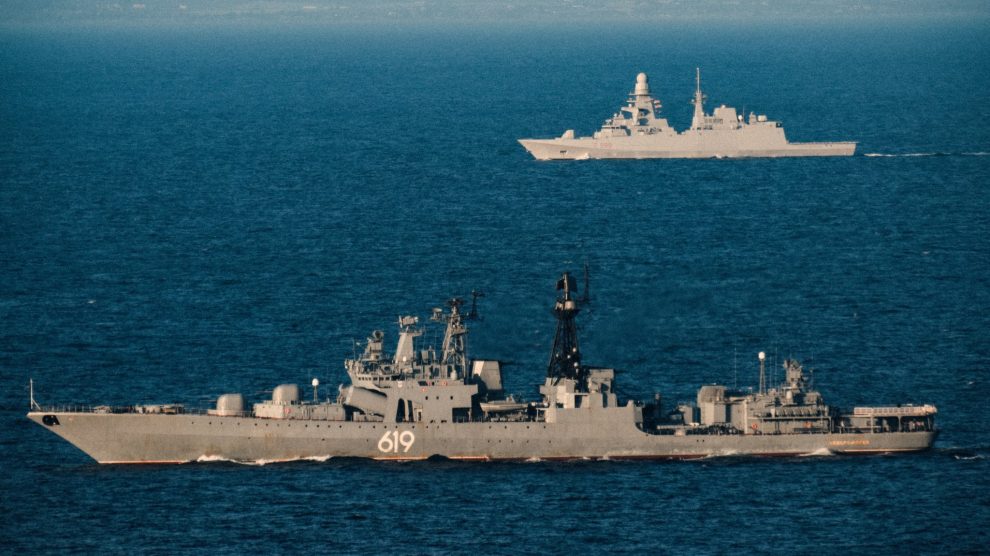
Decoding the news: The Mediterranean is sliding back toward a familiar pattern: not open confrontation, but persistent, monitored friction — a mix of Russian naval presence, sanctions‑evasion logistics and an increased emphasis by Western actors on maintaining visible maritime surveillance. What matters is not only what Russian units are doing at sea, but also how explicitly Italy and NATO choose to be seen watching them.
A Russian group holding a position east of Sardinia. Tracking data and open‑source reporting, including analysis published by the independent, Italy‑based OSINT platform Itamilradar, indicate that a small Russian naval group has been holding position east of Sardinia rather than resuming transit. This choice stands out from the more routine “pass‑through” movements observed in recent weeks across the central Mediterranean.
- Public reporting consistently identifies the core group as three vessels operating together: a Udaloy‑class destroyer (RFS Severomorsk), the naval auxiliary tanker Kama and the general cargo ship Sparta, both often linked to Russian military logistics.
- Sea conditions over the past days do not appear prohibitive enough to fully explain the decision to remain offshore, suggesting a deliberate — if limited — pause rather than a forced delay.
- The Sparta cargo ship is used by Russia’s Ministry of Defence for long-range military logistics, including the transport of weapons and sensitive matériel. For this reason, it has been repeatedly linked to Moscow’s military supply chains and is subject to U.S. sanctions.
- The vessel is commonly associated with Russia’s so-called “shadow fleet”, a network of ships used to sustain military and energy logistics while mitigating the impact of international sanctions.
What is happening? From an analytical perspective, posture matters. The interruption of the transit and the absence of a clear course adjustment remain unexplained, reinforcing the impression of a deliberate operational pause rather than routine navigation.
- While no hostile activity has been observed, the presence of critical subsea infrastructure in the area reinforces the strategic sensitivity of prolonged naval operations, particularly in a context of heightened concern over hybrid risks.
- Current assessments indicate that the vessel was expected to reach Kaliningrad around 17 February, though its prolonged presence off Sardinia suggests that the timeline may remain flexible.
Italy’s signal: a rare image and unusually direct language. Italy’s response reflects established operational routines accompanied by standard institutional communication.
- First, the image. A rare photograph released by the Italian Navy shows the FREMM frigate ITS Spartaco Schergat shadowing the Russian destroyer Severomorsk.
- The image is not incidental: it visually conveys proximity and continuity of monitoring. In an environment where navies usually prefer discretion, its publication suggests a calibrated choice to make ongoing vigilance visible.
- Second, the wording. In a message published on 5 February on its official X account, the Italian Navy stated that Operation Mediterraneo Sicuro continues “without interruption,” referring to close‑range monitoring of Russian military vessels and merchant units associated with the so‑called “shadow fleet” in the Mediterranean.
- Surveillance, the Navy noted, is carried out in an integrated manner by surface units, embarked and shore‑based helicopters, and maritime patrol aircraft, contributing to a constant presence in support of maritime security and stability.
- The language is relatively direct by institutional standards, linking naval activity and shadow‑fleet shipping within the same operational context. Rather than signalling escalation, it reflects an effort to describe ongoing surveillance activities transparently and matter-of-factly.
Mediterraneo Sicuro as the operational frame. These activities fall under Operation Mediterraneo Sicuro, the expanded successor to Mare Sicuro. The mission now covers most of the Mediterranean basin.
- It emphasises persistent presence, surveillance, protection of sea lines of communication and control of the sub‑surface domain, in cooperation with NATO, the European Union and other partners.
- In this context, monitoring and shadowing near Sardinia are not ad hoc reactions but expressions of a standing posture designed to normalise continuous situational awareness across a highly strategic maritime space.
The NATO layer: deterrence through visibility. Italy’s posture aligns with a broader NATO trend toward deterrence through transparency.
In recent weeks, NATO Maritime Command has publicly released images and statements describing how an SNMG2 unit — the Italian frigate ITS Virginio Fasan — monitored and shadowed the Russian Kilo‑class submarine Krasnodar, with surface escorts including Severomorsk.
- The decision to publicise such activity is itself significant. It reflects not only operational tracking, but also routine transparency toward allies and the public.
- This approach complements traditional military deterrence.
- By demonstrating readiness and coordination, NATO underscores situational awareness in a space increasingly exposed to hybrid pressure — from ambiguous naval movements to risks to subsea infrastructure and maritime logistics.
Shadow fleets move from policy debate to operational pressure. Parallel to military monitoring, Western attention to Russia‑linked shadow fleets is translating into concrete action.
- In the western Mediterranean, a tanker suspected of belonging to Moscow’s shadow fleet was seized near Marseille, underscoring the growing willingness of European states to enforce sanctions and maritime regulations.
- At the same time, Ukraine has demonstrated that the maritime dimension of the war no longer stops at the Black Sea, with reported strikes against Moscow‑linked shipping in the Mediterranean.
- Together, these developments suggest that opaque energy and logistics traffic along the Suez–Gibraltar route is increasingly treated as a security variable, not merely a compliance issue.
Between the lines: The maritime picture unfolds against a broader backdrop of Russian hybrid activity. Pro‑Russian hacktivist groups such as Killnet and NoName057(16) have recently carried out DDoS attacks against European targets, including Italian institutions, a trend that Italian authorities increasingly read also in light of the approach of the Milan–Cortina Winter Olympics, a high‑visibility event traditionally considered sensitive from a cyber and hybrid‑threat perspective.
- A recent report by the Germani Institute underscores this wider pattern, warning that Russian hybrid action against Italy operates on a continuous basis, blurring the boundaries between peace and crisis and spanning military, cyber and cognitive domains.
Why the Sardinia episode matters. The most cautious interpretation of the Russian group east of Sardinia remains the most persuasive: a deliberate but limited posture that stays visible, monitored and short of overtly hazardous conduct.
- Situational awareness at sea is never complete — cloud cover, AIS gaps and sensor limits apply to all actors.
- Yet the combination of prolonged presence, Italian and NATO surveillance, and controlled public disclosure points to a broader pattern.
- The Mediterranean is being managed as a contested space where security, energy flows and strategic messaging intersect.
The bottom line: This episode is not about a single incident, but about normalization. Russian naval units and shadow‑fleet shipping are operating under sustained scrutiny, while Italy and NATO continue to rely on established practices of monitoring and selective transparency.
- Any broader reading should be treated with caution: rather than asserting control, the episode reflects an effort to maintain situational awareness and routine presence in a maritime space that has regained strategic relevance.