
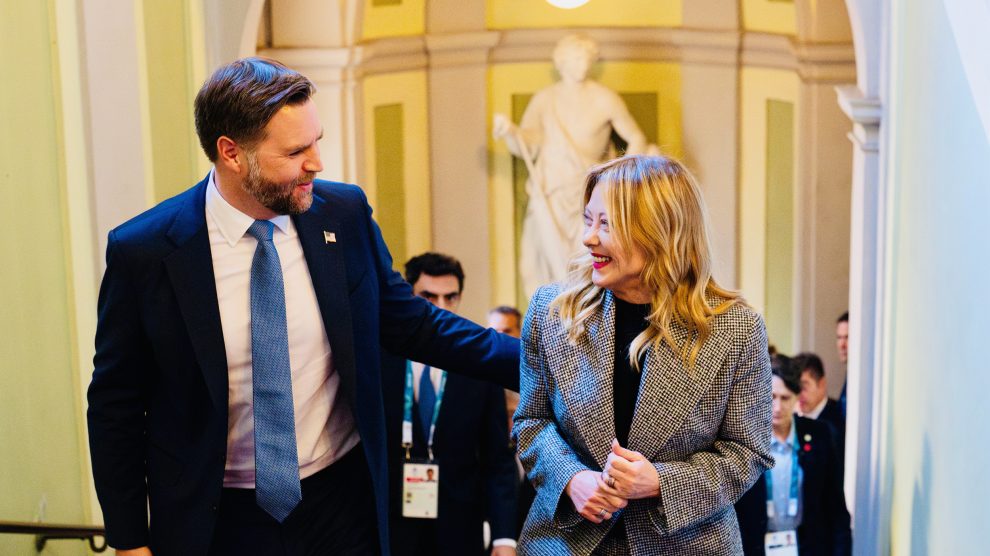
The news: U.S. Vice President J.D. Vance and Secretary of State Marco Rubio are in Italy for the inauguration of the Milano-Cortina Winter Olympics, turning a global sporting moment into a high-level diplomatic one.
- On the sidelines of the Olympic opening events in Milan, Vance met Italian Prime Minister Giorgia Meloni, alongside Foreign Minister Antonio Tajani, reaffirming the strength of the Italy–U.S. strategic partnership at a time of heightened geopolitical pressure.
Why it matters: The Olympic backdrop underscores how Washington is using symbolism and substance together — signaling Italy’s role as a key European anchor on energy security, critical minerals, and major international dossiers.
- International dossiers discussed included Iran and Venezuela..
Between the lines: Rome and Washington are framing their relationship as the backbone of the broader Euro-Atlantic link, with Italy positioned as a reliable node rather than a peripheral actor.
- The emphasis on critical minerals and secure supply chains fits neatly with U.S. efforts to diversify away from China—and with Italy’s ambition to play a convening role across Europe, Africa, and the Indo-Pacific.
- The keyword repeatedly surfacing is “the West”—but reinforced by a distinctly pragmatic tone in dossiers where interests, not just narratives, matter.
Context: PM Meloni explicitly linked recent high-profile encounters — from Rome to Milan — to a shared value system binding Europe and the United States, as well as to concrete cooperation on immediate challenges (tariffs, Ukraine, Gaza) and future agendas (rare earths, the Indo-Pacific, Italy’s Africa-focused Mattei Plan).
What they said: Meloni stressed continuity and alignment, presenting Italy–US ties as both values-based and action-oriented.
- VP Vance praised Italy’s organisation and invoked the Olympic spirit as a metaphor for rules-based competition and shared norms, setting the tone for broader strategic discussions.
Zoom out: For Washington, Italy looks increasingly like a connector — linking the transatlantic space to the Mediterranean, Africa, and the Indo-Pacific. For Rome, the relationship with the U.S. remains the multiplier that gives weight to its European and global ambitions.
What’s next: Watch for follow-up cooperation on critical minerals, Indo-Pacific coordination, and Mediterranean security — areas where the Italy–US axis is quietly becoming operational, not just rhetorical.