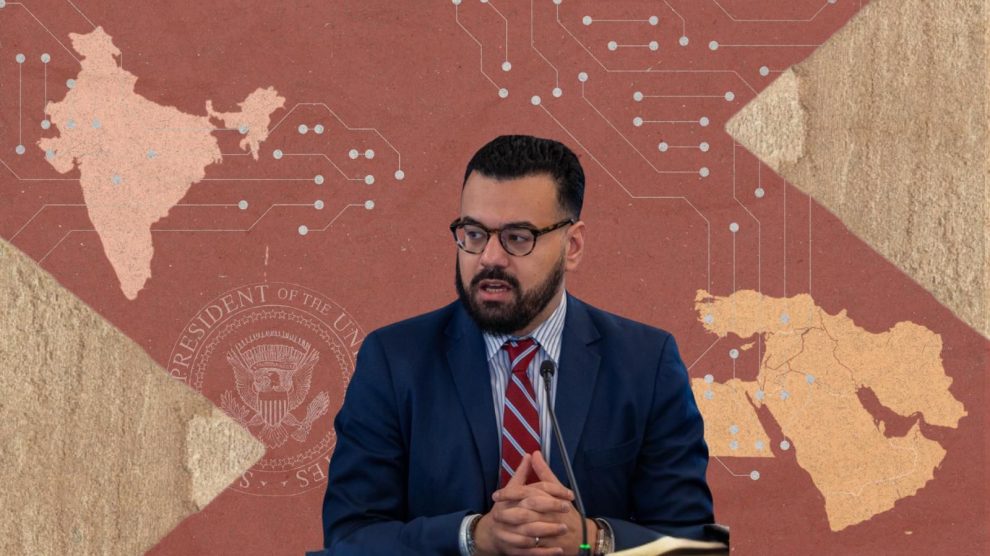
Mr Soliman outlines the conceptual shift from the “Middle East” to “West Asia,” argues for a transition from nation-building to order-building, and explains why AI, compute infrastructure, critical minerals, and geoeconomic corridors are becoming the new foundations of regional order. His analysis also speaks directly to Europe’s—and Italy’s—strategic positioning in an emerging transcontinental system stretching from the Mediterranean to the Indian Ocean.
Why he matters: Mohammed Soliman is a senior fellow at the Middle East Institute (MEI), where he focuses on the intersection of technology, geopolitics, and business in the Middle East and other emerging markets. Trained as an engineer, he is a director at McLarty Associates, advising on strategic and policy issues at the nexus of technology, AI, finance, and energy. He is the author of the forthcoming book West Asia: A New American Grand Strategy in the Middle East (Polity Press).
Q: In your book, you argue that the term “Middle East” no longer captures geopolitical reality, and propose “West Asia” as a more accurate framework. What is the most consequential mistake Washington makes by remaining trapped in the old mental map?
A: The book isn’t trying to pick a fight over terminology. Its main purpose is much simpler: to show that the old idea of the “Middle East” no longer exists. Plain and simple. There is no real border separating the Middle East from South Asia or from the Mediterranean world. What we’re looking at today is one connected space, linked by geopolitics, security, trade, AI infrastructure, and the movement of people. And this isn’t a new idea. This was always the case before European hegemony. I see West Asia as a modest contribution to the tradition Janet Abu-Lughod laid out in Before European Hegemony.
- The difference is timing. In 2026, this isn’t really a return to before European hegemony, but rather after European hegemony. And what’s emerging now is a new center of gravity in this system, with the Gulf at its core.
- This matters enormously for American policymakers, who remain the main architects of whatever is left of the global order, and still sit at its center.
- Rethinking the Middle East as part of a wider Asian order helps clarify some of the hardest questions we are now facing: our finite resources, our overstretched commitments, and of course, our long-term economic health, and most importantly, how to delegate regional order-management to capable regional and middle powers, instead of trying to do everything, everywhere, all the time, which we simply can’t do.
Q: You also argue that the United States must move from nation-building to order-building. What is the most misunderstood lesson of Iraq and Afghanistan?
A: The most misunderstood lesson from Iraq and Afghanistan is that the problem wasn’t execution or better plans or more military deployment or, of course, more money; it was the premise of these wars. We went to war for the wrong reasons, and then stayed for the wrong ones. In Afghanistan, after the Taliban were defeated, there was no real plan for the day after. Just an open-ended commitment centered on Bagram, and sending more American soldiers from the Mississippi to Kabul.
- Iraq, however, was the single biggest geopolitical disaster in the Middle East in the 21st century. Nothing comes close.
- It shattered the regional balance of power and opened the door to a sustained Iranian sectarian axis that ravaged the Sunni heartlands and posed an existential threat to the internal stability and cohesion of the Gulf states.
- Most critically, Tehran aimed to jeopardize the very developmental ‘visions’ upon which the future of the Arab world now depends.
- What followed was effectively twenty years of Iranian offensive momentum across the region. And it all traces back to the disastrous invasion of Iraq.
- The real lesson for the U.S. is simple: you can’t socially engineer stability from the outside. What America can do, when it focuses, is shape the broader strategic environment.
- Help institutionalize, maintain, and secure key economic corridors, support regional and middle powers that can actually enforce order, and set incentives that keep the system from spinning out of control.
- Staying influential doesn’t mean designing other societies from scratch. It means designing the system and letting regional powers handle the details.
- That’s not isolationism, despite what some argue.
- I’m simply being realistic about America’s finite resources and exercising power in an increasingly contested global landscape.
Q: In the book, you describe a strategic shift from oil to compute. How central is AI—and the competition over critical minerals—to the emerging US–West Asia relationship?
A: I was commuting between Saudi Arabia and Washington during COVID, and the contrast was striking. In the U.S., I was carrying a paper vaccine card in my wallet. In Saudi Arabia, everything was fully digital. I even did Umrah in Mecca through an app. It was impressive and it offered a very different picture of the Gulf’s digital resilience when the pandemic hit. Dubai became a global hub for digital nomads because it stayed open and built resilient digital services.
- This was all before the ChatGPT moment. Now it’s clear that compute is one of the Gulf’s main answers to a post-energy future. They are laser-focused on building a techno-industrial base that largely bypasses the industrial era of the 20th century.
- Compute, in my point of view, is finite.
- It’s constrained by chips, energy infrastructure, and capital. A single gigawatt of compute can cost north of $30 billion.
- That’s where the Gulf and its leadership matter.
- They see AI as a way to address some of their most fundamental challenges: economic diversification, national security, and more importantly, demographics.
- And as the U.S. looks to outscale China, it will increasingly lean on the Gulf to help build global compute capacity. We’ve already seen this in the Trump-era AI deals, the inclusion of two Gulf states in Pax Silica, and ongoing cooperation with Saudi Arabia on critical mineral processing.
Q: Several Gulf states are investing heavily in AI, data centers, and semiconductors. What should they do to avoid remaining mere hosting platforms for Western technology?
A: Building compute infrastructure attracts entire ecosystems. Like companies that design chips, build cooling systems, and manufacture legacy semiconductors, which is very doable in the case of the Gulf.
- These are also my own recommendations: build the talent pipeline needed to design and operate data centers and large compute clusters; invest in national champions to develop a homegrown enterprise layer; create shared compute pools that startups and research labs—both domestic and regional—can access; and support chip design through traditional industrial-policy incentives, with a laser focus on legacy chips.
- Compute isn’t just data centers on soil with enterprise services layered on top. It’s a catalyst for techno-industrialization.
Q: You describe what you call an “Indo-Abrahamic” axis. How can this configuration stabilize the region without becoming an overtly antagonistic bloc?
A: I wrote this thesis six years ago, and it still holds: the border between South Asia and the Middle East doesn’t really exist.
- That said, new dynamics are clearly emerging. Iran’s relative weakening, combined with Israel’s growing freedom of operational movement across Arab airspace, is reshaping the region.
- As I argue in the book, we’re seeing the beginning of something new between Israel and moderate Arab states, if it continues, the most significant shift since Sadat signed Camp David.
- At the same time, Pakistan is being drawn more directly into the regional picture, alongside India’s deepening alliance with Israel.
- Pakistan and India, each in different ways and degrees, will work with and cooperate with Saudi Arabia and the UAE. These aren’t zero-sum choices.
- The era of rigid, 100-percent alliance is over.
- The region’s real challenge is under-institutionalization. We lack enough mechanisms to manage differences, reduce friction, and contain escalation when tensions rise.
- This is why it is significant to see the ME3—Egypt, Turkey, and Qatar—playing a collective role in Gaza and Iran. And the I2U2, the India–Middle East–Europe Corridor, GCC–ASEAN, and the GCC–EU are frameworks aimed at building institutions for this expansive under-institutionalized region.
- The new norm is a web of overlapping coalitions—sometimes competing, sometimes cooperating—depending on the issue, the timing, and Washington’s posture.
Q: After Gaza and amid rising regional tensions, do corridors like IMEC remain credible tools of strategic order, or are they at risk of becoming mostly geopolitical narratives? And how should Europe—and Italy in particular—position itself?
A: Europe shouldn’t get fixated on Saudi–Israel normalization. That’s too narrow, and it misses the bigger picture. And if Europe keeps looking at the old “Middle East” only as a source of capital and a route to India, then frankly, good luck.
- Italy knows its history; it understands that its future is anchored in the Mediterraneo Allargato or the Enlarged Mediterranean.
- You see this in the Italian active engagement with Egypt, the Gulf, Turkey, and India. Or the footprint of companies like Eni and Sparkle’s subsea cables. Rome is effectively positioning itself as the bridgehead for a new transcontinental system.
- Meanwhile, Europe’s geoeconomic reset after Ukraine requires something much deeper: institutionalized ties with Egypt, Saudi Arabia, the UAE, Oman, the broader GCC, and yes, Turkey.
- Whether some European capitals like it or not, Turkey is a pillar of Europe’s post-Ukraine security, and a rethink of the relationship with Ankara is long overdue.
- The region shouldn’t be viewed through a single corridor or a single port. It’s a system.
- IMEC, the Turkey-led route, or the Suez Canal Economic Zone all serve the same objective: building a transcontinental geoeconomic system stretching from the Mediterranean to the Indian Ocean.
- You’re either part of that system or you’re not.
- If Europe treats Egypt as nothing more than the operator of the Suez Canal, it shouldn’t be surprised to wake up one day and find that the Suez Canal Zone has little to do with the European economy and far more to do with Asian manufacturers serving Asian value chains.
The bottom line: According to Mohammed Soliman, the strategic shift underway in West Asia is not about replacing one hegemon with another, but about redesigning the system itself.
- Power is increasingly exercised through technology, connectivity, and coalitions rather than direct control.
- For Europe, and for Italy in particular, the choice is not whether to engage with this emerging regional order, but whether to help shape it—or remain peripheral to a system that will, regardless, define its economic and strategic future.
(Photo: Fiona Brummer)