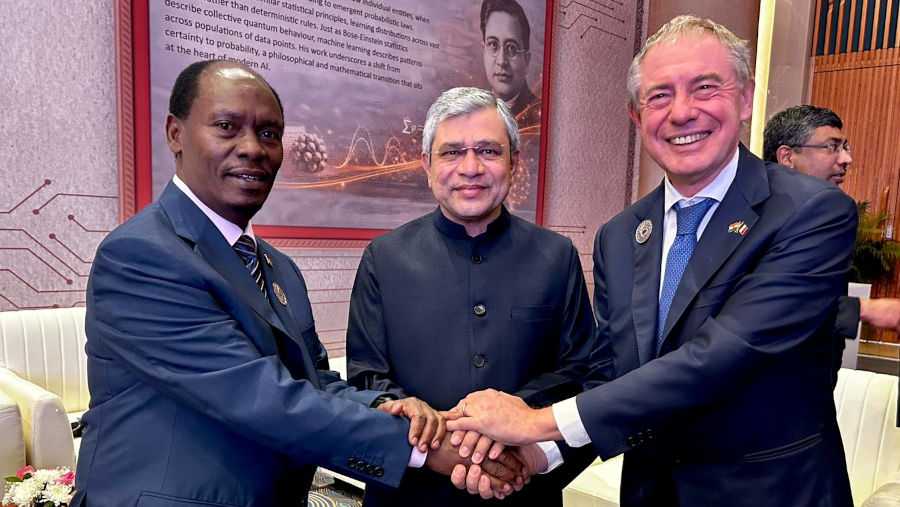
The accord, signed in New Delhi on the margins of the AI Impact Summit, brings together Italy’s Ministry of Enterprises and Made in Italy, led by Adolfo Urso, India’s Ministry of Electronics and Information Technology, led by Ashwini Vaishnaw, and Kenya’s Ministry of Information, Communications and Digital Economy, led by William Kabogo Gitau.
The goal: It aims to move beyond pilot projects towards the scalable deployment of AI systems in sectors such as agriculture, healthcare, education and public services, with an initial set of high-impact use cases scheduled from 2026.
Why it matters (for the three actors)
- For Italy, the initiative links two pillars of its external strategy: deepening ties with India — now viewed in Rome as a critical partner in technology and supply chains — and anchoring development cooperation in Africa through non-aid-based industrial partnerships.
- Officials describe the arrangement as a practical extension of the India–Italy Strategic Action Plan for 2025–2029, a test case for cooperation in third-country geostrategic environments where interests converge, and a concrete demonstration of the Mattei Plan’s shift from political signalling to execution.
- India’s role is equally strategic. New Delhi has spent the past decade building digital public infrastructure at scale, from identity systems to payments platforms, and is increasingly seeking to export this governance model across the Global South.
- By working with Kenya — one of Africa’s most dynamic technology ecosystems — and Italy’s industrial base, Indian policymakers see an opportunity to shape standards for “sovereign AI” that emphasise local data control, multilingual access and affordability in low-connectivity environments, echoing the summit’s guiding principle of “Sarvajana Hitaya, Sarvajana Sukhaya” (for the welfare and happiness of all).
- Kenya, for its part, is positioning itself as an operational hub for AI deployment in Africa rather than merely a recipient of imported technology.
- Nairobi hosted a dedicated AI Forum earlier this month that convened policymakers, companies and multilateral agencies to address practical constraints such as compute access, talent mobility and financing.
- The meeting underscored a shift in tone among African governments — from concerns about being left behind in the AI race to a determination to co-design infrastructure and governance frameworks.
Right-sized AI. The trilateral agreement will leverage the AI Hub for Sustainable Development, a G7-endorsed initiative implemented with the United Nations Development Programme, to coordinate projects and financing, alongside implementing partners including India’s EkStep Foundation and its People+AI initiative, as well as Kenya’s Directorate for Digital Economy and Emerging Technologies.
- Italy’s industry minister Adolfo Urso said the deal would “consolidate collaboration between Italy, India and Kenya to develop artificial intelligence across the African continent, in line with the objectives of our Mattei Plan”, adding that India — “a major partner for Italy and a crucial interlocutor for our companies in AI and innovation” — would play a central role alongside the G7-promoted hub in turning cooperation into concrete projects for sustainable development in Africa.
- Particular emphasis will be placed on voice-enabled systems in African languages, reflecting the reality that linguistic fragmentation and limited connectivity remain major barriers to digital adoption across the continent.
- Diplomats involved in the negotiations argue that the partnership represents a different model of technology cooperation.
- Instead of hyperscale data centres designed for advanced economies, the focus is on modular infrastructure aligned with local energy availability and actual demand — a concept often described as “right-sized AI”.
- The approach also aligns with Africa’s interest in retaining control over data and avoiding dependence on a small number of foreign providers.
The political message. The political messaging has been unusually coordinated. In recent weeks, senior Italian, Kenyan and UN officials — including Vincenzo Del Monaco, Italy’s ambassador to Kenya; Philip Thigo, Kenya’s special envoy on technology; and Keyzom Ngodup Massally of the UNDP’s AI Hub for Sustainable Development — have published joint opinion pieces emphasising a shift from traditional aid to the co-creation of economic capability, framing artificial intelligence as a new layer of strategic infrastructure comparable to energy or transport networks.
- In an op-ed published on February 16 on Citizen Digital, they argued that Africa must engage with AI not as a recipient of imported solutions but as a co-creator of capabilities, marking a shift from dialogue to delivery after the Nairobi AI Forum, and that partnerships structured around compute, talent and governance would determine whether innovation translates into inclusive development.
Rome’s POV. For Italian policymakers, the optics matter as much as the technology. Prime Minister Giorgia Meloni has sought to recast Italy as Europe’s gateway to Africa, capable of mobilising both public institutions and private industry.
- By linking the Mattei Plan to India’s technological reach, officials hope to demonstrate that middle powers can still shape global digital governance if they act in concert.
The bottom line: Whether the initiative can deliver at scale will depend on financing and execution — perennial challenges for development-driven technology projects.
- Yet the symbolism is clear. As competition intensifies between the US and China over AI standards and infrastructure, a coalition of European, Indo-Pacific and African actors is attempting to carve out a third pathway rooted in partnership rather than dependency.
What we’re watching: If successful, the Italy–India–Kenya axis could offer a template for how emerging technologies are deployed across the Global South: not as imported solutions, but as jointly designed systems tailored to local needs.
- In a world increasingly shaped by artificial intelligence, that may prove as consequential as the algorithms themselves.