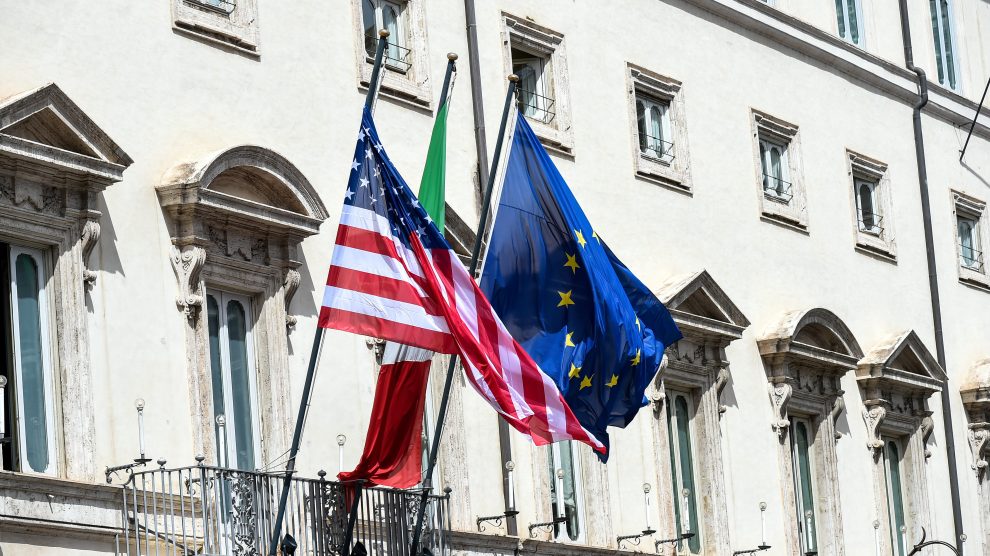
Today more than ever, the transatlantic alliance is no longer only about defense or trade. It is increasingly about technology: cloud infrastructure, data governance, artificial intelligence, networks, submarine cables, and security standards.
These are not merely technical sectors. They are the infrastructures that determine economic competitiveness, the resilience of states, the ability to protect citizens and businesses, and even the quality of the digital public sphere where democratic consensus is formed.
From this perspective, the United States and Europe broadly share the same strategic outlook. Global competition — with China at the center — has become a competition for technological leadership.
But there is also a second truth that is less comfortable to acknowledge. The alliance is indispensable, yet it is not symmetrical.
The United States has moved faster in several decisive digital technologies, particularly in its ability to translate innovation into industrial scale: access to capital, digital platforms, entrepreneurial ecosystems, and rapid growth dynamics.
Europe, by contrast, has often prioritized regulatory stability and the protection of rights — values that remain essential. But it has struggled more in the transition from scientific excellence to industrial power, moving from research to market.
At the same time, growing concerns about the societal impact of artificial intelligence — including privacy, labor markets, and fundamental rights — have brought increasing international attention to regulatory initiatives such as the European AI Act and Italy’s own legislation on artificial intelligence.
Still, a widening technological gap benefits no one.
It does not benefit the United States, because a stagnating Europe loses economic weight and strategic capacity, weakening the overall strength of the democratic camp. It does not benefit the European Union, because excessive dependence on external technologies and critical infrastructures — even when they come from allied partners — reduces strategic autonomy and creates vulnerabilities.
And above all, it does not benefit the West as a whole. Every structural misalignment creates opportunities for actors that explicitly aim to control global supply chains and digital infrastructures.
For this reason, we must adopt a mature reading of the transatlantic relationship — one that goes beyond simplistic narratives of “US versus EU.”
Europe has much to offer the United States: talent, universities, advanced industrial capabilities, quantum research, software engineering expertise, and high-tech manufacturing.
In many cases, European innovation and skills have directly contributed to the rise of major American technology companies.
At the same time, US technology firms are among the most significant foreign investors in Europe, contributing to infrastructure development, digital services, and employment across the continent.
A recent example is the Q-Alliance initiative, announced by two major quantum research companies — one American and one Canadian — to establish in Italy one of the most powerful quantum computing centers in the world.
This illustrates the reality of an integrated ecosystem. The scale of transatlantic trade and cross-investment makes this clear: if one pillar weakens, the entire structure begins to shake.
The issue, however, is not simply to celebrate interdependence — but to govern it.
And governing it requires the ability to address certain tensions without unnecessary dramatization.
The first tension concerns regulation.
The United States traditionally prioritizes the speed of innovation and market dynamics. This is not a new discovery. Europe, on the other hand, has developed a more extensive regulatory framework focused on rights protection, competition policy, and consumer safeguards.
These are two different regulatory cultures, both legitimate. But if they fail to engage with each other constructively, friction may emerge in areas such as artificial intelligence governance, data management, cybersecurity, submarine cable infrastructure, and platform responsibility.
Yet it is important to remember that what unites us is far stronger than what divides us.
In the field of submarine cable security, for example, I recently signed a Joint Declaration on the Security and Resilience of Submarine Cables in a Globally Digitalized World alongside the United States Ambassador for Cyberspace and Digital Policy, Nathaniel Fick, on the margins of the G7’s technological discussions.
From this perspective, the transatlantic agenda must be concrete and measurable rather than rhetorical.
The goal is not to homogenize our systems, but to ensure interoperability, predictability, and a shared perimeter of trust.
Within this framework, Italy — and the government led by Prime Minister Giorgia Meloni — can and must play the role of a bridge builder and a driver of European pragmatism.
We cannot limit ourselves to commenting on decisions made elsewhere. We must contribute to shaping a Europe that innovates more, simplifies regulation where necessary, invests in digital infrastructure and skills, and arrives at the transatlantic table with credible and structured proposals.
This is also the spirit guiding our work to develop a coherent national and European strategy for artificial intelligence and quantum technologies.
Our objective is not to chase technological trends, but to build lasting national and European capabilities, attract investment, and provide businesses with a clear and predictable regulatory environment.
Ultimately, the real question is who will write the rules of the new technological order.
If Europe and the United States act together — combining their strengths and strategic vision — they can define global standards, security frameworks, and development models consistent with liberal democracies.
If fragmentation prevails, however, both the competitive and political advantages will shift elsewhere.
At that point, the discussion would move from the loss of market share to something far more serious: the loss of choice.
This is why the transatlantic technology alliance must be understood as a long-term investment.
But when history accelerates, long-term investments require immediate decisions — decisions capable of turning shared principles into industrial strength, resilience, and freedom.