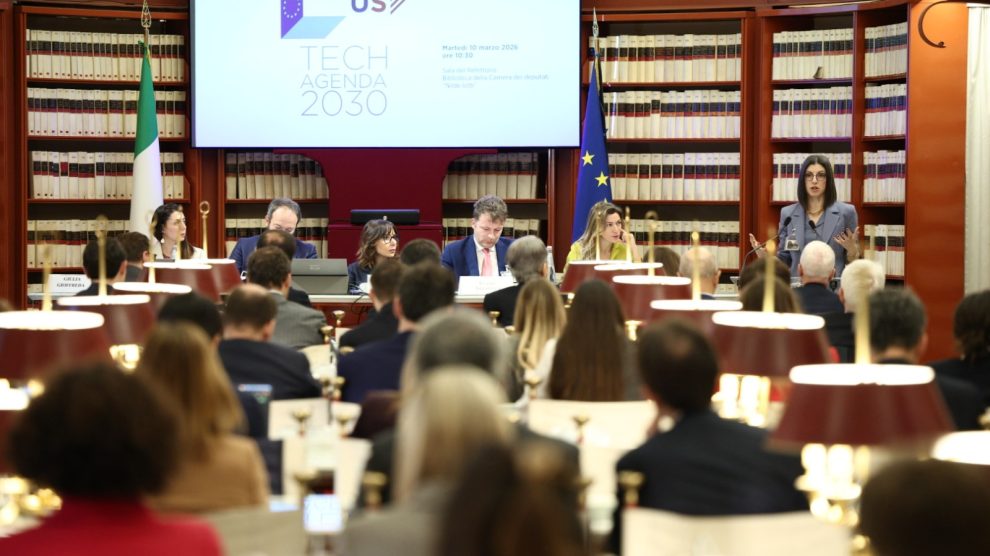
Why it matters: The event, organized by our sister media Formiche at the Italian Chamber of Deputies, built on the policy debate sparked by the CEPA report “Tech 2030 – A Roadmap for Europe-US Tech Cooperation.” The report argues that transatlantic collaboration is the only realistic way for democracies to remain competitive in the global technology race.
The big picture: Across panels and speeches, a common theme emerged:
technology is no longer just economic competition — it is geopolitical competition.
- From AI and cloud computing to defense technologies and industrial capacity, speakers repeatedly stressed that Europe cannot afford technological fragmentation, while the United States and Europe together remain the strongest ecosystem for innovation and democratic governance of technology.
The China factor: Italian Deputy Speaker Giorgio Mulé warned that Europe faces a strategic choice as China accelerates its technological ambitions, particularly in robotics and humanoid technologies.
- “We must decide today — not tomorrow — where we want to go in artificial intelligence and emerging technologies,” Mulé said. “China has made giant steps in recent years. If we fail to act, we will face not an invasion but a form of technological colonization.”
- In his view, Europe must strengthen cooperation with the United States to remain technologically sovereign while avoiding dependence on authoritarian systems.
Washington’s view: That message was echoed by Marta Costanzo Youth, Deputy Chief of Mission at the U.S. Embassy in Rome, who framed technological cooperation as a pillar of democratic security.
- “Technology today is synonymous with protecting democracy,” she said. “An alliance between the United States and Europe is essential to stop China from colonizing global technology ecosystems.”
- According to Costanzo Youth, emerging technologies — from AI to quantum computing — will shape not only economic growth but also the geopolitical balance of power.
Europe’s strategic dilemma: Italian Deputy Minister for Enterprises and Made in Italy Valentino Valentini stressed that the transatlantic alliance remains indispensable, but warned that Europe must also strengthen its own technological capabilities.
- “Alliances only work when each side carries its weight,” Valentini said. “The competition with China cannot be won alone. It must be won together.”
- Valentini argued that Europe’s real weakness lies less in research than in its inability to mobilize private capital at scale, a gap that still separates it from the United States.
Strategic dependencies: For Alina Polyakova, president of the Center for European Policy Analysis (CEPA), the stakes are even higher.
- “A technological dependence on China would be even harder to break than Europe’s past dependence on Russian gas,” she warned.
- Polyakova noted that Beijing is investing heavily in setting global standards for artificial intelligence and other emerging technologies — a move that could reshape the global digital order if democracies fail to coordinate.
The Mediterranean angle: Italian MP Ylenia Lucaselli proposed a more regional perspective, suggesting that the Mediterranean could become a strategic technological hub within the Western alliance.
- “We should imagine a Mediterranean of technology,” Lucaselli said, “where Europe and the United States work together to build a stronger West capable of countering China’s advance.”
- In her view, Italy could play a bridging role thanks to its industrial base and strategic position.
The private sector’s role: Industry representatives also stressed that transatlantic cooperation must include the private sector, not just governments.
- Giulia Gioffreda, public policy manager at Google Italy, called for a more pragmatic European approach to digital partnerships.
- “Partnerships with major technology companies are the path toward true digital pragmatism,” she said, warning that limited access to advanced AI technologies could significantly reduce Europe’s growth potential.
- Flavio Arzarello, Meta’s public policy manager for economic and regulatory policy in Italy, similarly argued that regulatory fragmentation remains a major obstacle.
- “Europe currently operates with more than 270 regulators,” he said. “Simplification is no longer optional if Europe wants to remain competitive.”
Tech meets defense: Several speakers highlighted how digital power and military power are increasingly intertwined.
- Riccardo Breda, Sales Director, Public Sector, Cisco Italy, pointed out that modern defense capabilities now depend on digital infrastructure and cybersecurity.
- “Defense assets and digital assets now move together,” Breda said. “Strengthening the connection between the digital and military domains is essential.”
- From the defense industry perspective, Enrico Della Gatta, VP Defence Market Business Intelligence, Fincantieri noted that the United States has successfully built innovation ecosystems around defense needs.
- “Some Silicon Valley companies grew by translating Pentagon requirements into technologies understandable to the commercial sector, attracting private investment and accelerating innovation.,” he said.
The security dimension: Italian Senator Giulio Terzi di Sant’Agata added a geopolitical warning, pointing to the growing military cooperation between Russia and Iran, including the use of Iranian drones in the war against Ukraine.
- For Terzi, this evolving security environment reinforces the need for Western technological coordination.
What we’re watching: The Rome forum reflected a broader debate unfolding across the Atlantic: how to build a transatlantic technology strategy capable of competing with China while preserving democratic values.
- The CEPA report presented during the event argues that the United States and Europe must act quickly — aligning standards, securing supply chains, and investing jointly in emerging technologies — if they want democracies to shape the future global digital order.