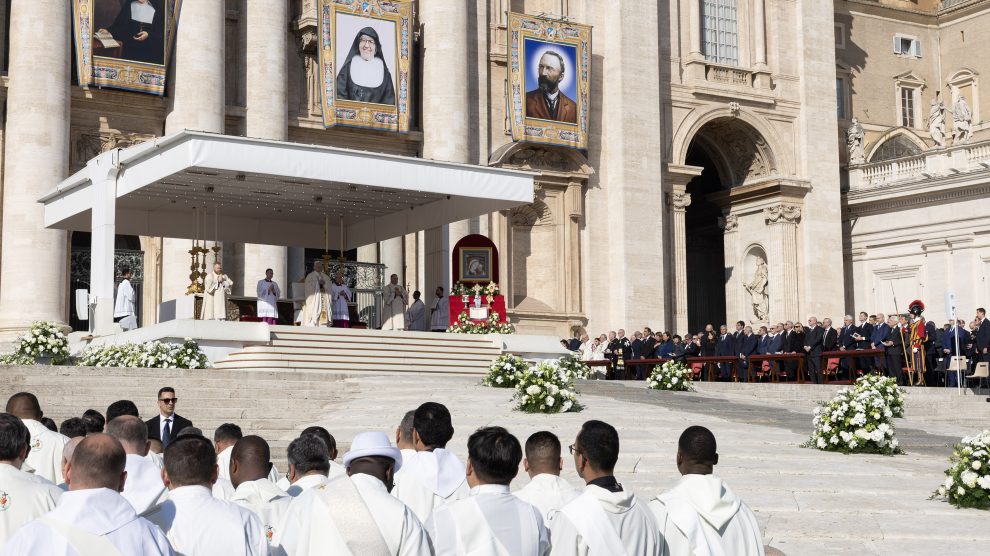
Decoding the News: According to an analysis by the Frankfurter Allgemeine Zeitung, the war between the United States, Israel and Iran poses a particular challenge for Pope Leo XIV. He is an American pontiff facing a conflict that directly involves Washington and Israel against a major Muslim country, and he also comes from a theological tradition influenced by the Augustinian doctrine of the “just war.”
- The result is an extremely cautious line. Yet it is precisely within this caution that the limits of Vatican diplomacy are becoming visible in today’s geopolitical environment.
Leo’s line: So far, Leo XIV has avoided direct criticism of the U.S. and Israeli military operation against Iran, relying instead on cautious language and general appeals to peace and fraternity among peoples.
- During the Angelus, he spoke of a “spiral of violence” and stressed the need for “diplomacy to regain its role” to prevent a wider tragedy.
- Beyond these appeals, however, the Holy See does not appear capable of influencing the course of events in West Asia, just as it was unable to influence the trajectory of Russia’s full‑scale invasion of Ukraine.
The signal from Tehran: Iran’s reaction fits into this broader picture. After the military escalation, Tehran sought a diplomatic opening through the Vatican.
- Iran’s ambassador to the Holy See, Mohammad Hossein Mokhtari, said he had explicitly asked the Pope to condemn the attack.
- That response never came. Mokhtari said he had written in recent days to the Pope and to senior representatives of the Holy See, calling it “my moral duty,” but added that “unfortunately I have not yet received any response.”
- Analytically, in Tehran’s view such a condemnation might have signaled indirect diplomatic support and put pressure on the Trump administration, where Christian constituencies today hold a level of representation and influence rarely seen in other phases of U.S. political history.
Why it matters: The episode reveals a broader issue. International actors still look to the Holy See as a potential platform for mediation. Yet in today’s international system, Vatican diplomacy struggles to convert moral authority into real negotiating influence.
Where is the problem? Without a functional channel with Washington — now weakened by tensions between the Holy See and the Trump administration — the Vatican risks remaining a respected moral voice with limited weight in the practical management of international crises.