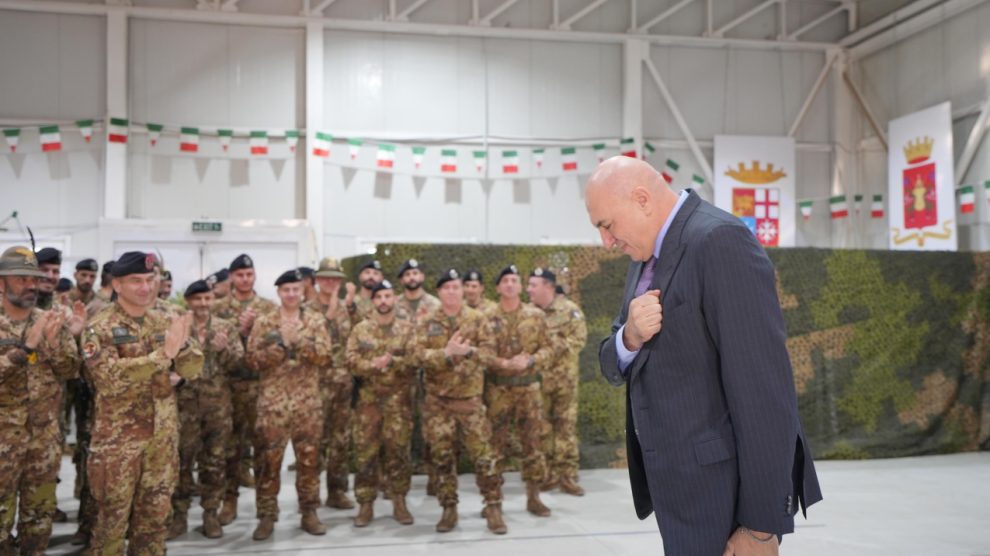
The trigger: An overnight drone strike hit Camp Singara, the Italian military facility located inside the military complex of Erbil International Airport in Iraqi Kurdistan.
- No Italian personnel were injured, though the drone destroyed a logistics vehicle and caused limited infrastructure damage.
- Italian troops had taken shelter in bunkers after receiving an earlier air-raid alert, according to Colonel Stefano Pizzotti, commander of the Italian contingent.
- “We are prepared and trained to deal with situations like these, and the safety of our personnel is always our top priority,” Pizzotti said.
- The base hosts 141 Italian soldiers, mainly tasked with training Kurdish security forces as part of the U.S.-led coalition mission against the Islamic State (Operation Inherent Resolve).
A deliberate attack. Italian Defence Minister Guido Crosetto said the strike appeared deliberate and noted that the installation operates within the framework of the coalition mission Operation Inherent Resolve, which involves NATO partners.
- “That is a NATO base within Operation Inherent Resolve, so it is also an American base,” Crosetto told Italian broadcaster RAI.
- Italian Foreign Minister Antonio Tajani said the origin of the drone remains unclear, but said it was not clear where the drone had come from, but added that it was probably the work of pro-Iranian militias based in Iraq.
- The incident occurred as tensions across the region continue to rise following the war launched nearly two weeks ago by the United States and Israel against Iran.
Testing NATO’s perimeter. The strike in Erbil fits into a broader pattern, suggesting that the confrontation with Iran is beginning to touch Western military infrastructure beyond the immediate battlefield.
- In recent days, incidents have affected installations connected to NATO members across the wider region.
- Iranian drones struck the British air base at RAF Akrotiri in Cyprus, one of the United Kingdom’s most important overseas military hubs and a key node for Western operations in the Middle East.
- In another episode highlighting the risks of escalation, a missile launched from Iran toward Turkey — a NATO member — was intercepted by air defences before reaching its target.
- Iraq also hosts the NATO Mission Iraq, a training and advisory mission coordinated by NATO’s Joint Force Command Naples.
- Taken together, these developments suggest that while NATO as an alliance is not involved in the conflict, the network of Western bases and deployments across the region is increasingly exposed to its spillover.
Zoom in: Iraq. Iraq is particularly exposed to the regional escalation. Long a proxy battleground between Washington and Tehran, it hosts U.S. and coalition forces, major energy infrastructure and powerful militias aligned with Iran.
- That mix is now turning the country into a widening front of the war. In recent days, drone strikes have hit airports, oil infrastructure and military facilities from Basra to Erbil — including the coalition hub that hosts Camp Singara, the Italian facility struck this week.
- Iraqi Foreign Minister Fuad Hussein has warned that the country is being pulled deeper into the confrontation, facing pressure from both sides.
- The militias: Much of that pressure comes from Shiite militias linked to Iran’s Revolutionary Guard Corps, many of them operating under the umbrella name “Islamic Resistance in Iraq”, including Kataib Hezbollah and Harakat Hezbollah al‑Nujaba.
- Formally integrated into Iraq’s Popular Mobilisation Forces, their fighters receive state salaries while retaining operational autonomy.
- That dual status allows them to remain embedded in Iraq’s security architecture while carrying out attacks on U.S. and coalition targets.
- In the past 72 hours alone, these groups have claimed around sixty drone strikes across Iraqi territory — 38 in Iraqi Kurdistan and 22 in Baghdad, including areas around the U.S. embassy and facilities near the capital’s international airport.
- Monitoring groups say that nearly 200 drone and missile attacks have hit Iraqi Kurdistan since the start of the regional war, underlining how Iraq is already emerging as one of its main secondary theatres.
The takeaway: The strike on the Italian base illustrates how quickly the conflict involving Iran, Israel and the United States is spilling into the wider regional environment.
- Even if NATO is not a direct participant in the war, the network of Western bases, training missions and logistical hubs stretching from the eastern Mediterranean to Iraq means that the alliance’s strategic perimeter is increasingly exposed to the conflict’s ripple effects.
What we’re watching: Meanwhile, some Shiite political forces and armed groups linked to the so‑called Coordination Framework, the main coalition of Iraqi Shiite parties, are trying to contain the escalation to prevent Iraq from being dragged directly into the regional conflict that erupted on February 28 with large‑scale U.S.-Israeli attacks against Iran.
(Photo: difesa.it)