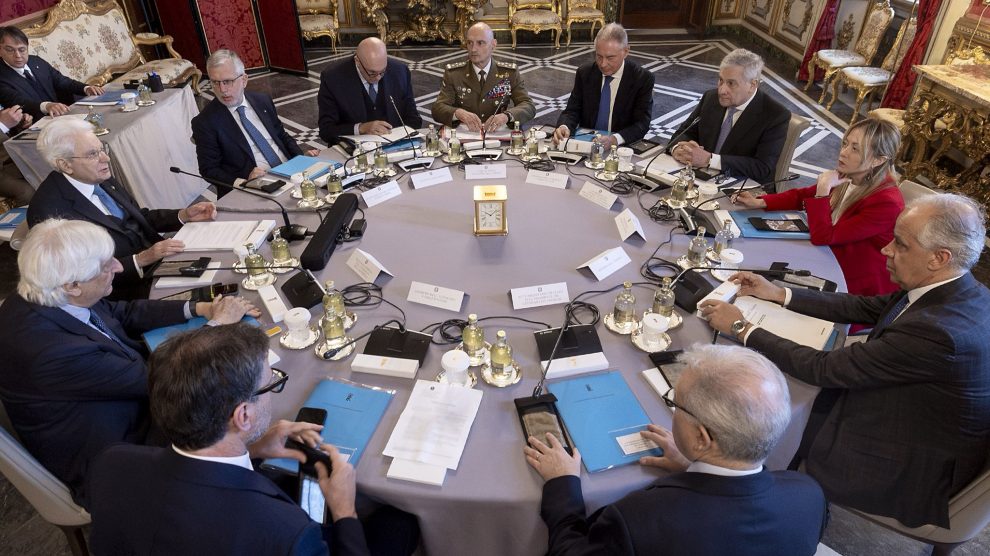
Italy’s top political and military leadership gathered at the Quirinale Palace for a meeting of the Supreme Defence Council, chaired by President Sergio Mattarella, as the war involving Iran risks reshaping the security landscape of the Middle East and the Mediterranean.
Who was there: Prime Minister Giorgia Meloni joined the meeting, alongside Foreign Minister Antonio Tajani, Interior Minister Matteo Piantedosi, Defence Minister Guido Crosetto, Economy Minister Giancarlo Giorgetti, Industry Minister Adolfo Urso, and Chief of Defence General Luciano Portolano, together with senior institutional advisers.
What’s on the table: The council discussed the strategic implications of the conflict following the military actions conducted by the United States and Israel against Iran, warning that the crisis could have serious destabilising consequences across the wider Middle East and the Mediterranean basin.
The big picture: Italian officials warned that the current escalation reflects a broader deterioration of the international order centred on the United Nations system.
- According to the council, the multiplication of unilateral actions is weakening multilateral institutions at a time when global security challenges — including the risk of Iran acquiring nuclear weapons and the need to ensure Israel’s security — require coordinated international responses.
- The statement also condemned the Iranian regime’s internal repression and reiterated concerns over the growing erosion of international law and global stability.
- Italian leaders linked the current tensions to a wider global context shaped by Russia’s invasion of Ukraine, which Rome sees as a turning point in the weakening of the international system and the rise of geopolitical confrontation.
Italy’s position: diplomacy over war. Despite the deteriorating security environment, Italy made clear that it will not participate in the war.
- The council reaffirmed that Rome remains committed to pursuing diplomatic and negotiated solutions to the crisis, consistent with Article 11 of the Italian Constitution, which limits the country’s participation in war and promotes international cooperation.
- Italian leaders also expressed concern about the growing number of conflicts across the Mediterranean and Middle East, regions where Rome has significant strategic, economic and security interests.
- Civilian casualties remain a central concern. The council strongly condemned attacks against civilians — including those affecting children — calling them unacceptable under any circumstances.
Risks of escalation and hybrid warfare. Italian officials warned that further escalation involving Iran could open the door to new forms of hybrid warfare and terrorist activity.
- Such risks could affect not only regional stability but also Europe’s security environment, particularly in areas such as maritime security, energy supplies and economic stability.
- One particular concern raised during the meeting was Iranian actions that could threaten freedom of navigation in the Strait of Hormuz, a critical chokepoint for global energy flows.
NATO, Europe and the Mediterranean dimension. The council emphasised the importance of coordination with European partners — particularly France, Germany and the United Kingdom — in responding to the crisis and protecting shared strategic interests.
- Italian leaders also expressed alarm after missiles launched during the conflict were directed toward Cyprus, a European Union territory, and Turkey, a NATO member, before being intercepted by NATO defences in the eastern Mediterranean.
- Rome warned that the conflict could have significant economic and energy consequences not only for Europe but also for global markets.
Protecting Italians and supporting partners. A key operational priority discussed during the meeting was protecting thousands of Italian citizens currently in the Middle East and Gulf region.
- Italy is also preparing measures to assist partner countries in the Gulf while ensuring the security of Italian troops deployed in the region as part of international missions previously authorised by parliament.
- The council also reiterated that any use of U.S. military infrastructure based in Italy must remain within the legal framework established by bilateral agreements. Any request exceeding that framework would require parliamentary approval.
Lebanon, UNIFIL and regional tensions. The council devoted particular attention to the situation in Lebanon, where tensions between Israel and Hezbollah have triggered renewed fighting.
- Italian leaders called on Israel to avoid disproportionate military responses while condemning Hezbollah’s actions that dragged Lebanon into a new conflict.
- They also raised concerns about repeated violations of UN Security Council Resolution 1701 (2006) and criticised attacks targeting the UNIFIL peacekeeping force, currently under Italian command.
- Even as the UN Security Council considers ending the UNIFIL mission, Italian officials stressed that maintaining security along the Blue Line between Israel and Lebanon remains essential, alongside strengthening the capabilities of the Lebanese Armed Forces.
Attacks on Italian forces. The council also condemned a recent attack against Italian soldiers in Erbil, Iraq, underscoring the risks faced by Italian personnel deployed abroad.
- At the end of the meeting, Italian leaders expressed gratitude to the country’s armed forces for their professionalism in ongoing missions, particularly those serving in southern Lebanon under UNIFIL and those stationed in Gulf countries.
The bottom line: Rome is positioning itself as a diplomatic actor rather than a military participant in the expanding Middle East conflict — while preparing to protect its citizens, defend freedom of navigation and coordinate closely with European and NATO allies.
(Photo: Quirinale.it)