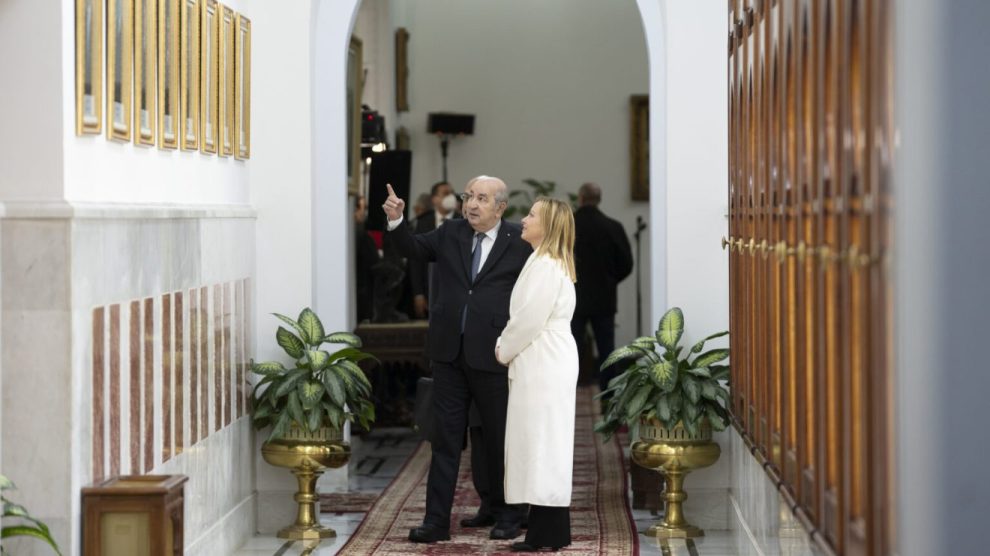
Following a setback in the referendum, Prime Minister Giorgia Meloni is set to travel to Algeria tomorrow to strengthen bilateral cooperation at a time of global energy uncertainty and emerging industrial opportunities.
The big picture: The war in the Middle East is putting pressure on Italy’s stability and economic security, so the PM needs to quickly pivot to external files that can unlock domestic needs, closing the gap between the domestic political setback and effective policy delivery at home, while sustaining credibility abroad.
- Algeria has become Italy’s leading gas supplier, surpassing Russia as early as 2022 and now accounting for around 36% of Italy’s pipeline gas imports.
- This central role is clearly reflected in interviews conducted by Massimiliano Boccolini for Decode39 in Arabic with Algerian experts, who highlight both the potential and the limits of the Italy–Algeria partnership.
Energy: pipelines, LNG, and green hydrogen. Algeria will remain reliable, but as part of a diversified European mix.
- Abdel Samad Saoudi, an economic expert at the University of Msila, describes Italy as a “very reliable partner” and Algeria’s main European ally, with trade above $13 billion.
- Energy remains central, but the TransMed pipeline is near its limits; a new link is planned to carry gas and green hydrogen. Algeria has boosted LNG exports to Europe by 74% in the past month, with Italy prioritized via long-term contracts.
- Farouk Tayfour, a researcher in political science and international relations, cautions that further gas increases are constrained: TransMed is close to full capacity and expansion would require significant upstream investment by Sonatrach.
- On hydrogen, both stress a long-term play. The corridor would need $20–$40 billion for renewables, electrolysis, and transport/storage—more geoeconomic investment than short-term fix.
- Abdel Kader Slimani, an energy expert based in Algiers, notes Algeria’s more than 3,000 annual solar hours. Capacity could reach up to 4 million tonnes of hydrogen a year, generating $6–$10 billion in exports and shifting Algeria from gas supplier to integrated energy player.
Industrial cooperation: automotive, agrifood, and minerals. Beyond energy, experts point to an already active partnership in key industrial sectors.
- Saoudi highlights significant Italian investments in the food sector, including projects in southern Algeria, as well as Fiat’s efforts to increase local content and produce vehicles for the domestic Algerian market.
- The food industry alone accounts for more than $50 billion of Algeria’s GDP, offering substantial opportunities for Italian small and medium-sized enterprises with strong agro-industrial expertise.
- The mining sector also presents promising prospects. New phosphate reserves at the Gara Djebilet mine and in the Tebessa region could support the development of a new mechanical industry in Algeria, with phosphates used both for agricultural fertilizers and food processing industries.
Security and regional stability. Cooperation also extends to Sahel security and migration management. Saoudi stresses that Algeria views Sahel stability as essential to protecting itself from terrorism and curbing irregular migration flows towards Algeria and, ultimately, Europe. This creates a clear need for coordination with Italy on these issues.
- Tayfour adds that, given Algeria’s sensitivity to foreign military presence, Italy can play a constructive role by prioritizing development and stabilization over narrowly defined security measures.
- Building trust through development projects and multilateral partnerships would be more effective than a purely military approach.
- Slimani confirms that security is an inseparable pillar of the partnership, with Algeria actively engaged in countering terrorism and irregular flows from the Sahel, alongside long-term investments in coastal development and efforts to stabilize Libya.
Towards a multidimensional partnership. Experts converge on the need to move beyond a model centered exclusively on gas imports. Tayfour argues that Italy’s Mattei Plan will succeed in Algeria only if it translates into tangible knowledge transfer, advanced vocational training, and industrial partnerships in renewable energy and smart agriculture, rather than remaining a purely diplomatic exercise.
- Slimani echoes this view, noting that the success of a multidimensional alliance will depend on the ability of both countries to shift from a logic of import dependence to models of joint production and direct industrial integration with the European market.
- Meloni’s visit on March 25 takes place within an already evolving framework of strengthened Italy–Algeria ties, where energy remains central but is increasingly complemented by concrete prospects in industry, green technology, and regional security.
- The challenge, as Algerian analysts emphasize, lies in transforming a partnership driven by emergency into a structured and multidimensional cooperation capable of generating shared value across both shores of the Mediterranean.