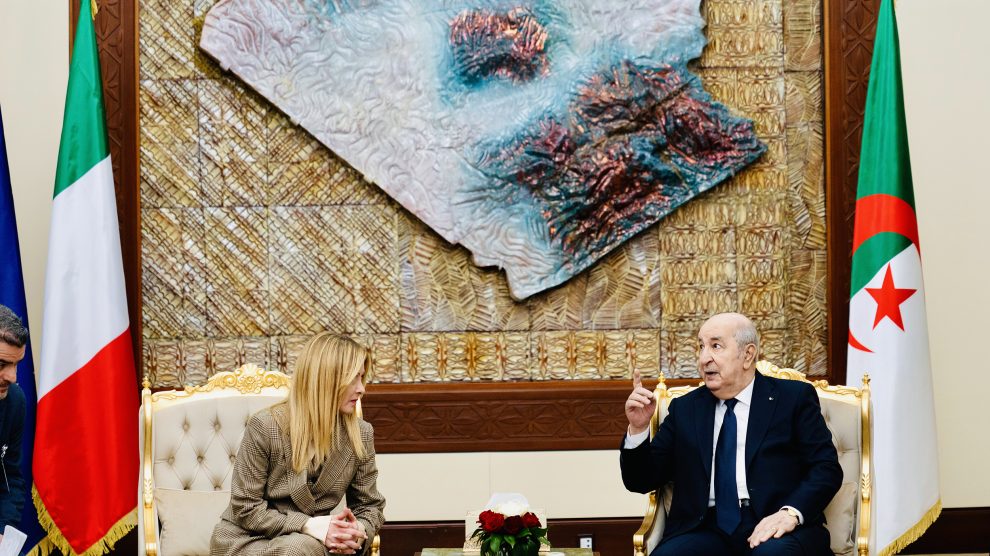
Prime Minister Giorgia Meloni travels to Algiers on Wednesday for her second visit to Algeria since taking office, underscoring what Italian officials describe as a relationship that has “reached an unprecedented level” in both political and economic terms.
The trip, as per Italian sources briefed on the visit, aims to strengthen a partnership that has transcended its traditional energy focus, although gas continues to be the cornerstone of bilateral relations. It comes at a time of heightened geopolitical volatility — from tensions in Iran and instability across the Sahel to continued disruption in global energy markets — that has elevated Algeria’s strategic importance for Rome.
Why Algeria matters. Italy has, in recent years, positioned Algeria as a cornerstone of its external economic and security strategy.
- The North African country is now Italy’s largest trading partner on the continent, with bilateral trade reaching €12.9bn in 2025, while Italian direct investment stands at €8.5bn.
- Rome is both Algeria’s leading customer and its second-largest supplier, holding a 7.3 per cent share of the country’s imports.
In their own words. “We have decided to strengthen our very solid cooperation, including by working on new fronts such as ocean and offshore gas, and this will allow us to strengthen gas flows,” Meloni said as she addressed reporters alongside Tebboune.
- The Algerian president thanked Meloni for “strategic collaboration in all areas of mutual interest”.
- Referring to the current “supply challenge”, Tebboune reiterated Algeria’s willingness to honour all commitments to Italy, describing it as “a strategic and reliable partner”.
- While in Algiers, Meloni welcomed reports of possible peace talks between Iran and the United States.
- “It would be excellent news and Italy will support any initiative for peace and stability,” she said.
Energy remains a crucial factor. Algeria, Italy’s primary natural gas supplier via the Trans-Mediterranean Pipeline, has the potential to enhance its exports. This relationship is the result of decades of cooperation between Eni and Sonatrach, with its roots tracing back to the legacy of Enrico Mattei.
- Officials say talks between Meloni and President Abdelmadjid Tebboune included a detailed stocktaking of energy cooperation, particularly in light of what they describe as a “complex international context”.
In the background: Qatar, which supplied 33% of Italy’s liquefied natural gas imports in 2025, invoked force majeure on its long-term contracts on Tuesday following Iran’s strikes on its primary LNG complex at Ras Laffan.
- Italian industries faced high energy prices before U.S. President Donald Trump’s attack on Iran. The surge in global oil and gas prices now raises concerns about their impact.
- The war in the Middle East and its spillover effects are seen as among the factors behind Meloni’s defeat in a referendum on judicial reform this week.
- Italy generates about 44% of its electricity from gas-powered plants, significantly above the EU average of 17%, making it vulnerable to sudden global gas price increases.
Partnership beyond gas. But the visit was also intended to signal a broader shift. Italian officials framed the relationship as increasingly multidimensional, spanning agriculture, industrial investment, training and digital cooperation — areas closely tied to Rome’s “Mattei Plan” for Africa.
- Two flagship initiatives are already under way in Algeria: a desert agriculture project developed with BF International and a training centre in Sidi Bel Abbès, designed as a pan-African hub for agricultural expertise.
- More broadly, the Mattei Plan envisages a portfolio of joint projects across energy, digital infrastructure, culture and tourism.
- “The objective is to move from a purely energy-based partnership to a structured, long-term strategic relationship,” one Italian official said ahead of the visit.
- That ambition reflects a wider recalibration in Italy’s foreign policy, which seeks to combine energy security with industrial policy and migration management, while expanding Rome’s influence across the Mediterranean and into Africa.
Migration was prominently in talks. Italian officials described cooperation with Algeria on controlling migration flows and combating human trafficking as “excellent”, with both sides looking to deepen coordination.
- The issue is politically sensitive in Italy, where the government has made migration management a central plank of its domestic agenda.
Security concerns extend beyond migration. Both leaders discussed the deteriorating situation in the Sahel, where jihadist groups have expanded their influence. The discussions included the broader instability in Libya, a country with which Algeria shares nearly 1,000 kilometers of border and remains a crucial port for Italian security interests.
- The bilateral also covered major international dossiers, including the conflicts in Gaza and Lebanon, tensions involving Iran, and the war in Ukraine, now entering its fifth year.
- Italian officials stress that Algeria is viewed in Rome not only as an energy supplier but as a relevant interlocutor on regional and global crises.
For Meloni, the visit carries both economic and geopolitical weight. Strengthening ties with Algiers allows Italy to reinforce its role as a bridge between Europe and Africa while hedging against external shocks in energy supply and regional instability.
- At the same time, the deepening partnership reflects a pragmatic convergence of interests. Algeria is seeking investment, technology and diversified economic ties beyond hydrocarbons, while Italy is looking for reliable partners in an increasingly fragmented geopolitical landscape.
- The challenge, Italian officials acknowledge privately, will be to translate this phase into scalable projects and sustained geopolitical integration.