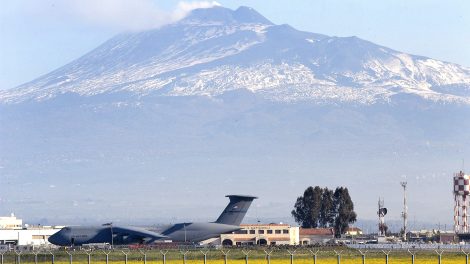

The move: On 27 March, Italy denied a US request to use the Sigonella air base in Sicily for operations reportedly linked to the Middle East, potentially involving Iran. The request, according to multiple accounts, arrived when US aircraft were already en route—leaving Rome with little time for formal authorization.
- Former Italian Defence Chief General Vincenzo Camporini described the refusal as “an act of necessity,” noting that the request came “when the aircraft were already in flight,” making proper political evaluation impossible. Under existing arrangements, Sigonella remains Italian territory, and any use beyond NATO frameworks requires explicit government approval.
- Former NATO Deputy Secretary General, Ambassador Alessandro Minuto Rizzo, confirmed the unusual timing, calling the episode “a decision taken under compressed conditions,” and stressing that such requests are typically handled with advance notice.
Why it matters: At stake is the balance between alliance interoperability and sovereign control. The Sigonella case underscores a legal and political reality often blurred in practice: US access to Italian bases is conditional, not automatic.
- Camporini emphasized that the denial was “perfectly consistent with established procedures,” rather than a strategic rupture. Yet Minuto Rizzo framed the decision as inherently political, reflecting “a change of line” driven by the need to safeguard Italy’s national interest and avoid entanglement in a widening Middle Eastern conflict.
- General Leonardo Tricarico, former Chief of Italian Air Force, went further, calling the move “a reminder that no delegation of sovereignty exists,” particularly in a context where US expectations of access may be taken for granted.
Strategic convergence. Despite differing emphases, the three assessments converge on a key point: the episode is less about operational disruption than about political signaling.
- Camporini sees procedural correctness at the core, while Tricarico interprets the decision as a long-overdue assertion of autonomy vis-à-vis Washington—“a step beyond an overly acquiescent posture.” Minuto Rizzo bridges the two views, acknowledging both the procedural anomaly and the political intent to maintain strategic distance from the conflict.
- There is also partial alignment with broader European dynamics. Camporini notes coherence with Spain’s cautious stance, while Tricarico argues that such decisions would carry more weight if embedded in a coordinated European position.
The bigger picture: The Sigonella episode unfolds against two structural backdrops: escalating tensions in the Middle East and an evolving transatlantic relationship shaped by the political style of Donald Trump.
- Operationally, the impact is negligible. Tricarico described Sigonella as “a drop in the ocean” compared to the scale of US operations across multiple theatres. Politically, however, the incident reflects a broader recalibration among European allies, particularly as Washington’s expectations collide with domestic constraints and strategic caution.
- It also highlights a persistent imbalance in Europe’s strategic focus. Tricarico warned that EU attention remains “too concentrated on the East,” neglecting the Mediterranean and Middle Eastern theatres that directly affect countries like Italy.
Political fault lines. Domestically, the episode has triggered mixed reactions. Tricarico criticized opposition parties for failing to support what he considers a legitimate assertion of sovereignty, arguing that this weakens the prospects for a bipartisan foreign policy.
- Minuto Rizzo cautioned against overinterpretation, warning that a sustained refusal could lead to “serious consequences” in bilateral relations, given the depth of the US–Italy alliance.
What it signals: The Sigonella case is unlikely to alter military realities, but it may mark a subtle political inflection point. If confirmed as a pattern, Italy’s stance could redefine how it manages access to its bases—moving from routine compliance to case-by-case political evaluation.
- For Washington, the episode may be perceived less through legal nuance than through political optics, especially under a leadership style sensitive to perceived non-alignment. As Camporini noted, reactions from the White House are likely to be “political rather than juridical.”
- For Europe, the case reinforces the need for coordination. Without a common framework, individual countries risk facing bilateral pressure alone.
- Ultimately, the incident signals a careful balancing act: Italy is testing the boundaries of its sovereignty while maintaining a strategic relationship that remains central to its security architecture.